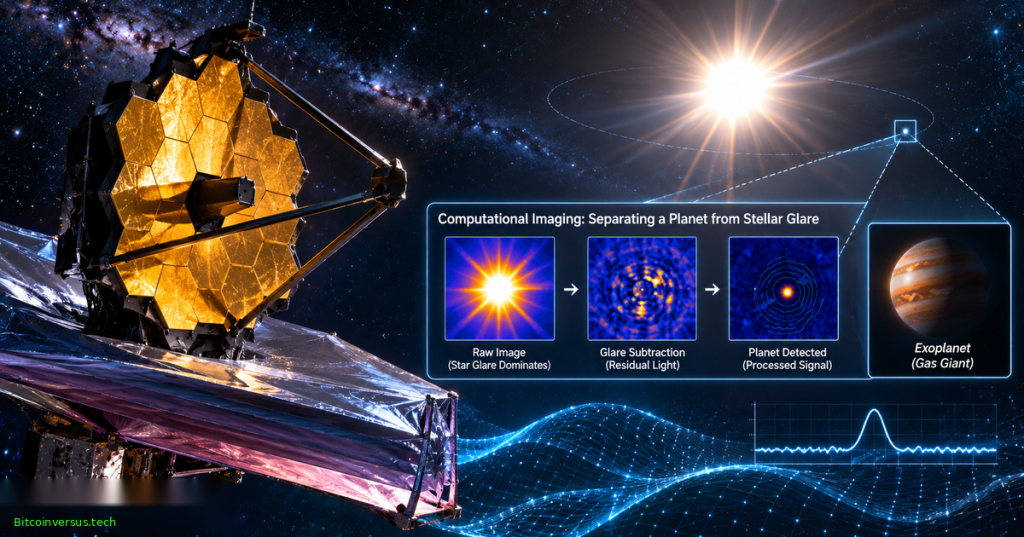
Photographing a planet outside our solar system is difficult because its host star can be 100,000 times brighter in near-infrared light. Astronomers use a coronagraph to mask much of the star, then process residual glare to find the faint planetary signal. Telescope instabilities, tiny pointing errors and thermal drift can leave misleading patterns in an image. New software called Physics-based Learning for Imaging Planets (FLIP) addresses the problem by reconstructing the telescope’s optics in software.
In a peer-reviewed Nature paper published November 4, 2026, scientists report that FLIP made exoplanet detection roughly 2–15 times more sensitive than conventional processing in tested James Webb Space Telescope observations. The method recovered a signal from 51 Eridani b at 4.3 micrometers where earlier analysis of the same observations had failed. The giant planet was previously discovered with ground-based telescopes; the finding is a new wavelength-specific image, not a newly discovered world.
How physics-based learning removes starlight
Webb’s Near-Infrared Camera (NIRCam) includes coronagraphic observing modes. Traditional processing estimates the star’s point-spread function—a characteristic pattern of light—from reference exposures. When telescope conditions change between exposures, the reference may leave bright residuals that obscure neighboring objects. FLIP takes a different route: it simulates the star, telescope optics and detector, then adjusts model parameters with automatic differentiation and iterative optimization.
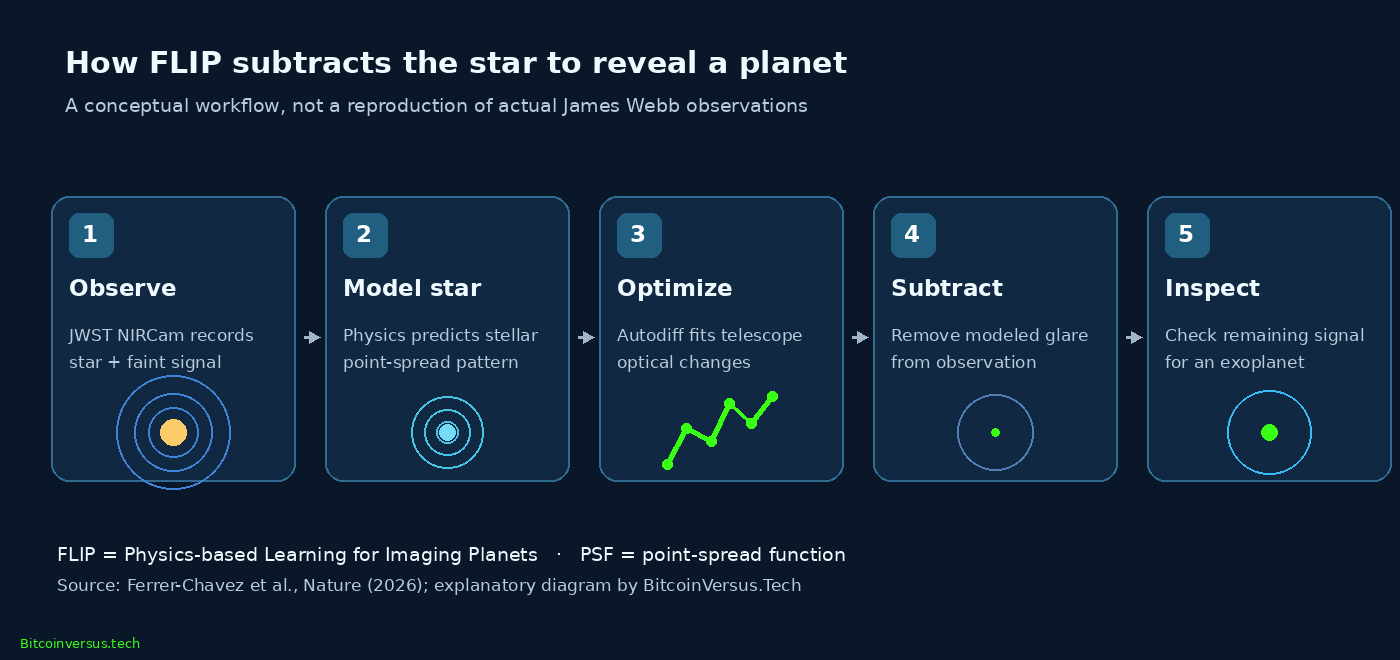
Calibration starts with a reference exposure and continues with fine-tuning on the science observation. The computed stellar pattern can then be subtracted, leaving a better opportunity to isolate a planetary signal. Researchers did not describe a generative image system inventing an exoplanet: instrument physics constrains the process. Computational astronomy already extends to other tasks, including AI-assisted analysis of large sky surveys.
Four observations, four important limits
The study evaluated four datasets from three star systems: HIP 65426, 51 Eridani in two filters, and TYC 5899. For TYC 5899, which has no known planetary companion, the team injected simulated planets to measure recovery performance. Those simulated targets must not be counted as actual discoveries.
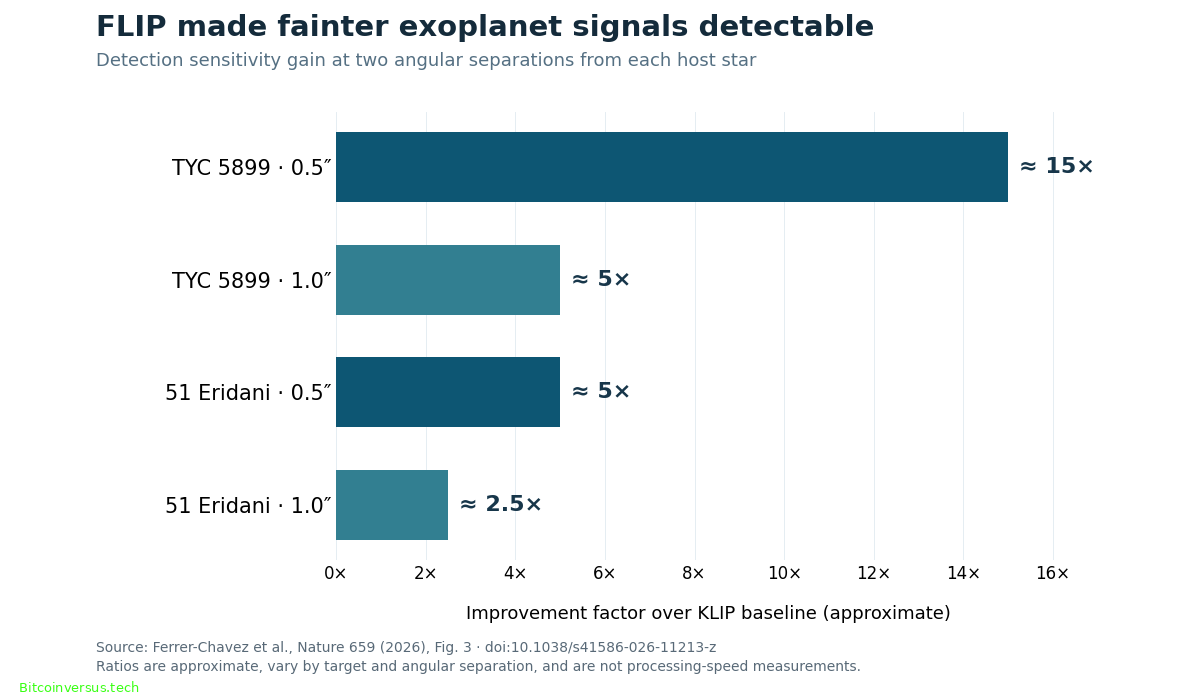
Compared with the established KLIP algorithm, FLIP improved sensitivity in TYC 5899 data by approximately 15× at 0.5 arcsecond and 5× at 1 arcsecond. For the 51 Eridani F430M dataset, the comparable improvements were approximately 5× and 2.5×. An arcsecond describes an angular separation in the sky, not a physical planet-to-star distance. The ratios depend on star system, filter and angular position; none represents a universal processing-speed increase.
For the previously hidden 51 Eridani b detection in the F430M filter, the authors measured a signal-to-noise ratio of 6.3. A 4.3-micrometer observation overlaps a carbon-dioxide absorption band, potentially helping scientists study atmospheric properties. The detected signal is not, by itself, a completed chemical-abundance measurement. Earlier BitcoinVersus.Tech reporting on known exoplanets highlights the wide variety of worlds under investigation.
Better analysis, not unlimited telescope capability
The researchers envision FLIP improving searches for fainter or cooler planets and possibly contributing to future observatories such as the proposed Habitable Worlds Observatory. No Earth analogue was discovered in the study, however, and improved processing cannot eliminate photon noise, uncertain calibration or every false positive. Repeated application across more datasets will test robustness, scalability and computing cost.
Different space instruments also solve different problems. NASA’s planned PRIMA mission concerns far-infrared astronomy, whereas COSI focuses on gamma rays. FLIP does not replace either instrument. Its significance lies in extracting previously inaccessible information from existing Webb observations without claiming a universal improvement for every target.
The next research task is applying physical-model subtraction to larger surveys while checking sensitivity gains, false detections and computational demands. A genuine improvement in recorded data can be important even when no new telescope hardware is involved.
Primary sources: Ferrer-Chavez et al., Nature, November 4, 2026; Caltech report; Northwestern University report; Space Telescope Science Institute technical documentation.
Editor’s Note: All measurements are attributed to the peer-reviewed research and participating institutions. BitcoinVersus.Tech has not independently reproduced the analysis. The original in-story diagrams are educational visualizations, not actual telescope observations; the 1200 × 630 cover is AI-assisted conceptual artwork, not a scientific image of 51 Eridani b. No unverified video embeds were used.
Support BitcoinVersus.Tech
To support independent technology reporting, scan the original donation QR below for an optional 5,000-satoshi contribution. On a phone, display the code on another screen and scan with a compatible Bitcoin wallet, or import the saved QR image if supported. Verify the destination and amount before confirming payment.

We volunteer daily to ensure the information on this platform is Verifiably True. If you would like to support the research, please scan QR code.


Leave a Reply