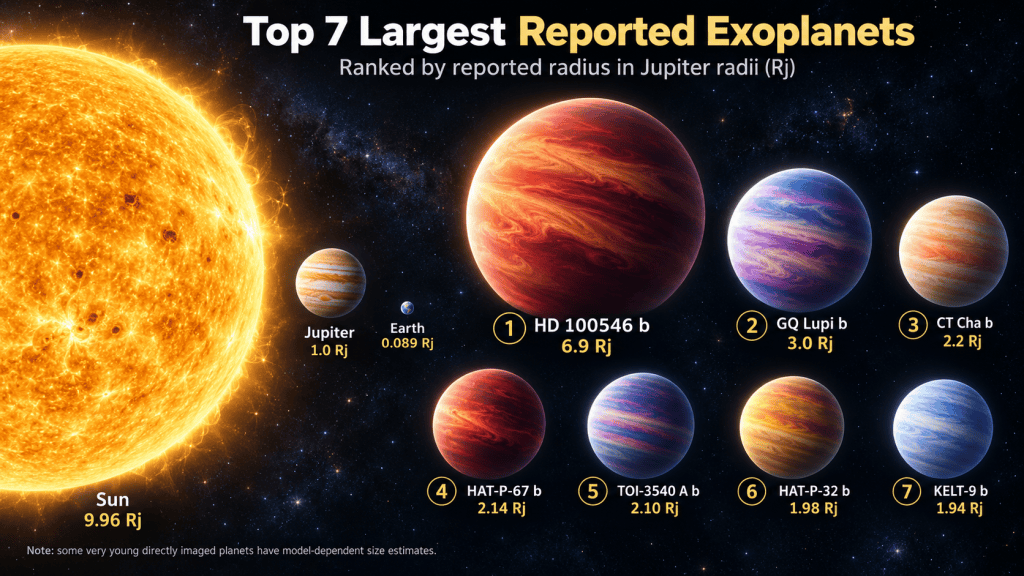
The largest planets we have measured beyond the Solar System make Jupiter look small, but there is an important catch: not every reported radius is measured the same way. The NASA Exoplanet Archive now tracks more than 6,400 confirmed planets, and several of the biggest catalog values belong to very young, directly imaged worlds whose radii depend heavily on models. This countdown therefore ranks reported radius, not a permanently settled list of the universe’s physically largest planets.
The featured image uses Jupiter as the scale reference. Earth is about 0.089 Jupiter radii (Rj), Jupiter is 1.0 Rj, and the Sun is about 9.96 Rj. That makes the biggest catalog value here, 6.9 Rj, roughly 77 Earth radii and about 69% of the Sun’s radius.
| Rank | Planet | Reported radius | Approx. Earth radii |
|---|---|---|---|
| 7 | KELT-9 b | 1.936 Rj | 21.7 |
| 6 | HAT-P-32 b | 1.98 Rj | 22.2 |
| 5 | TOI-3540 A b | 2.10 Rj | 23.5 |
| 4 | HAT-P-67 b | 2.14 Rj | 24.0 |
| 3 | CT Cha b | 2.2 Rj | 24.7 |
| 2 | GQ Lupi b | 3.0 Rj | 33.6 |
| 1 | HD 100546 b | 6.9 Rj | 77.4 |
7. KELT-9 b — 1.936 Rj
KELT-9 b is an ultra-hot gas giant with about 2.88 Jupiter masses packed into a radius almost twice Jupiter’s. It circles its star in roughly 1.5 days. The heat is so severe that the atmosphere is being driven outward, making KELT-9 b a useful example of how stellar irradiation can inflate a giant planet.
NASA Goddard explains how TESS observations revealed the extreme KELT-9 b system.
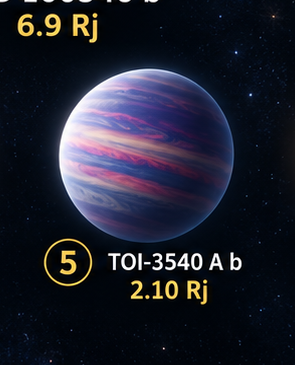
6. HAT-P-32 b — 1.98 Rj
HAT-P-32 b is another inflated hot Jupiter. Its mass is only about 0.68 Jupiter masses, yet its reported radius is nearly two Jupiters. That low mass-to-size ratio is a reminder that “largest” does not mean “most massive.” Giant planets can swell dramatically when their atmospheres absorb intense energy from nearby stars.
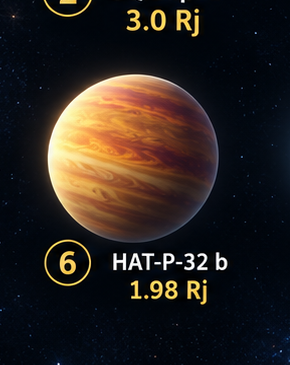
5. TOI-3540 A b — 2.10 Rj
TOI-3540 A b was announced in 2022 and orbits in about 3.12 days. Its reported 2.10-Rj radius puts it at roughly 23.5 Earth radii. At about 1.18 Jupiter masses, it is another clear example of a giant planet whose atmosphere occupies far more volume than Jupiter’s.
4. HAT-P-67 b — 2.14 Rj
HAT-P-67 b is the strongest candidate for the title of largest well-characterized transiting exoplanet. A 2025 revised analysis measured a radius of 2.140 ± 0.025 Rj and a mass near 0.45 Jupiter masses, giving it an exceptionally low density. Unlike the first three objects in this ranking, its size comes from transit measurements rather than direct-imaging models.
This explainer focuses on HAT-P-67 b’s scale, low density and atmospheric loss.
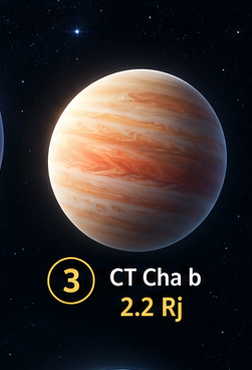
3. CT Cha b — 2.2 Rj
CT Cha b is a young directly imaged companion listed at 2.2 Rj and about 17 Jupiter masses. That mass sits above the often-used 13-Jupiter-mass deuterium-burning boundary, so its classification can depend on the definition being used. Its size estimate is also more model-dependent than a transit radius.
2. GQ Lupi b — 3.0 Rj
GQ Lupi b is another very young directly imaged giant companion. NASA lists a 3.0-Rj radius and about 20 Jupiter masses. That makes it enormous on paper, but the same youth and high mass that make it scientifically valuable also make the planet-versus-brown-dwarf label less clean than it is for mature transiting gas giants.
A visual simulation shows the scale typically associated with GQ Lupi b.
1. HD 100546 b — 6.9 Rj
HD 100546 b has the largest reported radius in this comparison at 6.9 Rj. NASA lists it as a directly imaged gas giant around a very young star. But this is the number that needs the biggest warning label: observations of the system can include emission from material surrounding the forming object, so 6.9 Rj should not be treated like a precise solid or atmospheric boundary measured during a transit.
European Southern Observatory (ESO) fly-through of the HD 100546 system, showing the dusty disk where the protoplanet candidate was reported.
What the ranking really tells us
The key lesson is that radius, mass and classification are separate questions. Some gas giants are physically enormous because their atmospheres are inflated; some directly imaged companions are young enough that their size is inferred from thermal models; and some objects sit close to the planet/brown-dwarf boundary. For more context, BitcoinVersus.Tech has also covered a planet apparently formed from a dead star’s debris, the evidence scientists use when discussing extraterrestrial life, and NASA’s next far-infrared observatory concept beyond Webb.
BitcoinVersus.Tech Editor’s Note:
We volunteer daily to ensure the credibility of the information on this platform is Verifiably True. If you would like to support to help further secure the integrity of our research initiatives, please donate using the QR code provided

For best QR-code scanning results, please scan this donation code from a desktop or larger screen. Mobile screens may prevent camera recognition.


Leave a Reply