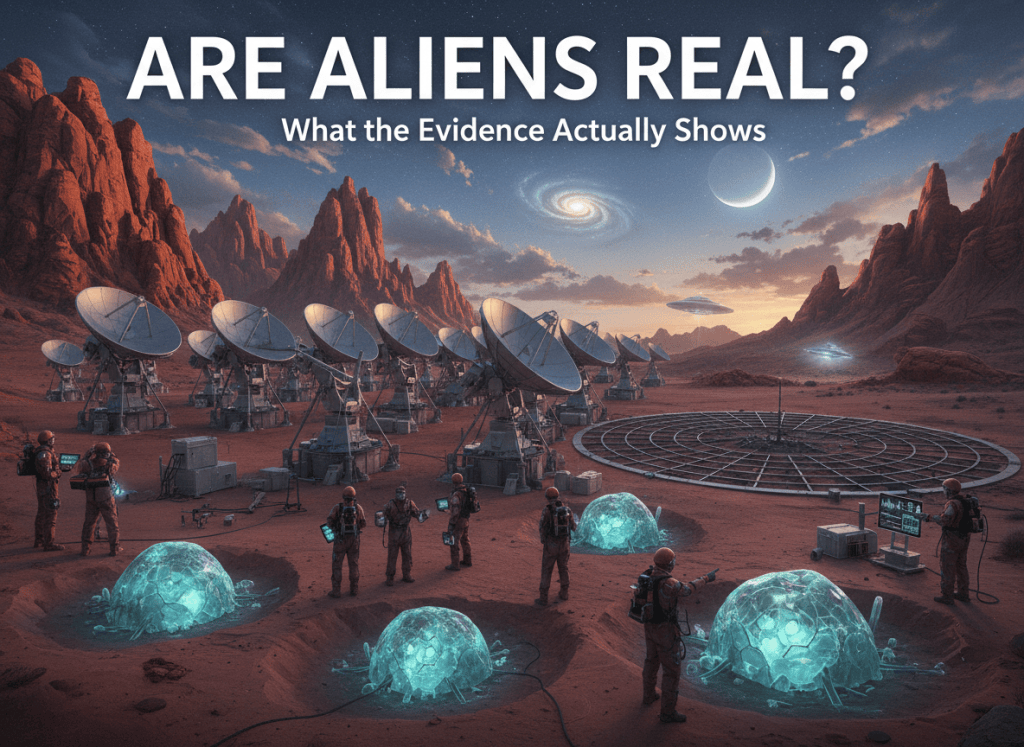
Are aliens real? It remains one of science’s biggest unanswered questions, but a new burst of social-media attention shows why the evidence and the headline are not always the same thing.
Polymarket drew attention to the subject as traders reacted to its market on whether the United States will confirm that aliens exist. A prediction-market price measures what traders are willing to bet on an outcome. It is not scientific evidence that the outcome itself is true.
Polymarket’s original post:
The scientific picture is more cautious. NASA’s search for life beyond Earth has identified a galaxy filled with planets worth investigating, but NASA says it has not found credible evidence of extraterrestrial life. The agency also says there is currently no evidence that unidentified anomalous phenomena, or UAP, are extraterrestrial.
That does not establish that life exists only on Earth. It means the stronger claim that extraterrestrial life has been discovered or that alien technology is visiting Earth has not been demonstrated by the available scientific evidence.
The Quantum Nomad quickly challenged the way the developing claim was being presented, adding a useful reporting-integrity angle:
The distinction matters for technology reporting. Extraordinary claims can move across social networks faster than the underlying evidence can be checked. Prediction markets, eyewitness accounts and viral posts can all be useful signals for journalists, but none independently establishes an extraterrestrial origin.
NASA’s independent UAP study reached a similar methodological conclusion: better calibrated observations, multiple measurements and reliable sensor metadata are needed before firm scientific conclusions can be drawn. That evidence-first standard is the same principle BitcoinVersus.tech applies when separating an emerging technology claim from what has actually been verified.
For now, the most accurate answer to “Are aliens real?” is that science is actively looking, the universe contains enormous numbers of potentially interesting worlds, and extraterrestrial life remains possible, but it has not yet been confirmed.
That evidence-first approach also applies across emerging computing stories, including BitcoinVersus.tech’s recent coverage of companies reportedly evaluating Intel’s 14A process, where evaluation was carefully distinguished from a committed production order.
Sources: NASA UAP FAQ, NASA’s Search for Life and NASA’s UAP Independent Study.
BitcoinVersus.Tech Editor’s Note:
We volunteer daily to ensure the credibility of the information on this platform is Verifiably True. If you would like to support to help further secure the integrity of our research initiatives, please donate here: 3C9o19EH5HSiwEPyCTmEKzxhNCbo2X6TTb
BitcoinVersus.tech is not a financial advisor. This media platform reports on financial subjects purely for informational purposes.


Leave a Reply