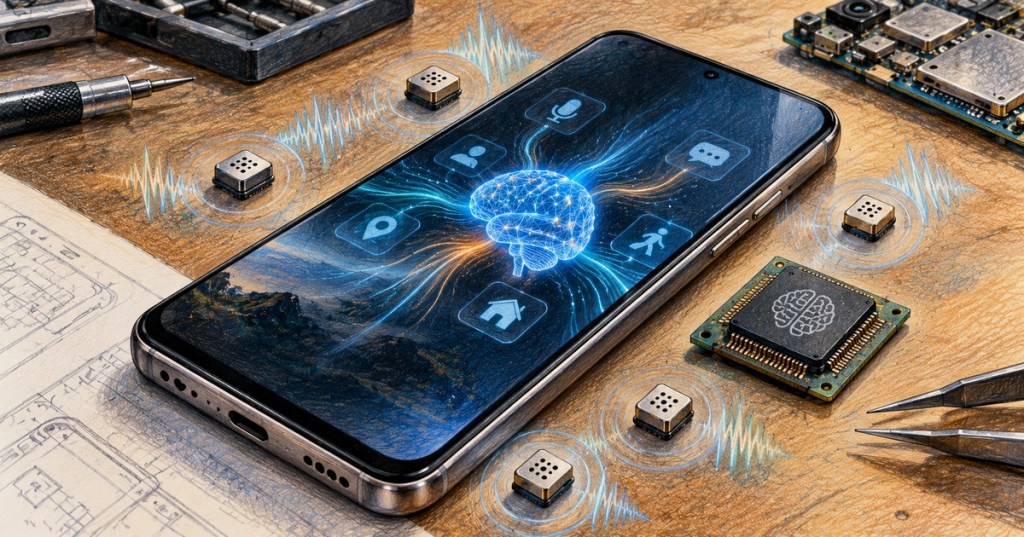
Syntiant says its ultra-low-power neural processing and sensing technology is now built into the STEPX Neo, a newly released agentic smartphone from Shanghai-based STEPX. The integration puts an always-on sensing layer beside the phone’s larger AI stack, giving the device a way to listen for selected context without continuously waking its main application processor.
According to Syntiant’s October 15 announcement, the phone uses the company’s NDP120 Neural Decision Processor and six SiSonic MEMS microphones. Those components support continuous audio and voice sensing workloads, including the phone’s Intelligent Hearing Enhancement System.
The distinction matters because an agentic phone needs context before a user explicitly asks for something. STEPX’s built-in agent, Step Amoo, is designed to interpret goals and coordinate actions across supported apps and services. Syntiant’s role sits lower in the stack: its hardware can process selected sensor inputs locally so the phone can remain aware of relevant audio events while consuming far less power than a full application processor.
Syntiant lists the NDP120 as a production audio-and-sensor processor with dedicated neural-network, microcontroller and DSP resources. Its broader hardware portfolio is built around running inference close to the sensor rather than sending every raw input to the cloud. That same architectural idea is showing up elsewhere: BitcoinVersus.Tech recently covered a Google and Synaptics low-power edge AI effort, NVIDIA’s local agentic AI push, and Intel’s physical-AI strategy.
The practical question is whether this architecture produces a better phone experience rather than simply another AI label. Always-on local sensing can reduce latency, improve privacy for selected workloads and avoid unnecessary power use, but the full result depends on how reliably Step Amoo converts that context into useful actions and how tightly STEPX controls permissions around continuous sensing.
For now, the Syntiant integration is a concrete hardware change: the STEPX Neo has a dedicated low-power perception layer alongside its agent-native software. That makes it a useful example of how “AI phone” design may shift from running a chatbot on a handset toward distributing intelligence across sensors, processors, operating-system services and agents.
BitcoinVersus.Tech Editor’s Note:
We volunteer daily to ensure the credibility of the information on this platform is Verifiably True. If you would like to support to help further secure the integrity of our research initiatives, please donate using the QR code provided

For best QR-code scanning results, please scan this donation code from a desktop or larger screen. Mobile screens may prevent camera recognition.


Leave a Reply