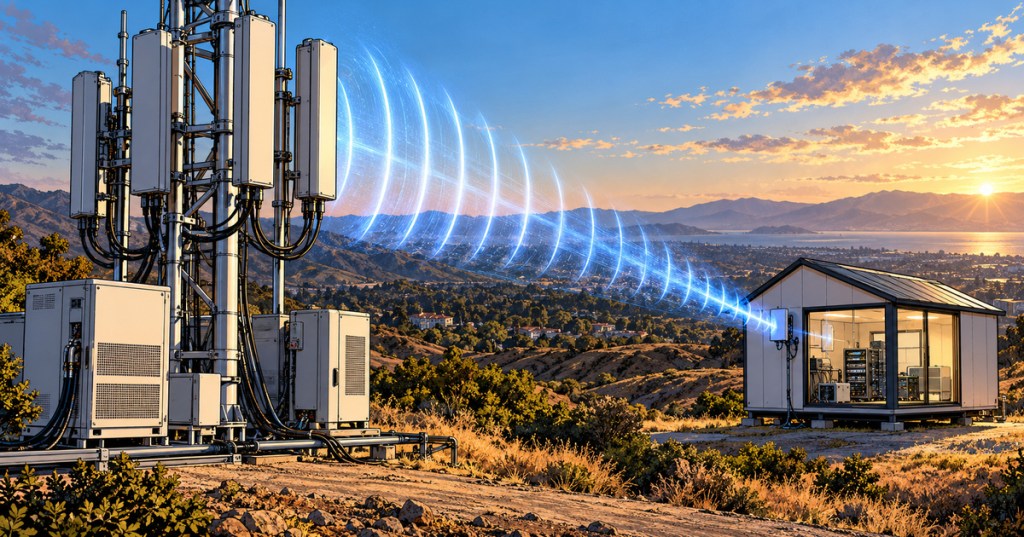
Verizon and Ericsson say they have moved pre-standard 6G testing out of the lab and onto a live commercial network site, completing an outdoor field call in the 7 GHz band in Concord, California.
According to Ericsson’s October 15 announcement, the companies used a fully deployed 6G proof-of-concept kit and a 400 MHz carrier. Verizon and Ericsson describe the result as the first pre-standard outdoor 6G field call of its kind. That “first” remains a company claim: 6G standards are still being developed, so this is not a commercial 6G launch or a certification against a finished 6G specification.
The work also follows Verizon’s earlier experimental spectrum activity with Ericsson. Spectrum analyst Steve Crowley highlighted one of those FCC filings in this X post, where Verizon sought authorization for Ericsson hardware and software tests tied to sensing technology described as a precursor to 6G.
What the Field Test Actually Did
The Concord setup was designed to test more than an ideal line-of-sight connection. Ericsson’s base-station equipment was installed at Verizon’s commercial site, while the user equipment sat inside an approximately 12-by-8-foot mobile test house with dedicated power, battery backup and different wall and window materials.
That let the teams measure coverage, throughput, latency and stability across open-air paths, obstructed paths, foliage and outside-to-indoor penetration. SDxCentral’s report notes that the 7 GHz test used 400 MHz of spectrum in a single channel and emphasizes the same limitation: this is experimental pre-standard work, not a consumer service rollout.
Why 7 GHz Matters
Future 6G systems will need more spectrum if they are expected to support denser AI traffic, sensing, robotics and high-bandwidth interactive services. The 7 GHz work gives engineers a way to study how a wider channel behaves in conditions closer to a real network instead of relying only on indoor lab equipment. The central engineering question is whether future networks can gain more bandwidth without giving up too much practical coverage and building penetration.
This Is Still Pre-Standard 6G
The most important distinction is timing. The industry is still defining 6G standards, spectrum plans and deployment architecture. The Concord call shows that prototype radios can now be exercised in a commercial-site environment, but it does not mean smartphones can connect to a finished 6G network today.
The field test fits a broader shift already visible across telecom infrastructure. BitcoinVersus.Tech recently covered Samsung’s AI-native 6G demonstrations in Silicon Valley, Nokia’s AI-RAN work to increase spectral efficiency, and the fiber-optic technologies being built for higher-bandwidth networks. Together, those efforts point toward a 6G transition built from radio, AI, spectrum and optical infrastructure rather than one isolated breakthrough.
For now, the Concord result is best understood as a practical field milestone: Verizon and Ericsson have taken a pre-standard 6G radio stack into a real commercial-site environment and started measuring how it behaves when buildings, glass, foliage and distance get in the way.
BitcoinVersus.Tech Editor’s Note:
We volunteer daily to ensure the credibility of the information on this platform is Verifiably True. If you would like to support to help further secure the integrity of our research initiatives, please donate using the QR code provided

For best QR-code scanning results, please scan this donation code from a desktop or larger screen. Mobile screens may prevent camera recognition.


Leave a Reply