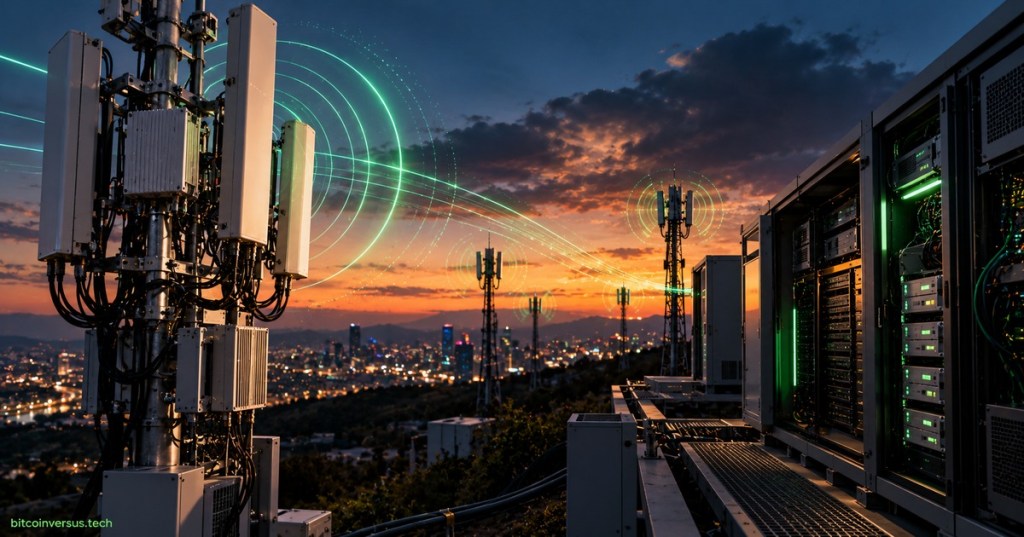
Nokia says its AI-native radio access network is moving toward live operator trials, with more than 20% improvements in spectral efficiency already demonstrated through AI-assisted radio algorithms. Nokia’s September 16 update says multiple operators are advancing proofs of concept or live trials using Nokia software with NVIDIA’s Aerial RAN Computer.
The engineering idea is to use accelerated computing and AI models inside the radio network itself to improve how spectrum, modulation, beams and scheduling resources are used in real time. If that software can make better radio decisions without a full hardware refresh, operators can potentially increase capacity using spectrum they already own.
What a 20% Spectral-Efficiency Gain Means
Spectrum is finite. Spectral efficiency measures how much useful data a network can move through a given slice of spectrum. A genuine 20% improvement would mean more traffic can be carried through the same licensed airwaves and radio footprint.
Nokia says its current gains come from AI-assisted radio functions such as link adaptation, which continuously adjusts modulation and coding decisions as radio conditions change. The longer-term roadmap targets larger gains through increasingly AI-native baseband processing.
This is part of a broader networking shift BitcoinVersus.Tech has been following. Lightmatter is trying to reduce the fiber count inside massive AI GPU pods with bidirectional optical links. In both cases, the objective is to extract more useful throughput from infrastructure approaching physical or economic limits.
AI-RAN Moves Intelligence Into the Radio Layer
Traditional RAN systems already perform very fast scheduling and signal-processing decisions, but they are built around carefully engineered algorithms and fixed compute budgets. Nokia’s AI-RAN approach adds accelerated computing so machine-learning models can participate directly in those decisions while still meeting strict radio timing requirements.
The platform combines Nokia’s anyRAN software with NVIDIA accelerated computing. Nokia is positioning it as a software-defined path from 5G and 5G-Advanced toward 6G, with updates designed to improve network behavior over time rather than relying only on hardware replacement cycles.
That architecture also mirrors what is happening deeper inside data centers. Ciena’s service-provider survey found operators increasingly expect AI traffic to force urgent optical-network upgrades. AI workloads are pushing intelligence and bandwidth requirements outward—from GPU clusters, through transport networks, and now into the radio edge.
The Bigger 2027–2028 Claims Still Need Proof
Nokia’s roadmap goes well beyond the current 20% figure, but those future numbers should be treated as targets rather than established field results. Fierce Network reported that analysts have questioned whether Nokia’s projected 50% gain by 2027 and more than 100% by 2028 will translate cleanly from demonstrations into real-world operator networks.
That skepticism is reasonable. Radio networks operate across dense cities, rural cells, highways, stadiums, indoor systems and very different spectrum bands. An algorithm that performs extremely well in one topology may deliver a smaller benefit in another. GPU placement, power consumption and the cost of accelerated hardware also determine whether an efficiency gain is economically useful.
Why This Matters for 6G
The important shift is not simply adding AI to network-management dashboards. AI-RAN puts machine-learning models into the timing-critical path of the radio network itself. If that works at commercial scale, future network upgrades could increasingly arrive as software and model improvements rather than only through new radio hardware.
BitcoinVersus.Tech recently covered NASA’s plan to build 5G and Wi‑Fi 6 infrastructure on the Moon. That project and Nokia’s AI-RAN work are very different deployments, but both point toward the same trend: future networks will be programmable systems that continuously adapt to changing traffic, terrain and mission requirements.
For now, the strongest claim is the smallest one: Nokia says it has already demonstrated more than 20% spectral-efficiency improvement and is expanding trials across multiple operators and regions. The much bigger 2027 and 2028 gains remain a roadmap. If those later targets survive real-world deployment, AI-RAN could become one of the most consequential shifts in cellular architecture on the path to 6G.
BitcoinVersus.Tech
Advertisement
Editor’s Note
We volunteer daily to ensure the credibility of the information on this platform is Verifiably True. If you would like to support to help further secure the integrity of our research initiatives, please donate here: 3C9o19EH5HSiwEPyCTmEKzxhNCbo2X6TTb
BitcoinVersus.tech is not a financial advisor. This media platform reports on financial subjects purely for informational purposes.


Leave a Reply