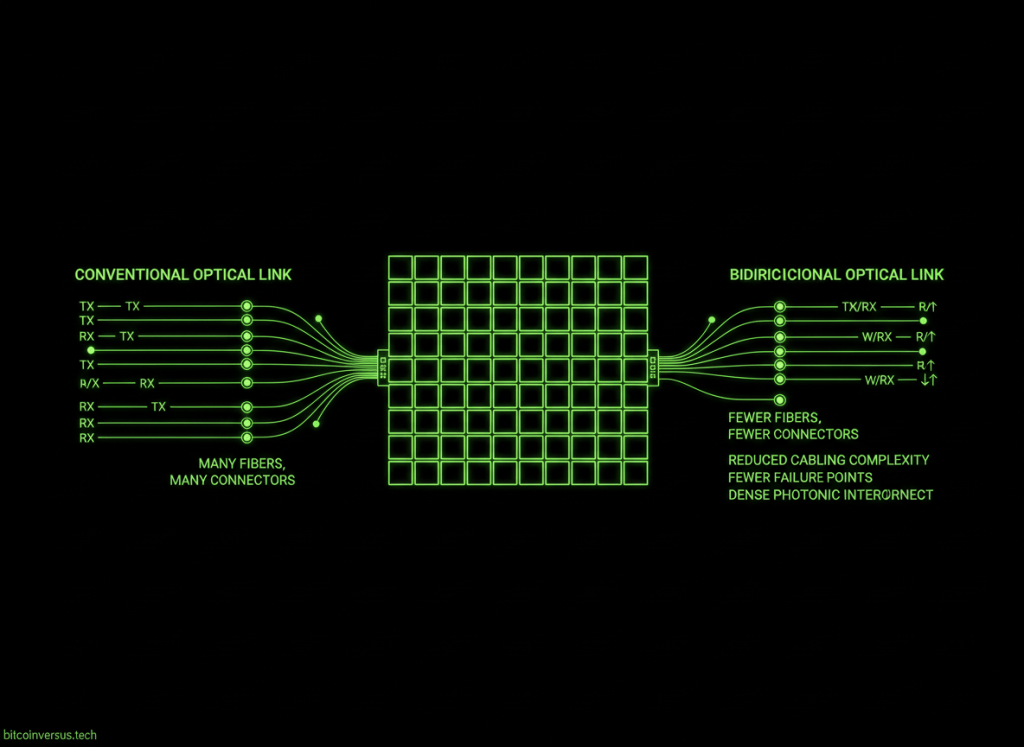
AI networking is running into a surprisingly physical problem: too many fibers, too many connectors and too many places for an optical link to fail.
Lightmatter is attacking that problem with Passage L20 CPX, a bidirectional optical engine that sends transmit and receive traffic over the same fiber instead of dedicating one fiber to each direction.
Passage L20 CPX combines both directions onto one fiber
In its September 17 product announcement, Lightmatter said Passage L20 CPX delivers 12.8 Tbps of total bandwidth — 6.4 Tbps transmit and 6.4 Tbps receive — from one socketed module.
The key idea is bidirectional optics. Conventional optical links typically use one fiber for transmit and another for receive. Lightmatter assigns a different wavelength to each direction so both paths can share one strand.
That does not double the bandwidth of the fiber. It reduces the amount of physical fiber and connector hardware required to carry the same bidirectional traffic.
A 512-GPU pod can require a staggering amount of fiber
Lightmatter’s scale-up model shows why the design matters. A conventional 512-GPU pod can require about 130,000 optical fibers between endpoints before shuffle infrastructure is counted. The company says its bidirectional architecture cuts that figure to roughly 65,000.
Lightmatter also estimates that the same design can eliminate more than 200 miles of fiber and around 16,000 connectors in a 512-GPU scale-up pod.
Those figures are Lightmatter modeling, not independent production benchmarks. The company also states that specifications remain preliminary and that actual cost and performance will vary by deployment.
Fewer connectors can matter as much as fewer fibers
Every optical connector adds another surface that must be installed, inspected and kept clean. At small scale that is manageable. At tens of thousands of links, connector count becomes a reliability and labor problem.
Lightmatter estimates that cutting fiber and connector counts in half can reduce total scale-up interconnect-network cost by about 15% while also shortening installation and validation work.
That is one reason this is a networking story rather than merely a photonics component announcement. The value proposition is partly about bandwidth, but it is also about making giant accelerator fabrics physically easier to build and maintain.
Copper is losing reach as scale-up domains expand
Modern AI systems increasingly try to make hundreds of accelerators behave like one logical machine. As electrical signaling rates rise, copper links become harder to extend across multiple racks without power, signal-integrity and distance penalties.
Optics pushes that boundary farther out. Passage L20 CPX is designed for more than 500 meters over single-mode fiber while following the IEEE 802.3dj DR link architecture and OIF-CMIS management protocols.
CPX is a bridge toward co-packaged optics
Lightmatter joined the Open CPX Multi-Source Agreement as part of the launch. CPX places optics close to the host ASIC, switch or accelerator while preserving a socketed module architecture.
The company positions that approach as a practical step between today’s pluggable optics and more deeply integrated co-packaged optics, where optical engines move even closer to the compute silicon.
A recent Converge Digest / NextGenInfra interview with Lightmatter CEO Nick Harris reinforces the same deployment thesis: AI clusters are becoming constrained by the amount of fiber needed to connect large scale-up domains, not simply by raw accelerator count.
AI infrastructure is becoming a cable-management problem
The networking industry has spent years talking about terabits, SerDes rates and switch radix. Lightmatter’s argument is that another limit is now becoming visible: the physical fiber plant itself.
BitcoinVersus.Tech recently covered Coherent moving 6.4T optics closer to AI switches with PhotonLink, JEDEC establishing its first reliability standard for silicon photonics in AI networks, and CScale building failure-tolerant optical interconnects for AI infrastructure.
All three trends point in the same direction: optics is moving from a peripheral data-center transport technology toward a first-order part of the compute architecture.
The next test is customer hardware in 2027
Lightmatter expects Passage L20 CPX evaluation kits to begin shipping to customers in the first quarter of 2027.
That will be the more important milestone than the announcement itself. The technology needs to prove that halving fiber count can translate into easier bring-up, lower failure rates and real operating savings once it leaves internal modeling and enters production-scale customer systems.
BitcoinVersus.Tech
Advertisement
Editor’s Note
We volunteer daily to ensure the credibility of the information on this platform is Verifiably True. If you would like to support to help further secure the integrity of our research initiatives, please donate here: 3C9o19EH5HSiwEPyCTmEKzxhNCbo2X6TTb
BitcoinVersus.tech is not a financial advisor. This media platform reports on financial subjects purely for informational purposes.


Leave a Reply