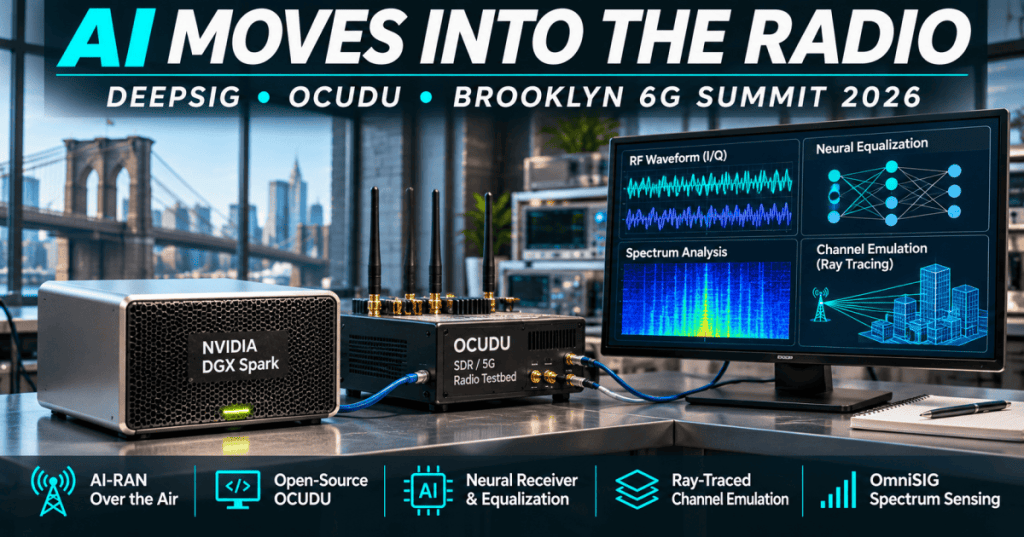
DeepSig demonstrated an AI-powered, over-the-air radio system at the November 4–5, 2026 Brooklyn AI-Native 6G Summit, running an open-source cellular software platform on NVIDIA DGX Spark hardware. The company’s event description identifies three concurrent workloads: neural receiver and equalization, ray-traced radio-channel emulation, and spectrum sensing through OmniSIG. The system represents research using functioning radio links, not the commercial launch of a 6G network.
A conventional cellular radio receiver converts noisy wireless waveforms into recoverable digital information. Engineers normally design signal-processing algorithms for channel estimation and equalization, while the network allocates transmission resources under strict timing deadlines. AI-native radio development attempts to put trainable models closer to those time-critical functions without interrupting ordinary traffic.
A small GPU computer runs several radio workloads
The showcase combined the Linux Foundation’s OCUDU open-source radio access network software with GPU acceleration. A neural equalizer estimates how wireless interference and reflections have distorted a received signal; ray tracing helps model paths through a physical environment; OmniSIG identifies radio-frequency activity. Together, the three applications show how one software-defined system might perform communication and sensing tasks.
DeepSig’s research follows earlier efforts described in BitcoinVersus.Tech’s OCUDU open-source 5G report and ATIS AI-native wireless research coverage. Using a compact GPU system at an event does not demonstrate cost-efficient nationwide deployment, nor does the description provide a verified throughput, power-consumption or error-rate comparison against conventional radios.
Milliseconds and microseconds matter
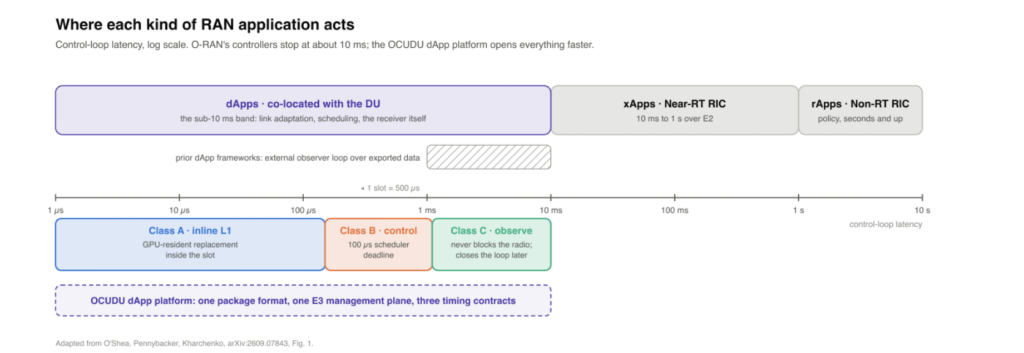
Radio-processing applications cannot simply wait for a distant cloud server to answer. DeepSig’s September technical report divides integrated AI applications into three timing classes: inline receiver functions, bounded scheduler decisions and asynchronous observation. Its Class B control contract targets responses below 100 microseconds. A conventional management application operating on a seconds-long timescale cannot substitute for a component that must process a radio timeslot immediately.
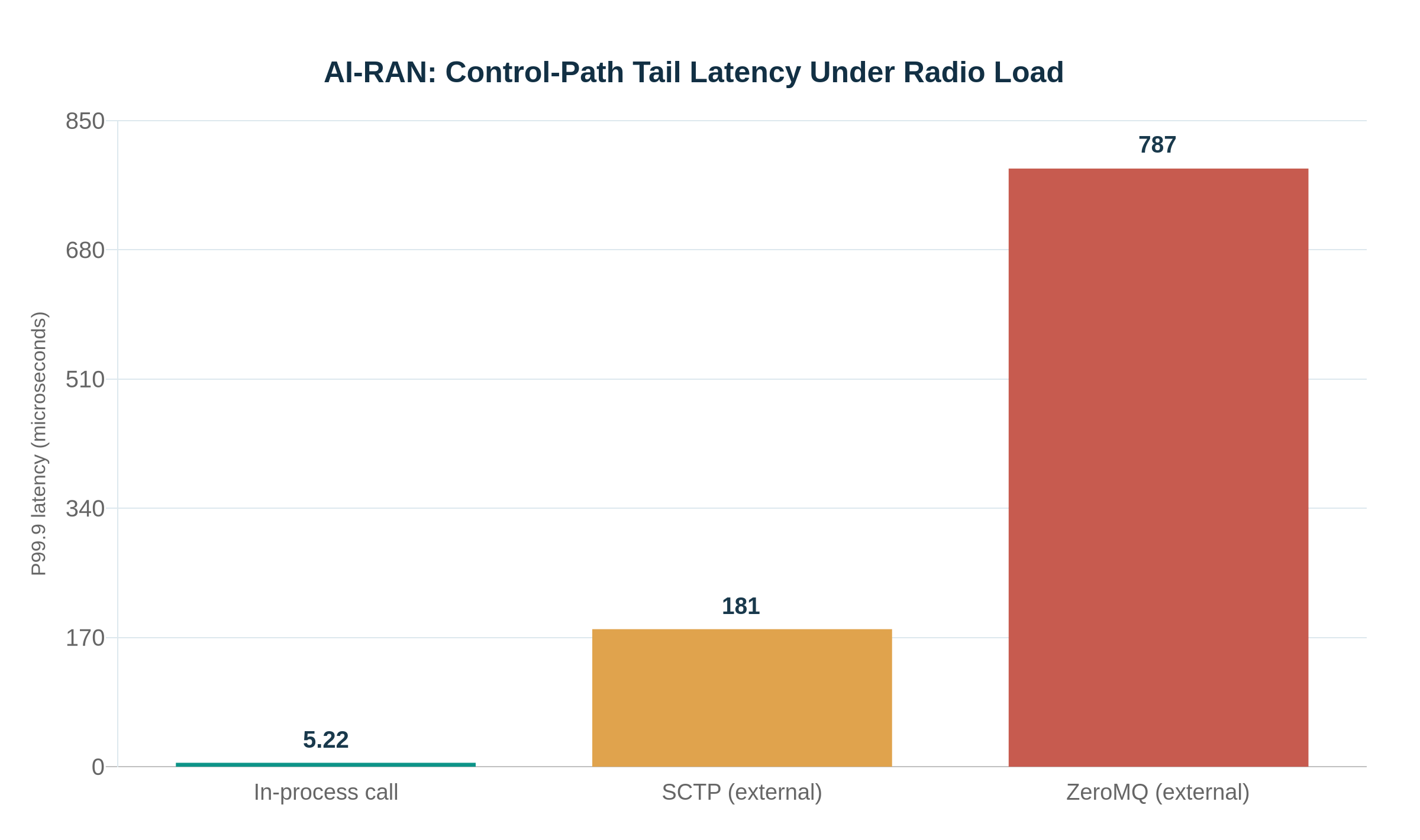
During a separate September live-cell evaluation, DeepSig reported more than 260,000 uplink transmissions using a neural equalizer without a fallback. A timing study on the same platform measured 99.9th-percentile control-path latencies of 5.22 microseconds for an in-process call, 181 for SCTP and 787 for ZeroMQ. Those numbers describe tested software interfaces under its specific radio load, not headline results newly recorded at Brooklyn.
An open radio stack still needs field validation
DeepSig says OCUDU exposes common interfaces that allow developers to add radio applications without maintaining an entirely separate cellular stack. Its Arlington AI-RAN laboratory, opened October 19, provides another test environment for operators and equipment suppliers. A shared software foundation could accelerate experimentation but introduces practical questions about model compatibility, fallback behavior, GPU scheduling and security.
The approach differs from simply using AI to optimize an existing network from afar. BitcoinVersus.Tech previously examined Nokia’s claimed AI-RAN spectrum gains and how phased-array antennas steer radio beams. Neural receiver gains depend on propagation conditions, model training and real-time deadlines; a successful exhibition should not be generalized to every cell site or smartphone.
The Brooklyn summit, hosted by Nokia and NYU WIRELESS, brought together researchers developing technologies for future wireless standards. Other field demonstrations, including Verizon and Ericsson’s outdoor 6G research call, tackle different portions of the future network. None establishes that consumers can subscribe to standardized 6G service today.
The most interesting implication is architectural: the radio itself can become programmable AI infrastructure rather than merely a conduit for AI traffic. Before the concept can move into mass deployment, operators need reproducible tests of spectral efficiency, energy use, failure recovery, interoperability and real-world maintenance costs.
Primary sources: DeepSig’s November Brooklyn 6G Summit event record; OCUDU AI-RAN timing and live-radio measurements; DeepSig’s October laboratory opening; Nokia’s 2026 summit listing; and the official DeepSig video index.
Editor’s Note: DeepSig’s November 2026 event description documents an over-the-air AI-RAN exhibition running on OCUDU and NVIDIA DGX Spark; it does not document standardized commercial 6G deployment. The more than 260,000 uplink transmissions and P99.9 control-latency figures are explicitly from an earlier September company study, not independent Brooklyn measurements. The featured cover is conceptual artwork. The embedded DeepSig YouTube video predates the event and is background, not summit footage. Actual public playback and site responsiveness require separate verification.
Support BitcoinVersus.Tech
To support independent technology reporting, scan the original QR below for an optional 5,000-satoshi contribution. Mobile readers can display the story on a second device and scan the image with a compatible Bitcoin wallet, or use a wallet’s image-scanning option when supported. Verify the destination and amount before paying.

We volunteer daily to ensure the information on this platform is Verifiably True. If you would like to support the research, please scan QR code.


Leave a Reply