
Developers of Stratum V2 Reference Implementation (SRI) 1.13.0 have released a substantial update to the Rust libraries that handle Bitcoin mining communication, correcting buffer-management defects, tightening message validation and expanding mining-job APIs. Release notes published in early November 2026 describe changes to core protocol components rather than a new ASIC miner, pool payout scheme or measured increase in mining efficiency.

Stratum is the communication protocol used to send mining work from a pool to connected hardware and return submitted shares. BitcoinVersus.Tech’s primer on ASIC-to-pool communications explains how hardware repeatedly hashes block-header candidates while the pool evaluates submitted proof-of-work shares. Stratum V2 adds encrypted communication and options for miners to exercise more control over block-template selection, depending on the deployed software configuration.
Background explainer, not the 2026 release: Braiins and Matt Corallo discuss the Stratum V2 mining protocol. Video: Braiins, January 31, 2020.
Buffer and frame handling receive audit fixes
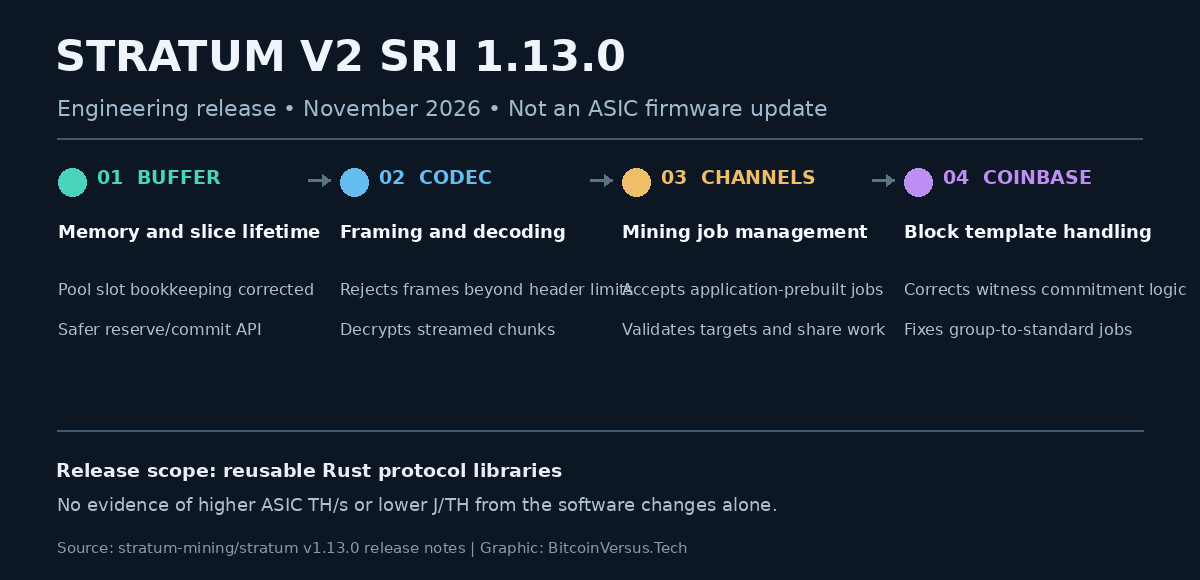
A central SRI change addresses the buffer pool storing incoming and outgoing protocol data. Developers corrected memory-slot bookkeeping, preserved backing memory while slices still reference it, and separated reserving space from committing written bytes. A randomized model test checks slice lifetimes. Safer ownership handling reduces opportunities for crashes or corrupted protocol state, although the release notes do not establish that a publicly exploited attack occurred.
Codec and framing libraries now reject encoded frames whose sizes exceed what their headers can represent. A message encoder also rejects a payload shorter than its declared length. The Noise-encrypted decoder processes headers and ciphertext chunks as they arrive instead of buffering as much as 16 MiB of ciphertext before decryption. These measures affect resource use and input validation, not Bitcoin’s SHA-256 consensus algorithm.
Application-defined jobs do not change Bitcoin consensus
The update also improves mining-job management. Pool-side channel code can accept an application-supplied prebuilt job and activate future jobs without requiring a Template Distribution message at activation. The feature gives software developers additional integration flexibility; it does not mean every connected ASIC automatically constructs its own block templates. The distinction is covered in the Stratum V1 versus V2 comparison.
Share-accounting fixes include limiting credited block-finding work to the difficulty actually proven by a hash and rejecting a channel target above its advertised maximum. Group-to-standard job conversion now avoids duplicating coinbase transaction outputs. Other changes correct witness-commitment handling so templates without a commitment do not receive inappropriate witness fields. The practical stakes involve correct job construction, share validation and avoiding rejected blocks—not faster hashing silicon.
Historical context: Braiins founders explain mining-pool decentralization, job negotiation and adoption considerations. Video: The Peter McCormack Show, April 5, 2023; not a 2026 release demonstration.
Breaking APIs require integration testing
The project also changes Rust APIs. Field names such as maximum_target and min_ntime were aligned with the current specification, becoming target or max_target and ntime_start where applicable. Release notes say the renames do not change the wire protocol, but dependent applications may need source-code changes and retesting. Builders integrating SRI should examine their crate versions and migration requirements before deployment.
For mining operators, reliable share handling is material: accepted, rejected, stale shares and variable difficulty directly affect diagnostic readings and pool-accounting confidence. Network software also requires careful trust configuration, as demonstrated by recent NerdQAxe firmware changes involving TLS certificates. Neither software update should be confused with independent proof of increased pool revenue.
SRI 1.13.0 remains a developer-facing software release. Its documentation does not report a fleet-wide benchmark demonstrating additional terahashes per second, lower joules per terahash or a universal security improvement in already deployed mining farms. Operators and software vendors should evaluate the changed libraries through compatibility, regression and live-environment tests rather than assuming that every upstream improvement reaches production hardware immediately.
Primary source: Stratum Mining SRI v1.13.0 release notes and the version-to-version source comparison. The videos provide historical protocol background and do not independently verify the release’s code changes.
Editor’s Note: Technical claims are attributed to the maintainers’ public release notes and accessible source changes, not independently reproduced security tests. No disclosed hashrate, energy-efficiency or revenue gains are attributed to the release. Featured imagery is conceptual; the accompanying graphic summarizes developer-stated changes. Video materials predate SRI 1.13.0 and serve as protocol background only.
Support BitcoinVersus.Tech
To support independent verification and reporting, scan the original approved QR code below for an optional 5,000-satoshi contribution. On a phone, open the article on another screen and scan using a compatible Bitcoin wallet, or use the wallet’s supported image-scanning function. Confirm the recipient and amount before payment.

We volunteer daily to ensure the information on this platform is Verifiably True. If you would like to support the research, please scan QR code.


Leave a Reply