
Stratum V1 and Stratum V2 solve the same basic problem: they carry mining work between Bitcoin miners and pools. But they were designed for very different eras. V1 is simple, widespread, and deeply compatible with existing ASIC fleets. V2 adds a binary protocol, authenticated encryption, lower communication overhead, and—when Job Declaration is used—the ability for miners to construct their own block templates instead of accepting every template from the pool.
The important comparison is not “old bad, new good.” V1 remains practical because almost every mining stack understands it. V2 offers stronger architecture and more miner autonomy, but the benefits depend on which V2 features a pool, proxy, firmware image, and mining operation actually deploy.
What Stratum V1 does
Stratum V1 became the standard way ASIC miners receive jobs from pools and submit shares back. The protocol uses JSON-based messages over persistent network connections. A pool sends work, a miner hashes against that work, and the miner submits proofs showing how much valid work it performed.
That simplicity helped V1 spread across nearly every major ASIC vendor, mining pool, proxy, and firmware stack. It is one reason a miner can often be moved from one pool to another by changing little more than a hostname, port, worker name, and password.
The network side of that setup connects directly with our older guide to network ports and why they matter in IT. Stratum endpoints are ultimately network services, and the miner still needs a reachable host, port, and reliable transport path regardless of which Stratum generation is used.
Where V1 shows its age
V1 was not designed as a formally specified, modern industrial mining standard. Its JSON messages are relatively verbose, and the base protocol does not provide native authenticated encryption between miner and pool.
That creates two broad weaknesses. First, the communication layer can be less efficient than a compact binary format. Second, plaintext or unauthenticated mining traffic can expose information or create opportunities for interception and manipulation if additional protections are not used.
The Stratum V2 project describes V2 as a redesign aimed at efficiency, privacy, security, interoperability, and miner autonomy while preserving a path for existing V1 hardware through translation proxies.
V2 replaces JSON with a binary protocol
Stratum V2 uses compact binary messages with defined framing instead of the text-heavy JSON approach associated with V1. That reduces the number of bytes required to communicate jobs and shares and can lower processing overhead in high-scale mining environments.
The practical value grows with scale. A home miner may never notice the bandwidth difference. A pool or mining farm handling huge numbers of workers and share submissions has more reason to care about protocol overhead, latency, and how efficiently connections are aggregated.
V2 adds authenticated encryption
One of V2’s clearest technical upgrades is transport security. The protocol supports authenticated encrypted communication so mining messages are protected against passive inspection and unauthorized modification while traveling between endpoints.
The official V2 security specification uses authenticated encryption and a Noise-based handshake design. Remote upstream connections are expected to establish secure session state before normal V2 messaging begins.
This does not make a mining operation invulnerable. A compromised control board, malicious firmware image, stolen pool credentials, insecure management network, or weak operational practices can still create risk. V2 improves one specific layer: the miner-to-upstream protocol itself.
Job Declaration is the bigger decentralization change
Stratum V2 is often described as letting miners choose transactions, but that needs one important qualifier: native V2 mining alone does not automatically mean the miner constructs the block template. Miner-selected templates come from the optional Job Declaration and Template Distribution pieces of the V2 stack.
With conventional V1 pool mining, the pool normally constructs the candidate block and distributes work derived from it. With V2 plus Job Declaration, a miner can build a candidate template from its own node and declare that work to a compatible pool while the pool continues handling share accounting and payouts.
That distinction connects directly to BitcoinVersus coverage going back to OCEAN’s 2024 launch and its push for more miner control. The same broader question—how much authority should sit with the pool versus the individual miner—predates today’s wider V2 rollout.
V1 still wins on installed compatibility
V1’s biggest advantage is inertia—and in infrastructure, inertia can be useful. Huge fleets of ASICs, firmware builds, monitoring systems, pool servers, and proxies already understand it. An operator can deploy hardware without redesigning the surrounding mining stack.
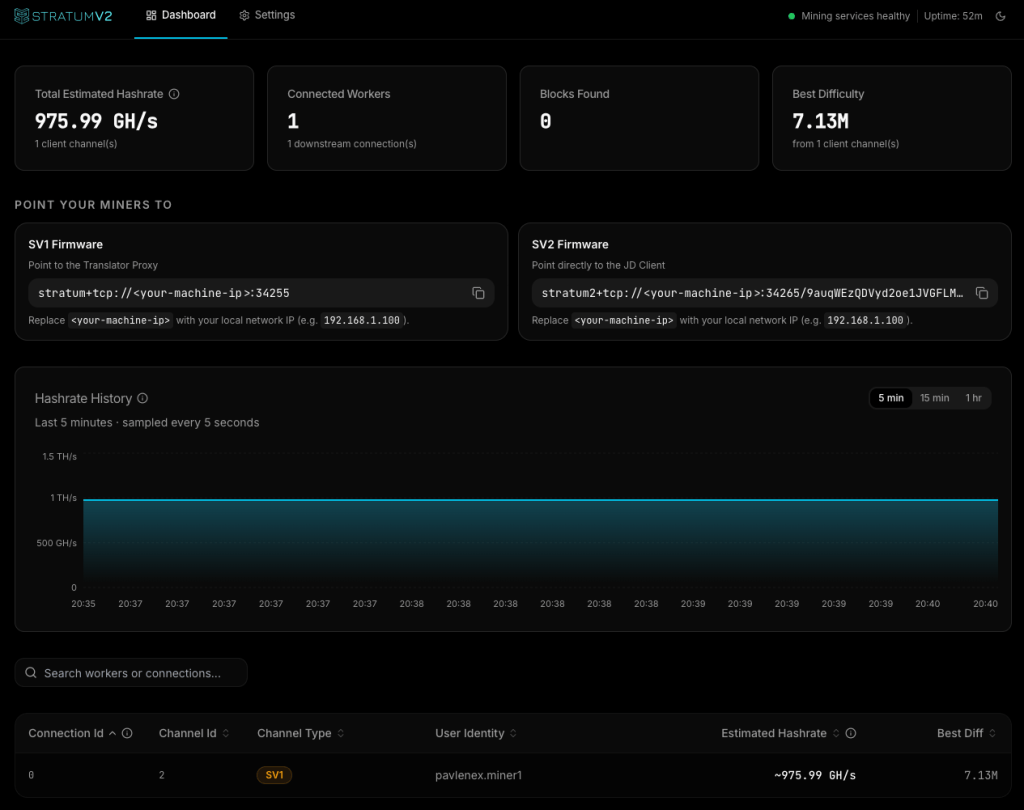
V2 adoption is improving, but support still varies across firmware, pools, proxies, and hardware. Translation proxies are therefore important because they let V1-speaking miners connect into V2 infrastructure without replacing every control board or immediately reflashing an entire fleet.
V2 does not automatically decentralize a pool
A pool can support the V2 Mining Protocol while still constructing every block template itself. In that configuration, the operator gets V2’s more efficient and secure transport without necessarily giving transaction-selection authority to miners.
This is why protocol labels should be read carefully. “Supports Stratum V2” can mean native V2 transport, translation support, Job Declaration, custom templates, or some combination of those features. The deployment details determine how much changes operationally.
The concentration debate also has a historical dimension. In 2025, BitcoinVersus covered OCEAN’s claim that it represented 56% of unique miners receiving newly generated Bitcoin rewards. Unique miner count, pool hashrate share, payout infrastructure, and block-template control measure different forms of concentration and should not be treated as the same statistic.
The first V2 Job Declaration block made the difference tangible
For years, Job Declaration was mostly discussed as protocol architecture. In June 2026, a mainnet block was mined through a V2 Job Declaration workflow, making the concept easier to evaluate as production mining rather than only a specification.
Stratum V1 vs. Stratum V2
| Feature | Stratum V1 | Stratum V2 |
|---|---|---|
| Message format | JSON / text-oriented | Binary framing |
| Native authenticated encryption | No | Yes |
| Bandwidth / protocol overhead | Higher | Lower |
| Existing ASIC compatibility | Very broad | Growing; translation proxies can bridge V1 devices |
| Miner-selected block templates | Not part of normal V1 pool architecture | Supported when Job Declaration is deployed |
| Pool-selected templates | Typical | Still possible |
| Deployment complexity | Lower because infrastructure is mature | Potentially higher, especially with Job Declaration and local nodes |
| Main advantage | Compatibility and simplicity | Efficiency, security, privacy, and optional miner autonomy |
| Main tradeoff | Older architecture with less native security and miner control | Uneven feature support across the mining ecosystem |
Which one should a miner use?
For a miner whose ASIC firmware and preferred pool only support V1, V1 remains functional and familiar. For an operator with compatible infrastructure, V2 can improve the communication layer without necessarily changing the economic relationship with the pool.
If the goal is miner-selected templates and greater independence from pool transaction policy, V2 needs to be evaluated specifically for Job Declaration support rather than simply checking whether the pool advertises “SV2.”
Bottom line
Stratum V1 is the mature compatibility layer that helped modern pooled Bitcoin mining scale. Stratum V2 is the redesigned protocol stack: binary, authenticated, more efficient, and capable of shifting block-template construction back toward miners when its Job Declaration features are actually used.
V2’s strongest argument is not that V1 suddenly stops working. It is that Bitcoin mining has grown far beyond the environment V1 was originally built for, and a larger industrial network benefits from a protocol designed around modern scale, security, privacy, and miner choice.
BitcoinVersus.Tech Editor’s Note: Stratum V2 is modular. Features such as Job Declaration are not automatically active in every V2 deployment. Operators should verify what their specific pool, firmware, proxy, and node configuration supports before assuming a feature is available.
Follow BitcoinVersus.Tech for Bitcoin mining, ASIC hardware, firmware, networking, energy, data-center, and open-source infrastructure coverage.
Support independent technology reporting: Bitcoin donations help fund BitcoinVersus.Tech research and publishing.
Disclaimer: BitcoinVersus.Tech provides technology news and education for informational purposes only.


Leave a Reply