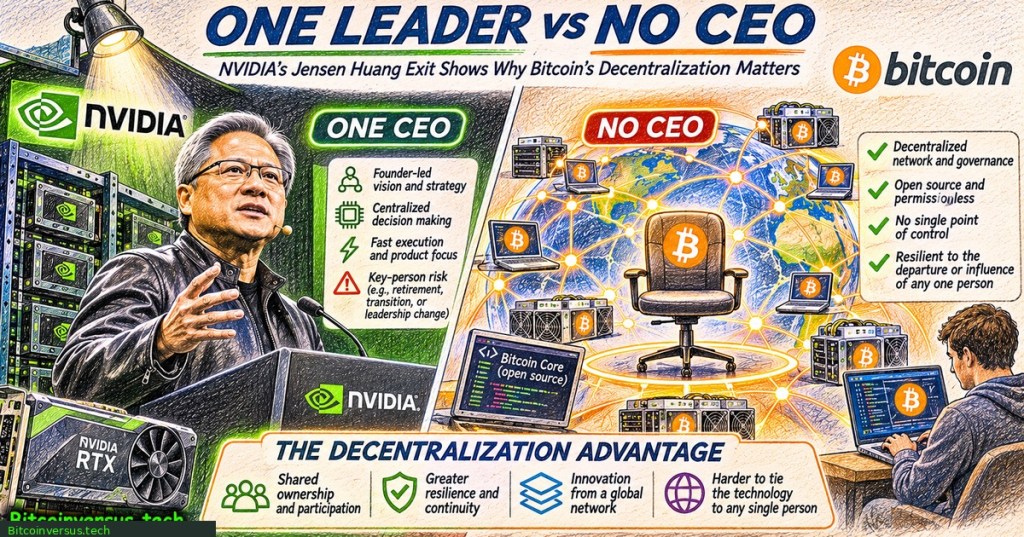
When a technology company becomes synonymous with one founder, that person can become both its greatest advantage and a source of extraordinary risk. NVIDIA’s Jensen Huang resigned as chief executive, president and director on November 11, 2026, according to a regulatory filing; the company announced the transition on November 12. Its board named finance chief Colette Kress interim CEO. Bitcoin, by contrast, has no chief executive to resign.
Official NVIDIA GTC 2026 keynote highlights, published March 20, showing Huang presenting the company’s technology roadmap. Historical footage, not a recording of his November resignation. Credit: NVIDIA / YouTube.
One company became inseparable from its founder
NVIDIA reached approximately $5.78 trillion in market value on October 6. Following weeks of selling and growing leadership uncertainty, shares had fallen more than 30% from that peak by mid-November. Huang’s exit added a new governance challenge, although the stock decline cannot be attributed entirely to one event: investors were also questioning AI infrastructure spending, earnings expectations and valuation.
The board’s November 8 announcement of an independent investigation followed reporting about potential foreign-intelligence exposure involving Huang. NVIDIA said it had no reason to believe national security or company secrets were compromised. Allegations, board inquiries and verified findings must remain separate. Existing BitcoinVersus.Tech coverage of NVIDIA’s succession explains why a leadership shock does not erase the company’s chips, engineers or customers.
NVIDIA shareholders own equity in a legal corporation, with a board, executive leadership, capital spending decisions and reputational exposure. Corporate governance can provide accountability, financial reporting and coordinated execution, but leadership succession can abruptly change how investors assess future returns.
Bitcoin has users and operators, not a CEO
Bitcoin is not a corporation issuing shares. A person holding bitcoin owns units of a digital asset, not a voting stake in a company that can appoint or dismiss a Bitcoin CEO. The software is open source. Independent node operators validate blocks using rules they choose to run; miners propose blocks, developers contribute code, and exchanges or wallet companies build services around the network. None can unilaterally rewrite the rules everyone else follows.
Satoshi Nakamoto’s departure from public development by 2011 demonstrates the central difference. Bitcoin continued operating without its creator. A programmer’s resignation, an exchange founder’s scandal or a miner’s bankruptcy does not automatically replace the protocol’s management, because no such management office exists. Earlier BitcoinVersus.Tech reporting contrasted Saylor’s corporate Bitcoin strategy with Huang’s NVIDIA leadership; Strategy’s corporate governance and Bitcoin’s protocol governance are distinct.
The Bitcoin Developer Ecosystem, a Bitcoin 2026 open-source-stage presentation published by Bitcoin Magazine in May. Developer participation and alternative implementations are the subject, rather than NVIDIA’s November news. Credit: Bitcoin Magazine / YouTube.
No central face reduces the risk of collective blame
A CEO often becomes the public identity of the enterprise. If that executive departs or becomes controversial, customers and investors may reassess the company even when its products remain unchanged. Bitcoin has prominent advocates, but their actions are not formally decisions by the network. A crime committed through a cryptocurrency exchange, for example, should not automatically be attributed to every person who validates blocks, mines bitcoin or holds the asset.
That separation benefits participants through continuity, resistance to concentrated pressure and freedom to dissociate from individual personalities. It also makes Bitcoin harder for any one celebrity, business or government to claim as its proprietary product. Bitcoin Core explains that separately validating nodes enforce consensus rules, rather than accepting orders from a chief executive.
Decentralization is a safeguard, not immunity
The argument has limits. Large custodians hold customers’ keys; mining pools coordinate block production; widely used software creates maintenance dependencies; and famous investors can still influence Bitcoin’s market price. The distribution of major mining pools illustrates why organizational concentration matters even without a protocol CEO. Work on Stratum V2 mining infrastructure addresses elements of miner and pool control.
Bitcoin 2026 panel on development funding, influence and software-client diversity, featuring Jon Atack, Eric Voskuil and Eric Lombrozo. Its participants debate remaining concentrations of influence; their positions are not an official Bitcoin governing decision. Credit: Bitcoin Magazine / YouTube.
Bitcoin’s decentralized model also sacrifices some corporate conveniences: no designated crisis spokesperson, no central support desk and slower coordination over contentious upgrades. Protocol independence cannot shield holders from volatility, fraud by intermediaries or a serious implementation bug.
NVIDIA’s founder transition presents a test of corporate resilience. Bitcoin presents a different test: whether millions of independent decisions can sustain a financial protocol without depending on one person. Decentralization’s central value is not the absence of influential people; it is the absence of a person with unilateral authority over everyone else.
Sources and verification: NVIDIA November 12 SEC Form 8-K, recording the November 11 resignation; NVIDIA November 12 succession announcement; NVIDIA November 8 board statement; Axios October peak capitalization and November stock context; Reuters November 13 market assessment; Bitcoin Core full-node validation explanation; Federal Reserve analysis of blockchain governance tradeoffs; MIT Digital Currency Initiative’s Bitcoin development history; archival videos from NVIDIA and Bitcoin Magazine. NVIDIA valuation and price-move figures are historical market data, not claims that Huang’s departure alone caused the entire decline.
Editor’s Note: NVIDIA’s SEC filing records Huang’s resignation effective November 11, 2026; the public company announcement followed on November 12. The board’s November 8 statement reported an investigation but said it had no reason to believe company secrets or national security had been compromised. No allegation is presented as a finding of misconduct or espionage. This article examines a structural governance distinction, not a claim that Bitcoin is safe from financial losses, coordination problems or attacks. Bitcoin holders are asset holders, not shareholders in a unified Bitcoin corporation. The original colored-pencil 1200 × 630 cover portrays Jensen Huang and a symbolic global Bitcoin network, rather than documentary imagery of actual events, and bears a neon-green bottom-left Bitcoinversus.tech mark. Three sourced videos are historical and educational; saved embeds, final public rendering and mobile playback must be checked separately.

BitcoinVersus.Tech is volunteer-run and publishes independent educational technology reporting. An optional 5,000-satoshi donation supports ongoing research. Scan the original QR from a second screen with a compatible Bitcoin wallet; on mobile, use a wallet that supports scanning a saved image. Independently verify the recipient address 3C9o19EH5HSiwEPyCTmEKzxhNCbo2X6TTb and the payment amount before sending. Bitcoin transfers are generally irreversible.
We volunteer daily to ensure information on the BitcoinVersus.Tech platform is Verifiably True. Coverage is educational and informational and does not constitute financial or investment advice.


Leave a Reply