
NVIDIA co-founder Jensen Huang resigned as chief executive, president and director on November 12, 2026. The board appointed longtime finance chief Colette Kress interim CEO while seeking a permanent successor, and named director Harvey C. Jones its first independent board chair. Huang’s departure follows an internal investigation into reported conduct and potential foreign-intelligence concerns. Allegations remain separate from established regulatory or legal findings. The succession creates uncertainty, but NVIDIA’s latest filings show a substantial operating business rather than a company facing immediate financial collapse.
Official NVIDIA GTC 2026 keynote highlights, published March 20, 2026, featuring Jensen Huang presenting the CUDA ecosystem and AI infrastructure roadmap. Historical technology context, not a recording of the November resignation or board deliberations. Credit: NVIDIA / YouTube.
NVIDIA’s business is bigger than its founder
Kress joined NVIDIA in September 2013 and previously held senior finance positions at Cisco and Microsoft. She continues as CFO during the interim leadership period. NVIDIA’s board says the engineering organization, customer commitments and product roadmap should continue, although the claim is a management expectation rather than an independently established forecast. Earlier BitcoinVersus.Tech reporting detailed the board investigation and questions raised about China-related exposure. Neither account establishes that the company has lost its technical workforce or customer base.
The software and hardware organization also extends beyond Huang. CUDA developers, networking engineers, chip architects, manufacturing partners and hyperscale customers sustain NVIDIA’s existing platforms. Its accelerator competition with AMD will continue regardless of the CEO’s identity. A leadership change can slow decisions and recruiting, but does not erase product designs, installed systems or software libraries.
A stock-market loss is not a cash withdrawal
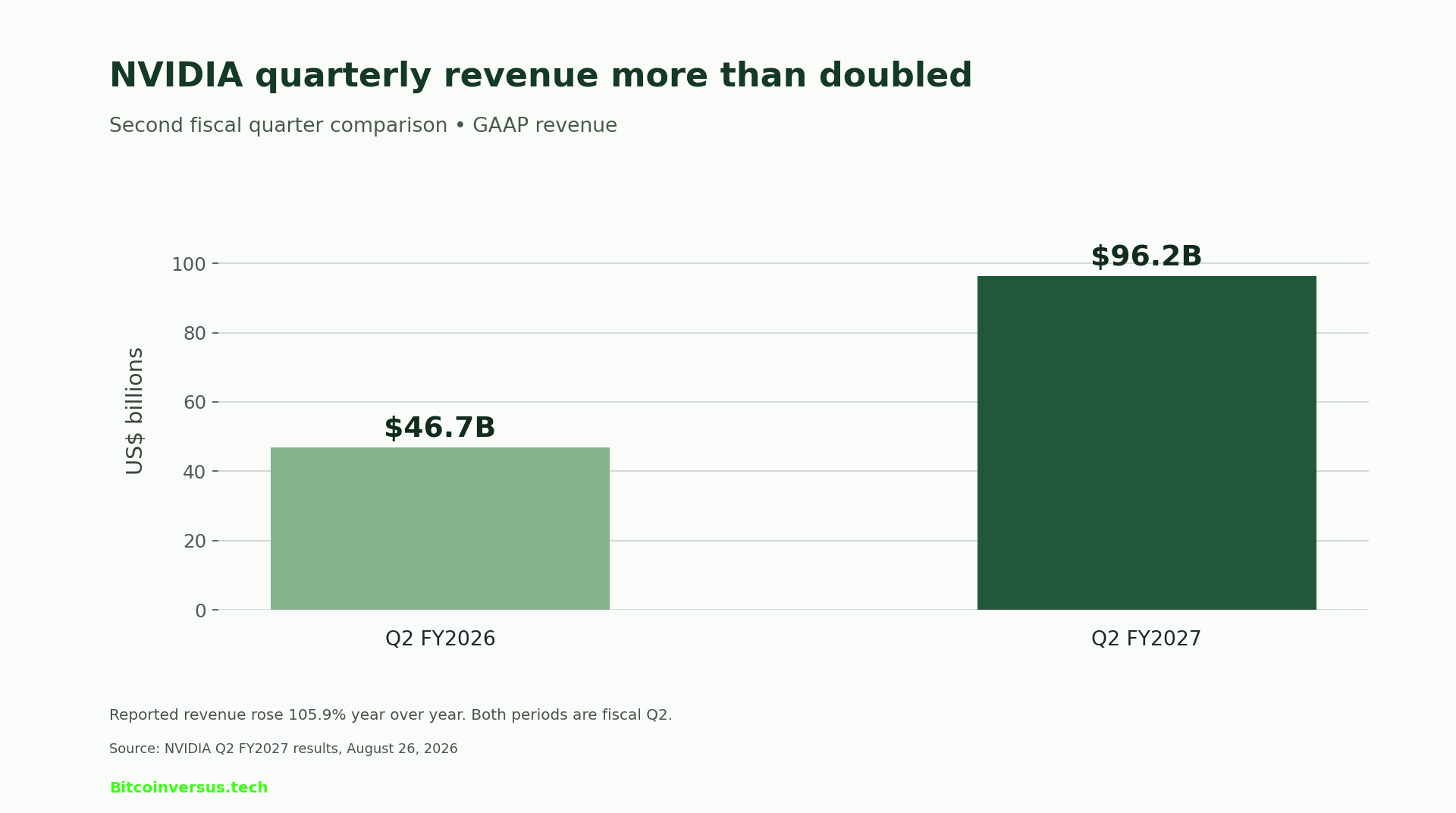
NVIDIA reported $96.221 billion in second-quarter fiscal 2027 revenue, compared with $46.743 billion a year earlier. That represents 105.9% growth. The quarter ended July 26, 2026, months before the leadership upheaval. Data-center revenue alone reached $89.0 billion. Future demand is not guaranteed, but strong historical sales help explain why a leadership shock is different from insolvency.
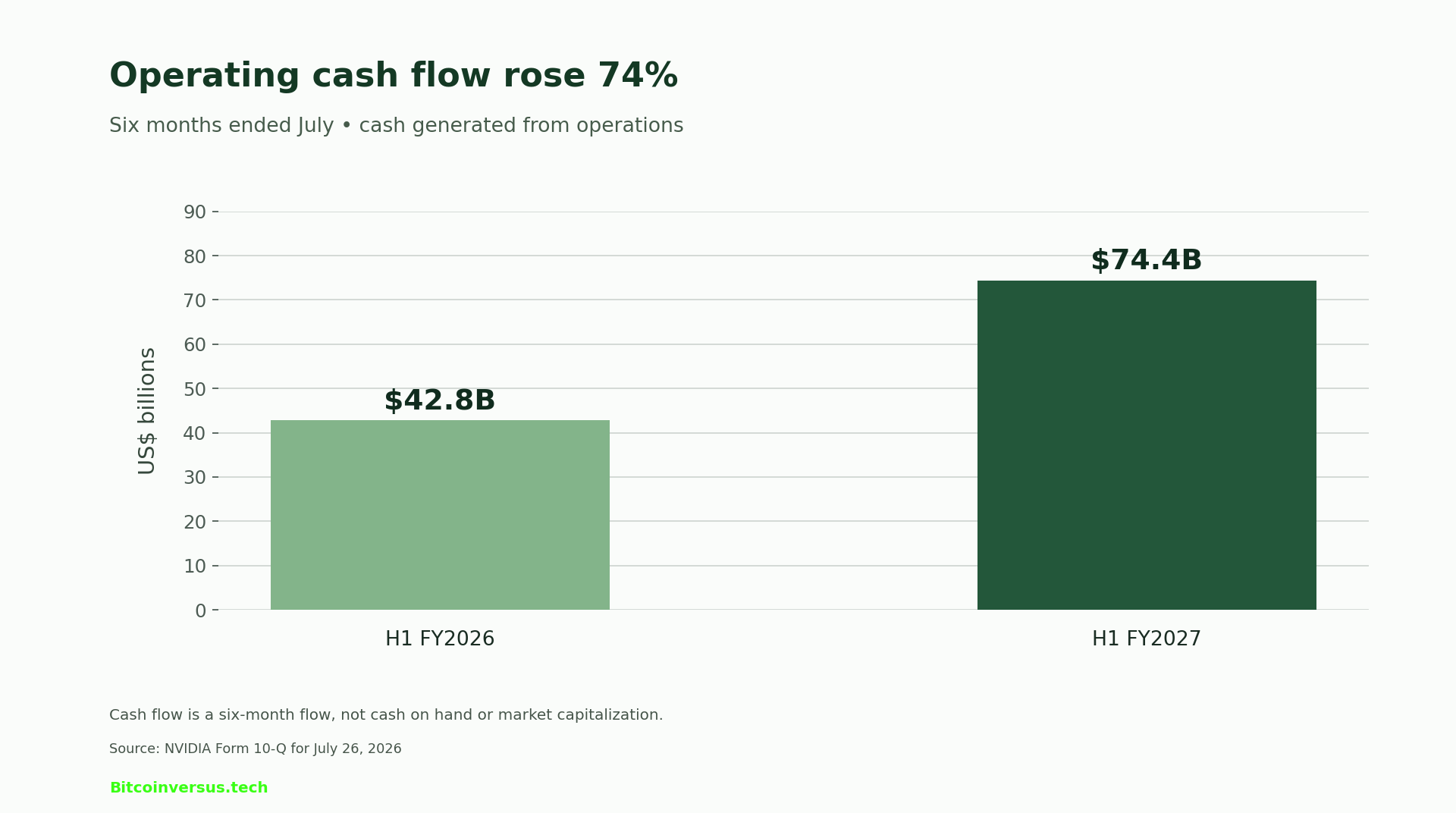
The company generated $74.421 billion in operating cash flow over the first six months of fiscal 2027, up from $42.779 billion in the comparable prior-year period, a 74.0% increase. It reported $22.443 billion in cash and cash equivalents plus $34.143 billion in marketable debt securities at July 26: $56.586 billion combined. The same filing listed $228.984 billion in accounting shareholders’ equity. All figures are dated balance-sheet or cash-flow measurements, not a current stock valuation.
Reuters reported NVIDIA’s market capitalization dipped below $4 trillion during the November 12 selloff. A $300 billion drop in market value would reflect changing share prices multiplied by shares outstanding, not $300 billion leaving NVIDIA’s bank accounts. Investors can nonetheless lose considerable wealth when a highly valued stock reprices.
The Apple precedent—and the actual failure scenario
Apple provides a historical comparison with important differences. Its board appointed Tim Cook, then chief operating officer, CEO on August 24, 2011; Steve Jobs died October 5. Cook inherited a planned transition, whereas NVIDIA now faces an abrupt search. Apple’s subsequent durability shows that founder succession need not destroy an established platform, but cannot predict NVIDIA’s 2027 results.
A lasting NVIDIA decline would require deeper damage: an extended AI-spending slowdown, lost hyperscale contracts, deteriorating CUDA adoption, supply constraints, export restrictions or serious legal consequences. Rival offerings such as Google’s advanced TPU platforms already pressure the market. Earlier analysis of founder-linked corporate risk provides further context. Multiple setbacks could persist despite large cash reserves; no trillion-dollar company is automatically protected from strategic failure.
NVIDIA’s next measurable checkpoint arrives November 17, when the company plans to report fiscal third-quarter results. Revenue, gross margin, forward guidance and clarity on succession will matter more than a short-lived price rebound. Stabilization during 2027 is possible, but neither the timing nor a return to previous market highs can be treated as assured.
Reporting sources and calculations: NVIDIA CEO-transition announcement, November 12, 2026; NVIDIA Form 10-Q, quarter ended July 26, 2026; NVIDIA Q2 fiscal 2027 results, August 26; Reuters, November 12 succession coverage; Reuters, November 12 market reaction; Apple succession announcement, August 24, 2011. Calculations: ($96.221B ÷ $46.743B − 1) × 100 = 105.9%; ($74.421B ÷ $42.779B − 1) × 100 = 74.0%; $22.443B + $34.143B = $56.586B. No post-transition quarterly performance has been assumed.
Editor’s Note: NVIDIA’s November 12 corporate announcement confirms Jensen Huang’s resignation and Colette Kress’s interim CEO appointment. The investigation and related concerns have not been treated as proven wrongdoing. Q2 fiscal 2027 revenue, cash, debt securities, equity and cash flow come from earlier filed statements and do not constitute post-succession outcomes. Market capitalization is not corporate cash or accounting equity. Apple’s transition is a historical comparison, not a prediction. The cover is conceptual artwork depicting an executive vacancy and AI hardware, not an actual boardroom or photographed NVIDIA device. Both original charts use zero baselines, labeled historical periods and filed financial data. NVIDIA’s official March GTC video is historical context, not resignation footage. WordPress’s saved and rendered HTML confirms an iframe with the intended official NVIDIA video ID, correct images, internal links, and footer. Actual YouTube playback, physical mobile-device layout, and external public-browser rendering were not verified.

BitcoinVersus.Tech is volunteer-run and publishes independent educational technology reporting. An optional 5,000-satoshi donation supports continued research. Scan the original QR from a second screen using a compatible Bitcoin wallet; on mobile, use a wallet capable of scanning a saved QR image. Verify recipient address 3C9o19EH5HSiwEPyCTmEKzxhNCbo2X6TTb and the amount independently before paying. Bitcoin transactions are generally irreversible.
We volunteer daily to ensure information on the BitcoinVersus.Tech platform is Verifiably True. Coverage is for educational and informational purposes, not financial or investment advice.


Leave a Reply