
Microsoft Outlook users encountered widespread mailbox connection failures on Thursday, November 12, 2026, as an Exchange Online outage disrupted access across the Americas and potentially other regions. Microsoft registered the email incident as EX1550543 and a broader Microsoft 365 service disruption as MO1550821. The company had not declared full service restoration in its 12:56 p.m. Pacific update.
Exchange Online is Microsoft’s hosted business email system. Potentially affected connection paths included Outlook on the web, Messaging Application Programming Interface (MAPI), Exchange ActiveSync and REST-based applications. Different access methods failing together pointed toward shared server-side infrastructure rather than an isolated problem with a user’s local Outlook installation. Microsoft first publicly acknowledged Teams problems in North America earlier in the morning, then reported the Exchange mailbox failures.
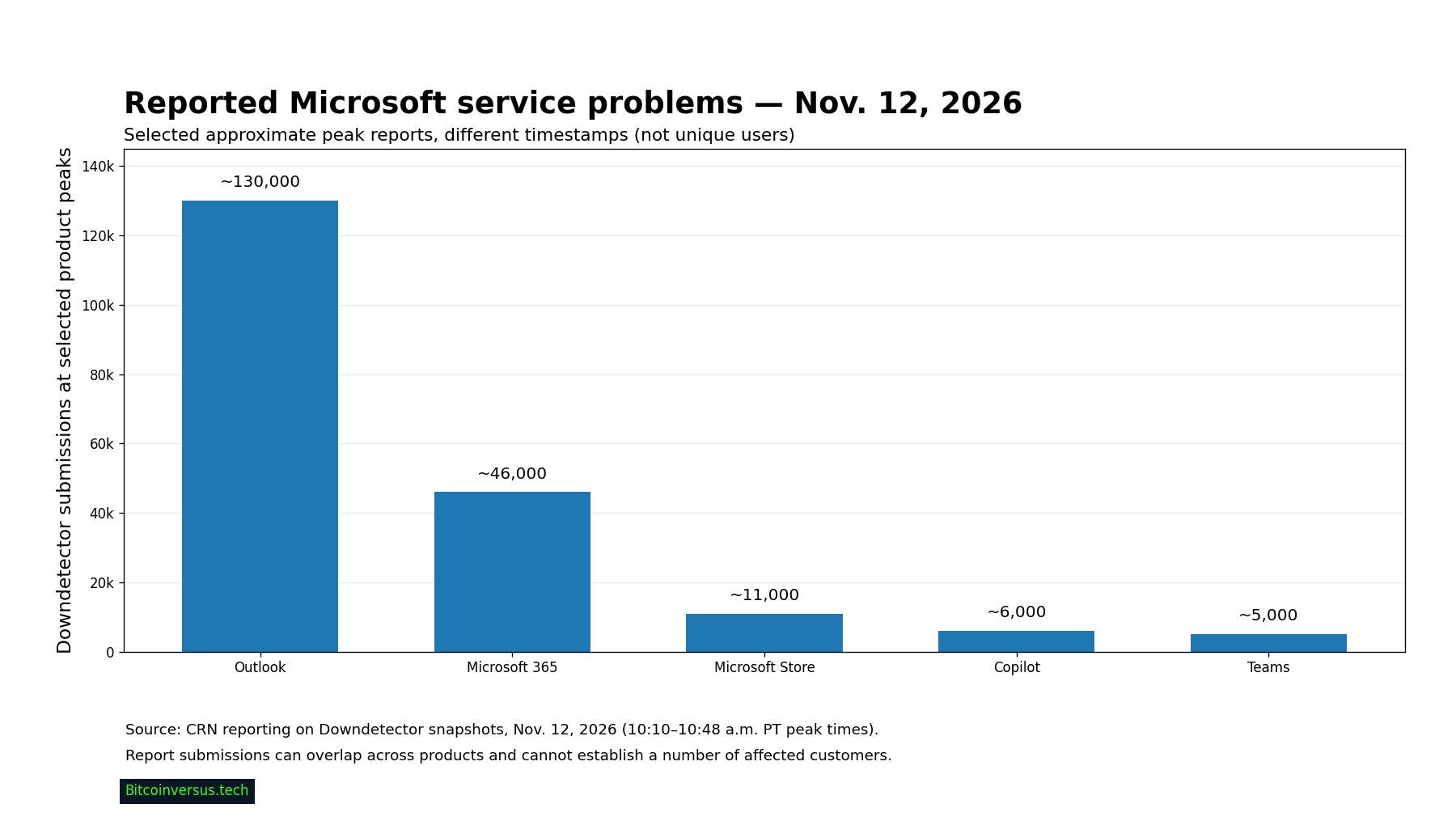
Reports peaked at more than 100,000
At about 10:11 a.m. Pacific, outage tracker Downdetector displayed approximately 130,000 Outlook problem reports, according to CRN. Product-specific peaks included about 46,000 submissions for Microsoft 365, 11,000 for Microsoft Store, 6,000 for Copilot and 5,000 for Teams at different times. Those are user-submitted reports, not verified counts of distinct affected customers; one person can report several products and the displayed totals change throughout the day.
Server loss, not a demand surge
Microsoft identified an infrastructure-capacity failure behind the elevated load. A group of servers was failing automated health checks and becoming unavailable. Existing customer requests then shifted to fewer working servers, increasing load even without an increase in total demand. An unsuccessful health check can cause traffic routing or service discovery systems to treat a server as unusable. Microsoft had not established the definitive technical root cause or confirmed a security intrusion.
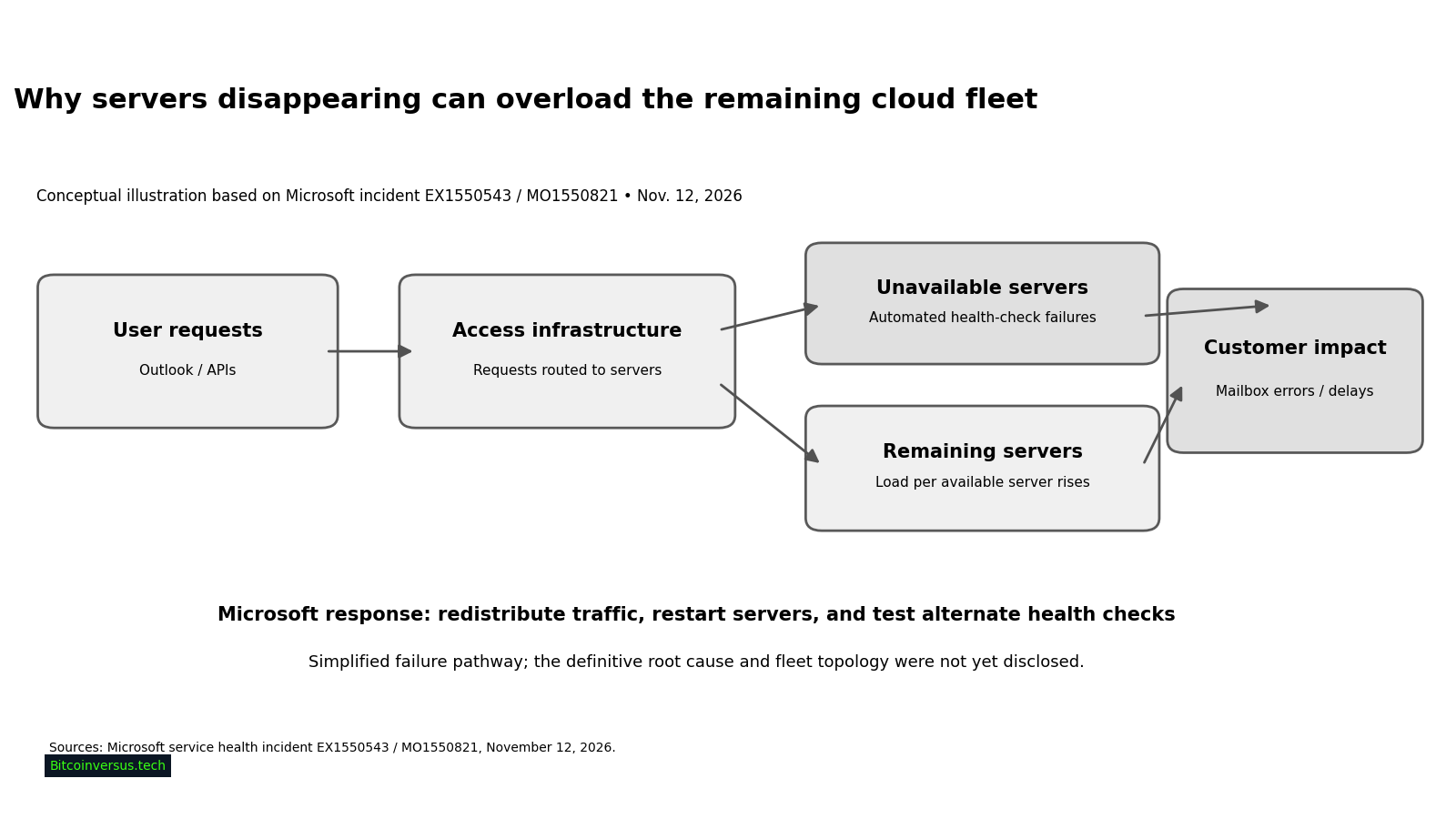
The distinction matters operationally. A system can become overloaded because available capacity falls, not because requests suddenly rise. The resulting cascade can impair multiple services sharing access components. Data-center reliability engineering addresses failure domains, redundancy and recovery procedures, but built-in redundancy does not guarantee that a control-plane or health-check fault stays isolated.
Microsoft tests recovery changes
Microsoft temporarily paused deployments and configuration changes, redirected connection traffic and restarted affected servers. In an update logged at 12:56 p.m. Pacific, the company said an alternate health-check method had brought a subset of servers back into service and was being deployed more broadly. Automated recovery procedures were also being prepared. Partial recovery in a subset does not establish that every tenant, region or service has recovered.
The wider advisory named Teams, SharePoint Online, Microsoft 365 Copilot and Defender XDR among potentially affected services. Third-party integrations could also experience errors when relying on Microsoft’s cloud APIs. Unlike the July 2024 worldwide IT disruption, investigators had not tied the November 12 incident to a defective endpoint-security update. Speculation about a single underlying trigger would be premature.
What affected organizations can do
For organizations, the practical response is to check Microsoft’s public service-health status and the authenticated Microsoft 365 admin center for incident updates, avoid repeated credential changes without evidence of an authentication issue, and use alternate communication channels when email and Teams are both impaired. Procedures covered in BitcoinVersus.Tech’s incident-response leadership guide emphasize clear escalation and status communication independent of the failing service.
An outage across a major cloud vendor also exposes the trade-off between centralized management and concentration of operational risk. The cloud market’s recent rapid revenue expansion creates larger dependencies for organizations. Microsoft still needed to prove broad restoration, identify the component failure and publish lasting prevention measures.
Sources: Microsoft incidents EX1550543 and MO1550821, via University of Pennsylvania mirror; Microsoft status portal; CRN, Nov. 12; Associated Press; Reuters; The Verge. Report totals overlap and change over time.
Editor’s Note: Incidents EX1550543 and MO1550821 remained active at the reviewed 12:56 p.m. PT update. Lost server capacity was confirmed; root cause and full restoration were not. Downdetector submissions are not unique users. The branded cover and server diagram are conceptual; the original chart cites CRN. No verifiable event-specific official YouTube or social-post ID was found, and mobile/browser playback tests were not performed.

BitcoinVersus.Tech is volunteer-run. Optional 5,000-satoshi donations support reporting. Scan the original QR with a wallet; on mobile, save and scan the QR image. Verify recipient 3C9o19EH5HSiwEPyCTmEKzxhNCbo2X6TTb and amount before sending. Bitcoin payments are generally irreversible.
We volunteer daily to ensure information on the BitcoinVersus.Tech platform is Verifiably True. Coverage is for educational and informational purposes and does not constitute financial or investment advice.


Leave a Reply