
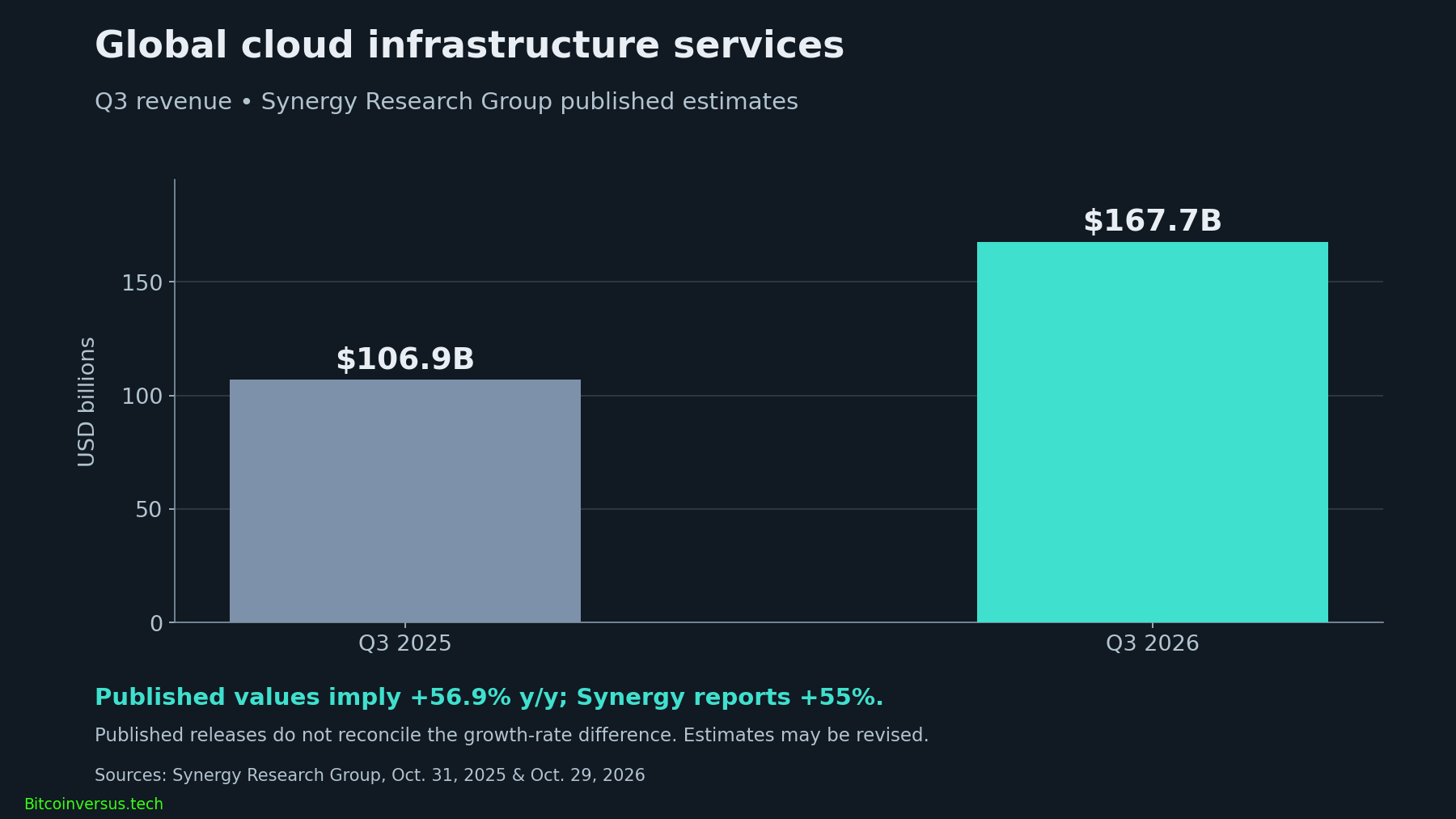
Global cloud infrastructure services generated an estimated $167.7 billion in Q3 2026, up 55% year over year according to an October 29 report from Synergy Research Group, now part of TechInsights. The period covers July through September. Synergy said the annual growth rate accelerated for a twelfth consecutive quarter and that revenue over the latest 12 months reached $558 billion. Those figures describe service revenue, not spending on physical servers or data-center construction.
CNBC Television, August 6, 2026. Archival overview of Google Cloud; not Synergy’s Q3 report.
What the cloud revenue figure includes
The market definition includes infrastructure as a service (IaaS), such as rented computing and storage; platform as a service (PaaS), including managed application and AI tools; and hosted private-cloud services. It does not represent all enterprise software spending. Synergy said public IaaS and PaaS revenue rose 59% in Q3. Products such as Red Hat’s OpenShift platform help explain why cloud revenue extends beyond rented virtual machines.
The 55% claim and the comparison problem
A comparison with Synergy’s earlier release reveals a reporting nuance. The firm previously estimated $106.9 billion for Q3 2025. Using its published dollar levels, ($167.7B ÷ $106.9B − 1) × 100 gives 56.9% growth, not 55%. Conversely, 55% growth would imply a $108.2 billion comparison base. The October 2026 release does not reconcile the two published figures. The reported 55% should therefore remain attributed to Synergy rather than presented as independently reproduced arithmetic.
Amazon leads as Google gains share
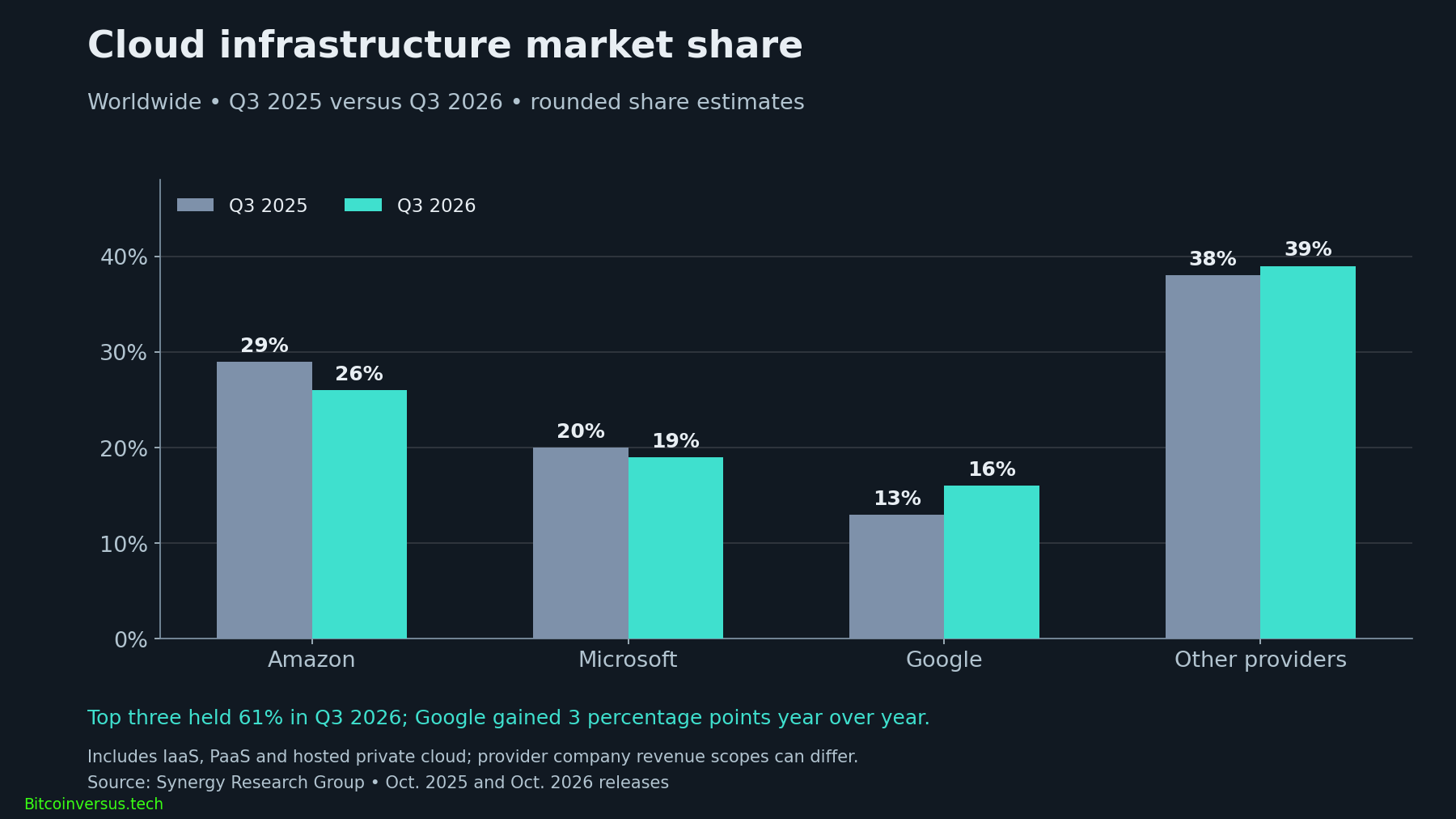
Amazon retained the largest share at 26%, followed by Microsoft at 19% and Google at 16%, according to Synergy. The remaining providers collectively accounted for about 39%. From Q3 2025, Amazon lost three percentage points and Microsoft lost one, while Google gained three. Market-share percentages are rounded estimates within Synergy’s service definition; multiplying them by $167.7 billion does not recreate each supplier’s full reported company revenue.
Alphabet separately reported $30.7 billion in Google Cloud revenue for the September quarter, more than double its year-earlier total. Yet Google’s accounting segment also includes services outside Synergy’s infrastructure-only measure, so the two totals should not be treated as identical. BitcoinVersus.Tech previously examined Google Cloud’s Q3 performance and the company’s new TPU accelerator variants.
Neoclouds broaden the competitive field
Synergy identified Oracle and specialized AI infrastructure providers including CoreWeave, Crusoe, Nebius, Fluidstack, Together AI and Nscale among the faster-growing challengers. It did not publish comparable growth rates for every listed operator. AI-specific services now represent roughly one-third of infrastructure spending, according to the firm; the proportion is an estimate, not a separate audited revenue total. The accompanying expansion also draws on high-speed data-center networking equipment.
Growth brings physical infrastructure costs
The United States accounted for approximately 44% of worldwide cloud infrastructure revenue, Synergy reported. Greater demand for AI workloads benefits providers, but new capacity requires costly accelerators, networking, cooling, electricity and site construction. IDC’s separate AI infrastructure spending estimate covers a different market and cannot be added to cloud service revenue. Revenue growth alone does not establish returns on capital, energy efficiency or customer profitability.
The quarter confirms rapid expansion in commercial cloud services, with Google and AI-focused providers taking ground in a market still led by Amazon. Provider shares, country totals and year-over-year growth should remain marked as market-research estimates until underlying datasets and comparison methods can be reconciled.
Sources and methodology: Synergy Research Group, October 29, 2026; Synergy Research Group, October 31, 2025; TechInsights, October 30, 2026; Data Center Dynamics, October 30, 2026; CRN, November 2, 2026. Original calculation: 167.7 ÷ 106.9 − 1 ≈ 56.9%; 167.7 ÷ 1.55 ≈ 108.2 billion.
Editor’s Note: Synergy reports 55% growth; its separately published 2025 and 2026 dollar estimates yield 56.9% when divided directly, with no reconciliation provided. Charts show market-research estimates and rounded shares, not audited totals. Cover is illustrative; CNBC video is archival context. Actual playback and mobile rendering were not independently tested.

BitcoinVersus.Tech is volunteer-run. Optional 5,000-satoshi donations help support independent research. Scan the QR with a Bitcoin wallet from a second screen; on mobile, save the QR image and use the wallet’s image-scan function. Verify recipient address 3C9o19EH5HSiwEPyCTmEKzxhNCbo2X6TTb and amount independently before paying. Bitcoin payments are generally irreversible.
We volunteer daily to ensure information on the BitcoinVersus.Tech platform is Verifiably True. Coverage is educational and informational and does not constitute financial or investment advice.


Leave a Reply