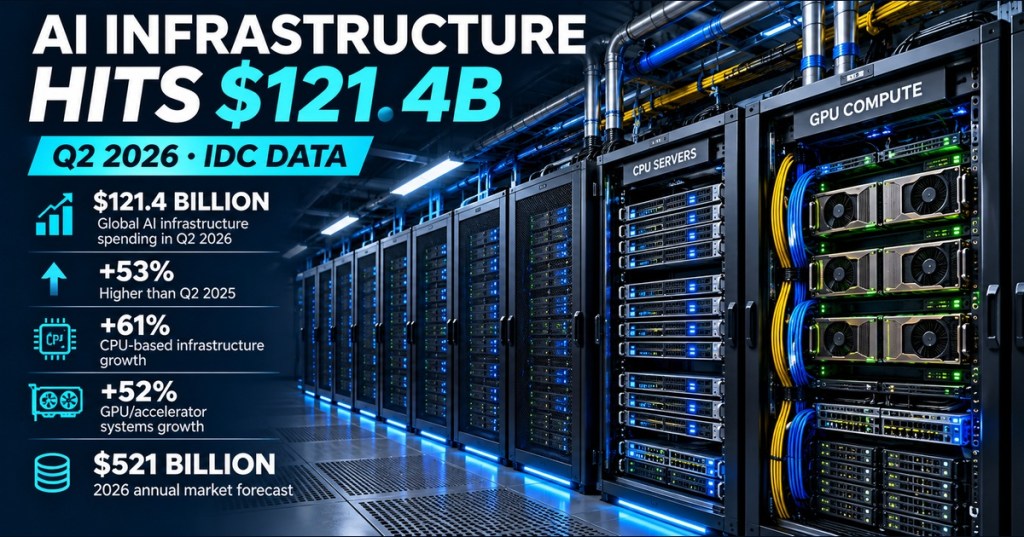
Worldwide spending on artificial-intelligence infrastructure reached $121.4 billion in the second quarter of 2026, rising 53.3% from a year earlier, according to IDC’s November 6 research update. The market comprises servers and storage deployed for AI workloads, including accelerated systems used for training and inference and conventional CPU-based equipment supporting orchestration and data processing. IDC also raised its full-year spending forecast to $521 billion, an increase of $24 billion from its previous estimate.
Accelerated systems still capture 87% of spending
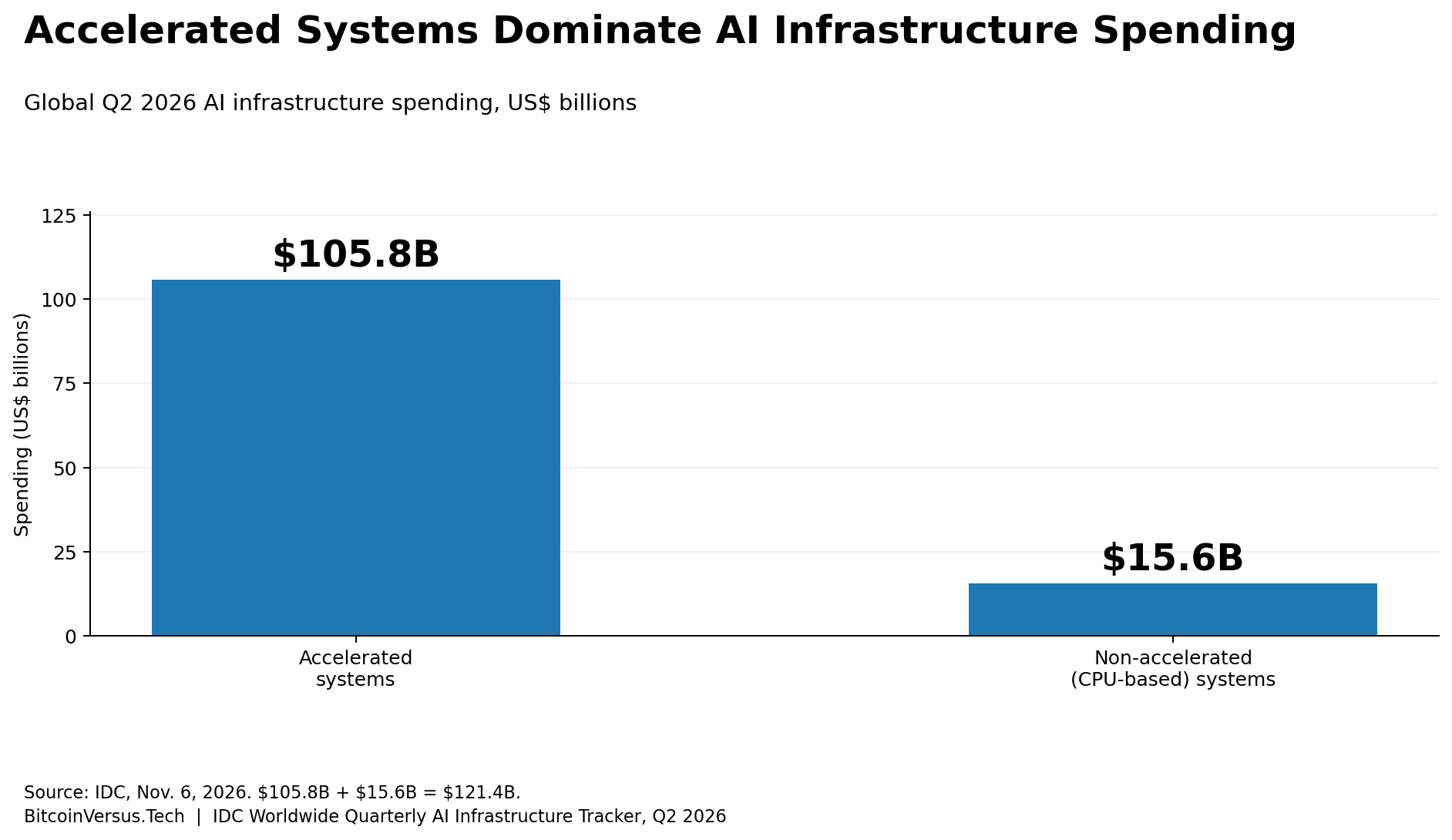
IDC measured $105.8 billion in accelerated AI infrastructure spending and $15.6 billion for non-accelerated systems in Q2. The values reconcile exactly to $121.4 billion, with accelerated hardware accounting for approximately 87.1% of total spending. GPU-heavy training and inference systems therefore remain the primary market by value, despite growing interest in ordinary server capacity.
The distinction matters when comparing individual systems. Google Cloud’s recently announced A5X Vera Rubin instances illustrate advanced accelerator investment, but software agents also require CPU servers to schedule tasks, route requests and process information. Earlier BitcoinVersus.Tech reporting examined Arm’s growing data-center CPU business. Neither company example establishes its share of IDC’s quarterly totals.
CPU-based spending grows faster
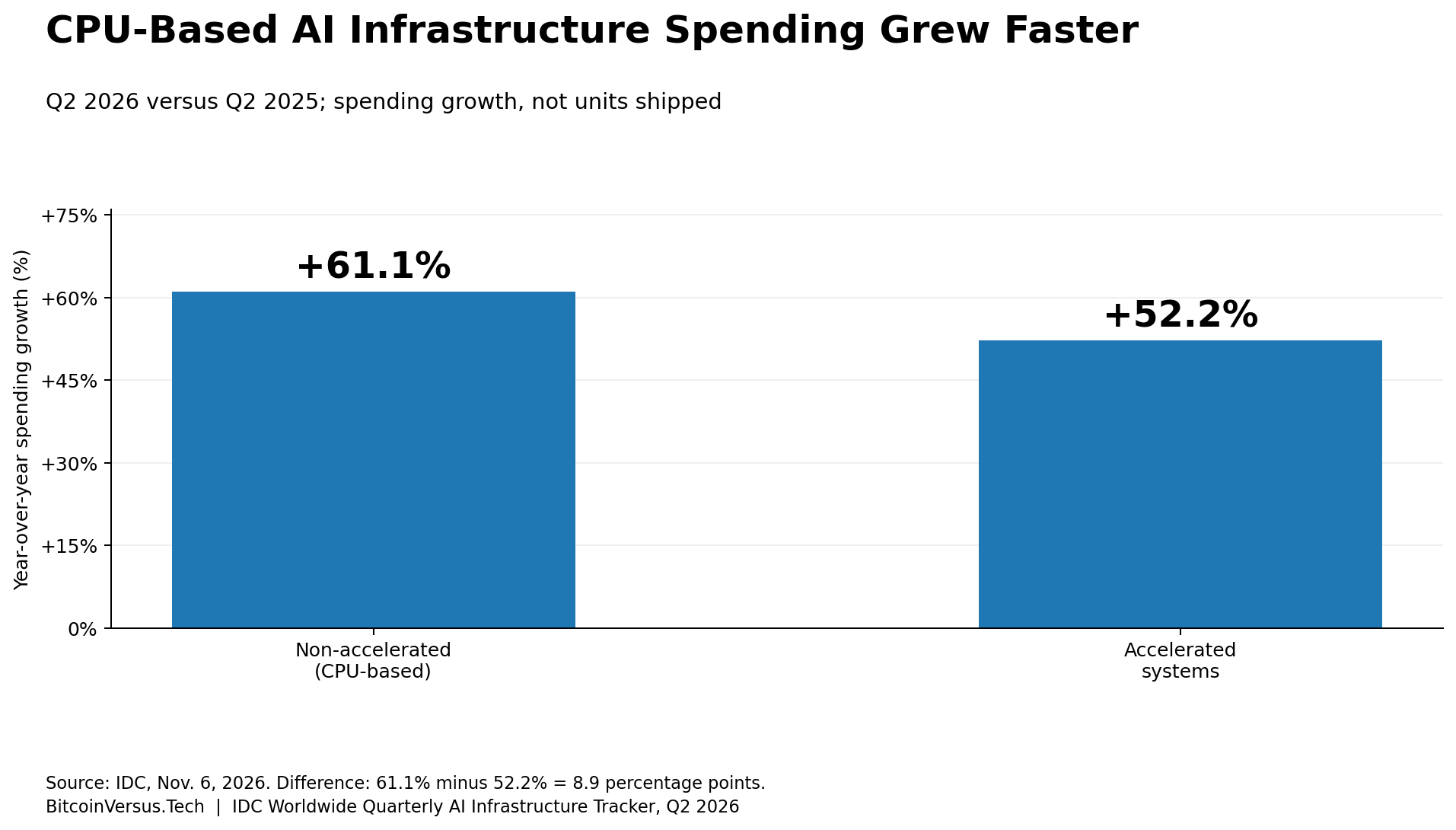
Non-accelerated infrastructure spending expanded 61.1% year over year, compared with 52.2% for accelerated systems. The difference is 8.9 percentage points, but it does not mean CPU servers overtook GPUs in total market value. IDC attributes broader demand to AI-agent orchestration and data pipelines, alongside component price increases that lift reported dollar spending.
Server systems represented approximately 98% of AI infrastructure spending, with storage accounting for about 2%. The report also identifies elevated memory pricing as a material factor. BitcoinVersus.Tech previously examined AI memory manufacturers’ financial performance. Higher component prices can increase market revenue without a proportional increase in installed computing power.
The annual forecast rises by $24 billion
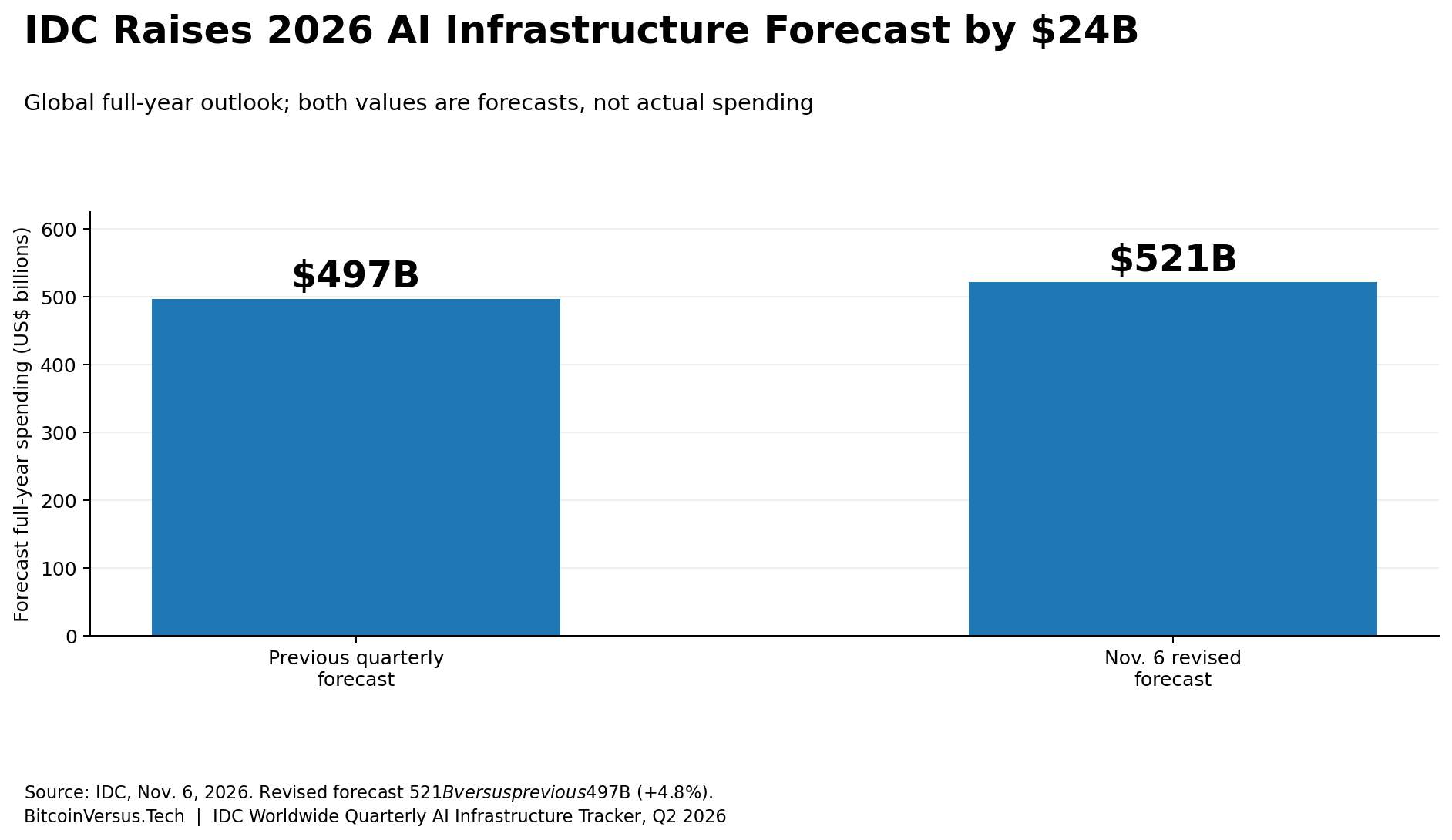
IDC raised its 2026 worldwide AI infrastructure forecast from $497 billion to $521 billion, an upward revision of approximately 4.8%. For perspective, the researcher estimates the market totaled $318.7 billion in 2025. The newer outlook implies approximately 63% year-over-year growth, but the 2026 number remains a forecast rather than an observed full-year result.
IDC projects further growth to $1.17 trillion in 2029 and $1.33 trillion in 2030. Those long-range estimates carry substantial uncertainty involving utility access, memory costs, export controls and actual demand for AI services. A prior BitcoinVersus.Tech report covered other infrastructure market projections, which use different definitions and must not be added directly to IDC’s totals.
American spending leads, but power remains a bottleneck
The United States accounted for $92.8 billion, or approximately 76.4% of Q2 global spending. China contributed $13.0 billion, while Western Europe reached $6.4 billion. IDC’s figures are spending estimates, not a census of completed data-center facilities or electricity consumption. BitcoinVersus.Tech separately reported a forecast of data centers’ share of future U.S. electricity-demand growth.
Grid interconnections and power availability could delay hardware deployments, while higher memory prices can suppress purchases. The decisive question for operators is whether additional spending translates into reliable computing output, better utilization and commercially valuable AI services. IDC’s quarterly results show rapid financial expansion, not proof that every planned server or facility has entered service.
Editor’s Note: Data and methodology were checked against IDC’s November 6, 2026 report, based on the Worldwide Quarterly Artificial Intelligence Infrastructure Tracker for Q2 2026. The 53.3% year-over-year change compares Q2 2026 with Q2 2025. Chart 1 totals $105.8 billion plus $15.6 billion, or $121.4 billion. Chart 2 compares 61.1% and 52.2%, an 8.9-percentage-point gap. Chart 3 shows a $24 billion revision from $497 billion to $521 billion; both annual values are forecasts. Global market spending must not be mistaken for unit shipments, data-center capacity, electricity consumption or company profit. The featured cover is a conceptual editorial illustration, not a photograph of a specific IDC-tracked facility. All three in-story charts are original data visualizations based on IDC’s released figures. No unverified video or social-media embed was added.

To donate 5,000 sats, open the article on a separate display and scan the original QR code with a compatible Bitcoin wallet. On mobile, use another screen or your wallet’s supported image-scanning feature. Verify the destination 3C9o19EH5HSiwEPyCTmEKzxhNCbo2X6TTb before sending.
We volunteer daily to ensure the information on this platform is Verifiably True. If you would like to support the research, please scan QR code.
BitcoinVersus.tech is not a financial advisor. Market statistics and forecasts are informational, and equipment prices and demand assumptions may change.


Leave a Reply