
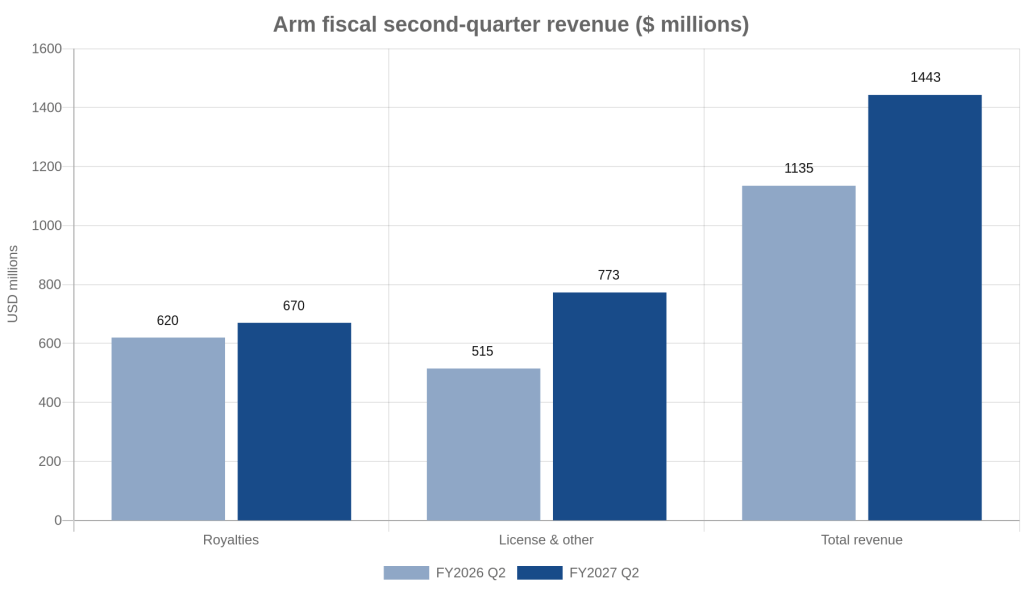
Arm Holdings reported fiscal second-quarter revenue of approximately $1.44 billion on November 4, 2026, up 27% from a year earlier, as demand for AI-related computing boosted the processor designer’s licensing business. The Cambridge, England-based company also outlined an expectation for roughly $2 billion in Arm AGI CPU sales across fiscal 2027 and 2028. The processor sales figure is a forward-looking target, not revenue already collected. The results cover the quarter ended September 30, 2026, according to Reuters’ November 4 earnings report and Arm’s investor-results hub.
Arm recorded $773 million in licensing and other revenue, compared with $670 million in royalties from designs already shipped in customers’ products. The combined $1.443 billion compares with $1.135 billion in the year-earlier quarter. Licensing grew approximately 50% while royalties increased about 8%, a difference that matters because large license contracts can produce uneven quarterly revenue even when chip shipments expand steadily.
The AGI CPU moves beyond licensing
The AI infrastructure opportunity extends beyond Arm’s established business of licensing chip architectures to other semiconductor manufacturers. Its AGI CPU introduces Arm-branded production silicon for server workloads, while established Neoverse intellectual property remains available to partners. Arm expects the new product line to contribute substantially to sales over the next two fiscal years, but the forecast depends on manufacturing supply, customer deployments and product acceptance.
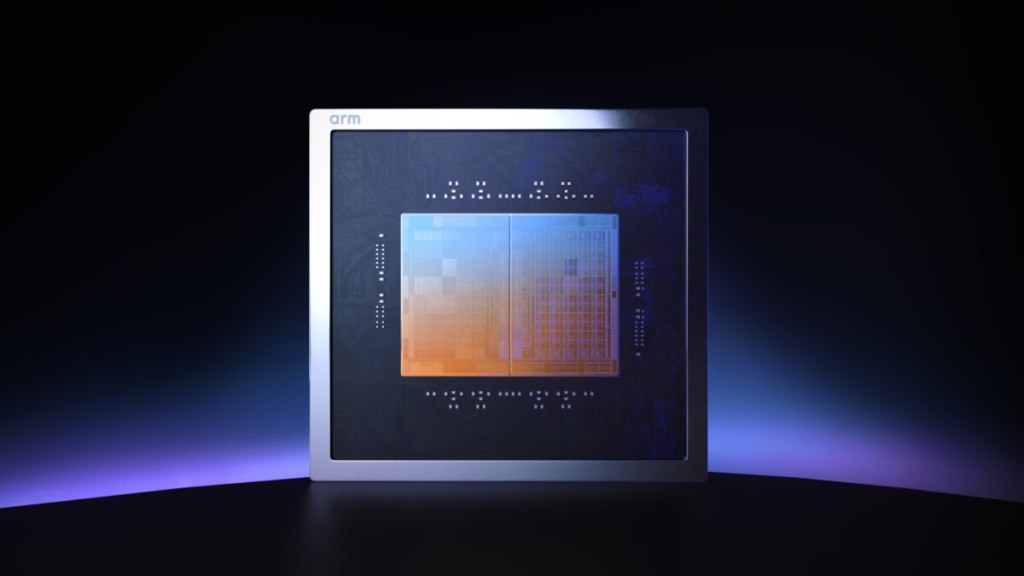
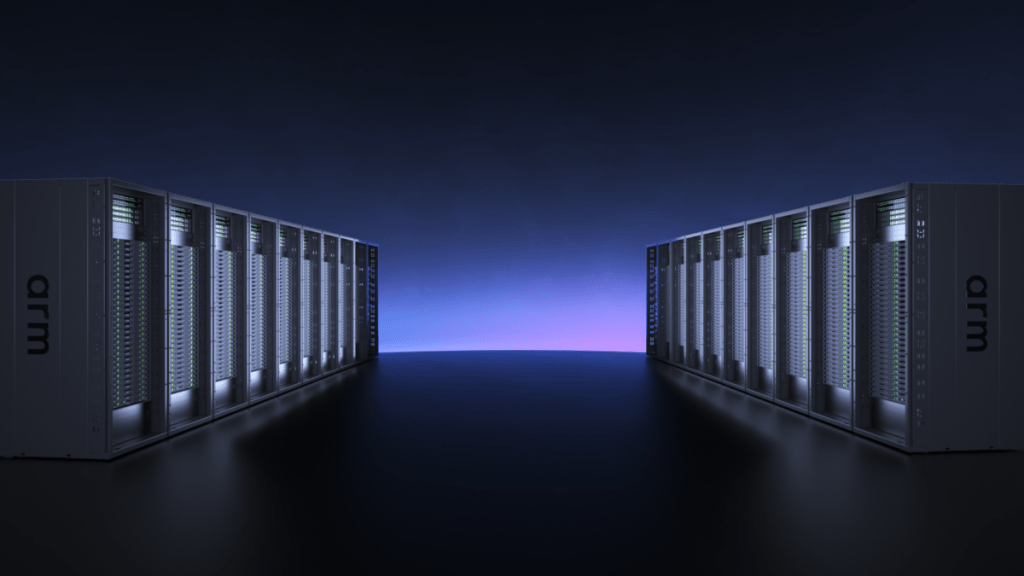
Earlier BitcoinVersus.Tech coverage documented Arm AGI CPU open-rack designs accommodating up to 336 processors and a modeled 1.99× rack-performance comparison against AMD EPYC. The latter analysis was commissioned by Arm and extrapolated from server-level testing rather than direct full-rack measurements. Rack-density demonstrations therefore do not establish sustained production performance at every customer site.
AI agents require CPUs for software orchestration, storage and network operations alongside accelerators handling model inference. The company’s Neoverse CSS N4 platform illustrates its parallel strategy of supplying processor building blocks to chip designers. Memory capacity, network latency and rack power limits remain constraints regardless of processor architecture.
Growth does not eliminate the risks
Arm said data-center royalties doubled year over year, although the company did not break out a complete standalone data-center sales figure in the coverage examined. It also projected that Arm-based server deployments at major cloud operators could exceed 60% by the end of 2026; the projection should not be confused with worldwide server market share. Google’s Axion processors represent one example of Arm technology entering hyperscale computing.
Reported net profit nevertheless declined to $130 million from $238 million a year earlier, according to The Wall Street Journal. Adjusted earnings of $0.52 per share beat analysts’ estimates, but non-GAAP earnings are not interchangeable with reported net income. Memory-component shortages and customer concentration also complicate hardware shipment forecasts. Semiconductor demand elsewhere is increasing, as Siltronic’s latest wafer-sales outlook illustrates, without proving any specific supply relationship.
What comes next
Arm forecast roughly $1.54 billion in revenue for its fiscal third quarter, plus or minus $50 million. The next disclosures should clarify how much AI infrastructure demand becomes repeatable royalties, how quickly AGI CPU customers take delivery and whether manufacturing supply supports the projected $2 billion of silicon sales. The relevant comparison is realized shipments and financial results against management’s forecast, not the announcement of a product roadmap alone.
Editor’s Note. Reported quarterly figures are attributed to Arm’s earnings disclosures as covered by Reuters and The Wall Street Journal. Product imagery originates from Arm’s March 2026 press kit and does not depict a new November launch. Financial projections and modeled hardware comparisons are not realized sales or direct deployment benchmarks.

Scan the donation code from another device if your phone cannot scan its own screen.
We volunteer daily to improve the credibility of the information on this platform. If you would like to support the research, please donate here: 3C9o19EH5HSiwEPyCTmEKzxhNCbo2X6TTb
BitcoinVersus.tech is not a financial advisor. This media platform reports on technical and financial subjects purely for informational purposes.


Leave a Reply