OpenAI announced on November 4, 2026, that it plans to acquire Pierre Computer Company, developer of the Code Storage Git service and the open-source Trees and Diffs libraries. The acquisition would broaden OpenAI’s Codex coding platform beyond generating software toward storing, reviewing and tracking code changes. OpenAI’s announcement describes a proposed transaction, not a completed purchase: customary closing conditions and regulatory approvals remain outstanding.
The transaction’s financial terms were not disclosed. OpenAI said Pierre and OpenAI will operate as independent companies until closing. Pierre’s open-source projects are expected to stay open, while Code Storage customers can continue using the service after the deal closes.
The tools already inside Codex
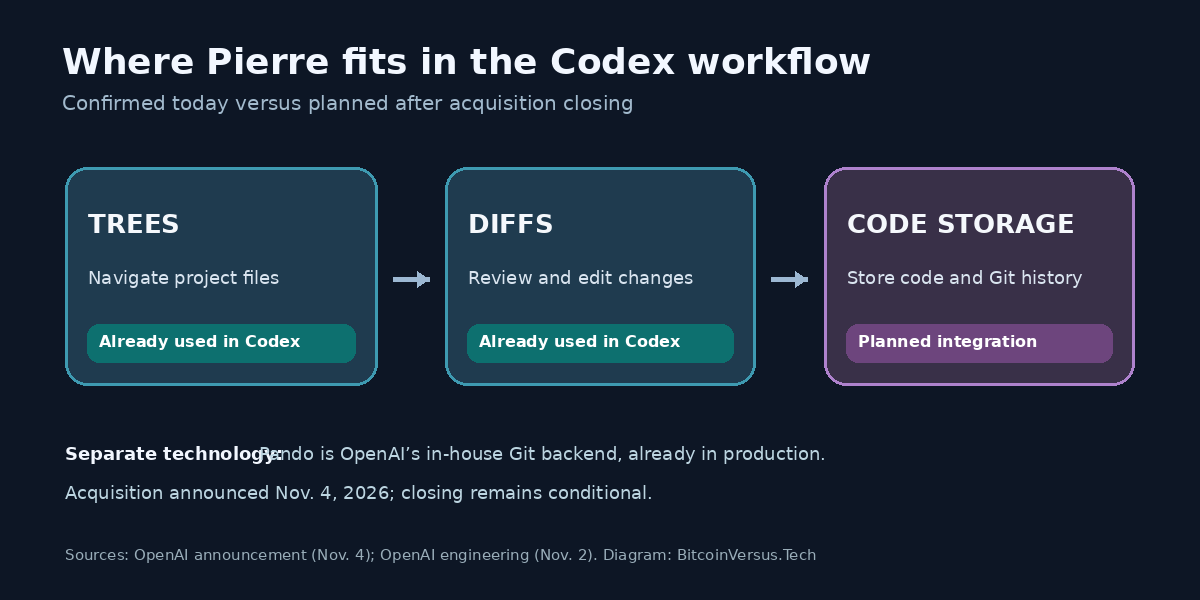
Pierre’s Diffs library presents code changes, including side-by-side comparisons and an edit mode that lets reviewers revise a line directly. Trees provides file navigation. OpenAI confirms that both libraries already power parts of the Codex interface; neither needs the acquisition to become an existing integration. Pierre also built Highlights, a syntax-highlighting library designed for rapidly changing code views.
The distinction matters for developers evaluating actual functionality. A code-review interface handles what someone sees and edits, whereas a Git backend stores commits, references, branches and history. Pierre’s Code Storage targets the latter problem. Integrating it more deeply into Codex is OpenAI’s stated ambition rather than a feature the acquisition announcement proves is fully deployed.
Official OpenAI code-review demonstration (November 2025), showing Codex pull-request review workflows. Archival video, not acquisition footage. Source: OpenAI.
The Git infrastructure challenge
OpenAI’s November 2 engineering report described Pando, an internally developed Git-compatible backend already supporting its main codebase. OpenAI says Pando reduced median push latency by nearly fivefold and now serves almost one petabyte of Git data daily. Those are company-reported operational results, not independent benchmarks of Pierre’s storage product.
Git activity has also expanded across the wider industry. BitcoinVersus.Tech’s Octoverse coverage recorded GitHub’s 17.9 billion pushes in the reporting year ending September 2026. A push can contain multiple commits; neither count establishes code quality. As AI agents work simultaneously, repository concurrency, access control, review queues and rollback capabilities become operational concerns.
Pierre adds programming interfaces for agents
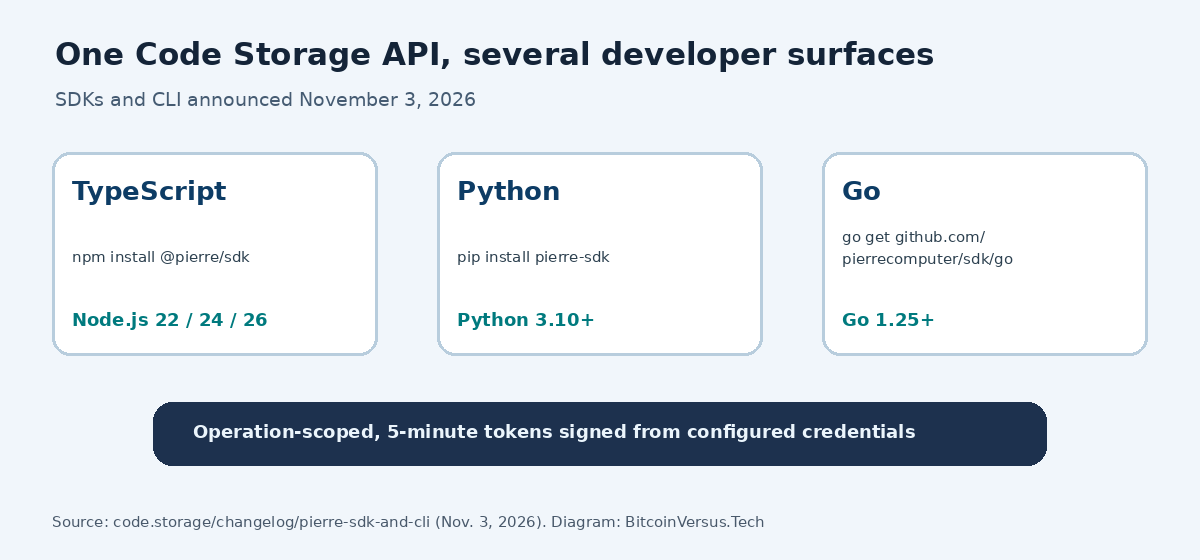
One day before the deal announcement, Pierre released SDKs and a CLI for Code Storage. TypeScript requires a supported Node.js 22, 24 or 26 release; the Python package requires Python 3.10 or newer, and Go requires Go 1.25 or newer. Documentation lists installation commands for each ecosystem. They are vendor-documented examples, not commands independently executed for the article.
npm install @pierre/sdk
pip install pierre-sdk
go get github.com/pierrecomputer/sdk/go
npm install -g @pierre/cli
The clients use the PIERRE_ORG and PIERRE_PRIVATE_KEY environment variables, with operation-scoped tokens signed for five minutes, according to Pierre. Engineering teams should avoid committing private keys, inspect SDK permissions and test access revocation. Deploying a Git service through an AI agent does not remove normal repository security duties.
Competition and unanswered questions
The acquisition could put Codex in closer competition with Microsoft-owned GitHub’s integrated development workflow. The companies have not disclosed a completed integration schedule, independent storage benchmarks or acquisition price. Developer teams will still need to assess migrations, reliability, source-code residency and licensing before changing repository providers.
Related BitcoinVersus.Tech reporting examines GitHub Agentic Workflows, Copilot Fusion, and VS Code’s cross-device agent sessions. The next verifiable milestone for Pierre is regulatory clearance and a clearly documented production rollout inside Codex.
Editor’s Note: Reporting draws on OpenAI’s November 4 acquisition announcement, its November 2 Pando engineering article and Pierre’s November 3 SDK documentation. The cover and explanatory diagrams are editorial illustrations. The embedded OpenAI code-review demonstration predates the acquisition.

To support our volunteer research, scan the original QR code from a laptop or larger screen to donate 5,000 sats. Bitcoin address: 3C9o19EH5HSiwEPyCTmEKzxhNCbo2X6TTb. Verify the address before paying.
We volunteer daily to ensure the credibility of the information on this platform is Verifiably True. If you would like to support our work and help further secure the integrity of our research initiatives, please scan the QR code above to donate 5,000 sats. For best results, scan the QR code from a laptop or larger screen.
BitcoinVersus.tech is not a financial advisor. This media platform reports on financial subjects purely for informational purposes.


Leave a Reply