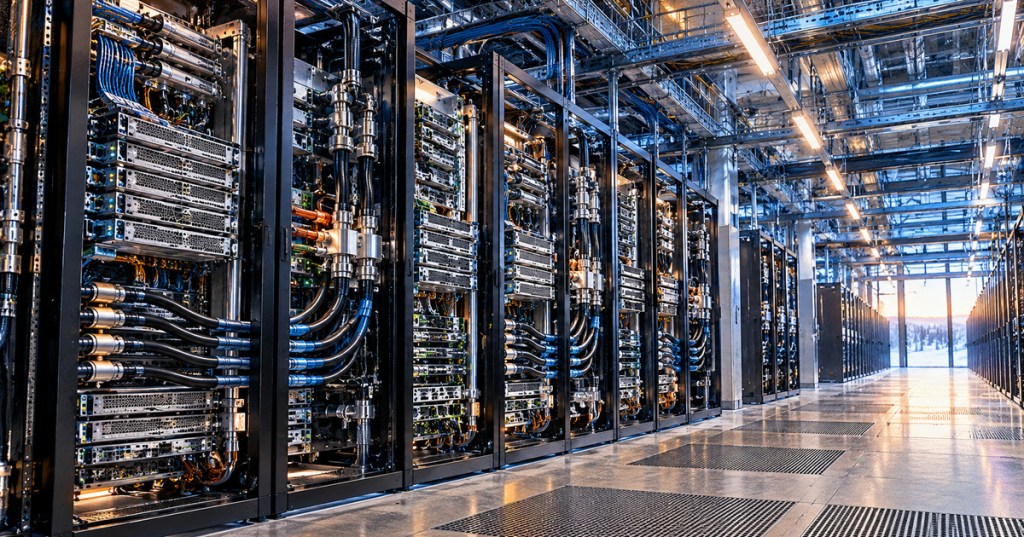
Open Compute Project-recognized infrastructure could become a much larger share of global data-center spending by the end of the decade, according to a new IDC forecast commissioned by the Open Compute Project Foundation.
OCP published the study summary on October 13. IDC now projects about $800 billion in annual spending on OCP-recognized equipment in 2029, up from last year’s $295 billion forecast for the same year. The estimate rises to $892 billion in 2030.
The number is a forecast, not booked revenue. The study is commissioned by OCP, so it should be read as an industry outlook rather than an independent sales report. Still, the scale of the revision is notable: IDC’s 2029 estimate is roughly 2.7 times higher than the prior forecast.
AMD said at the 2026 OCP Global Summit that it is donating its Helion Agentic Rack design to OCP, one example of the open-infrastructure push behind the forecast.
IDC projects OCP-recognized spending growing from about $154 billion in 2025 to $892 billion in 2030, a compound annual growth rate of roughly 42%. Servers dominate the forecast: OCP says about $814 billion of the 2030 total is expected to come from servers, while approximately $628 billion across the measured categories is expected to be AI-related.
That helps explain why open rack, power and cooling specifications are becoming more important. BitcoinVersus.Tech recently covered OCP’s view that AI racks are moving beyond 1 MW, forcing changes in voltage, cooling and facility design.
Open Compute Project’s 2026 Global Summit welcome session sets out the foundation’s current open-infrastructure priorities.
The forecast also stretches beyond conventional servers. OCP says its covered categories include storage, switches, racks, power, cooling, carrier equipment and peripherals. That broader definition matters because modern AI clusters are increasingly constrained by what sits around the accelerator: network fabrics, power conversion, heat rejection and physical rack design.
BitcoinVersus.Tech has already seen that shift in specific projects. OCP is studying superconducting power for AI data centers, while vendors are bringing 800 VDC power and multi-megawatt cooling systems into the same open ecosystem.
AMD also used OCP 2026 to highlight its next-generation EPYC roadmap for AI-era infrastructure.
The larger implication is that OCP is no longer just about standard server chassis. The organization’s current work spans chiplets, Ethernet-based AI networking, high-voltage DC power, liquid cooling, energy storage and grid coordination. Its 2026 summit program reflects that chip-to-grid scope.
AMD CEO Lisa Su’s OCP 2026 keynote focuses on building the next generation of open AI infrastructure.
Whether spending actually reaches $892 billion will depend on AI demand, power availability, construction capacity and how quickly open designs move from specifications into deployed systems. The forecast does not guarantee that outcome. What it does show is how rapidly expectations for open AI infrastructure have changed in a single year.
BitcoinVersus.Tech Editor’s Note:
We volunteer daily to ensure the credibility of the information on this platform is Verifiably True. If you would like to support to help further secure the integrity of our research initiatives, please donate using the QR code provided

For best QR-code scanning results, please scan this donation code from a desktop or larger screen. Mobile screens may prevent camera recognition.


Leave a Reply