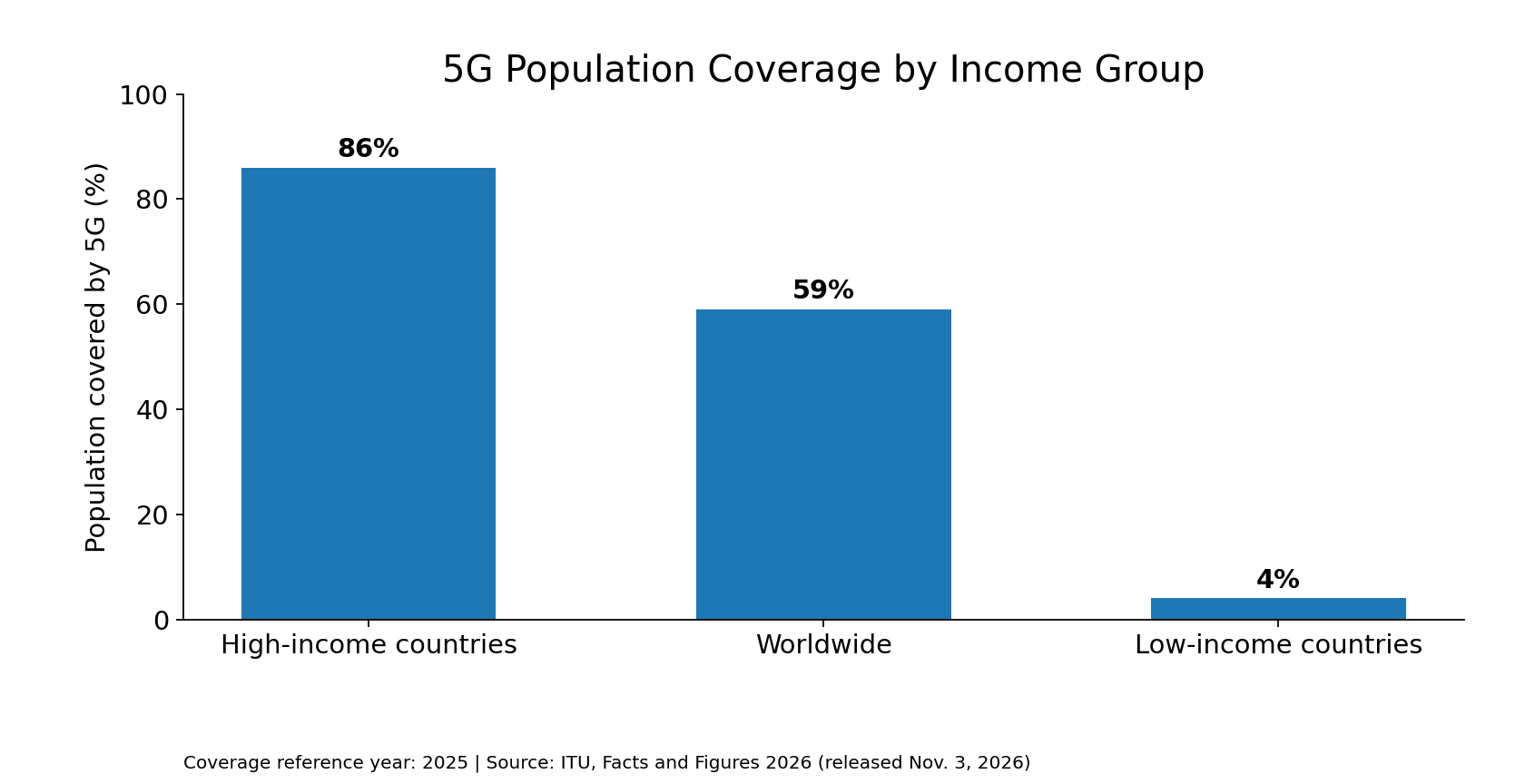
Fifth-generation mobile networks reached 59% of the world’s population in the latest global coverage estimates, but reached only 4% of people in low-income countries. The International Telecommunication Union (ITU), a United Nations technology agency, published the findings in its November 3, 2026 Facts and Figures 2026 announcement. In high-income countries, coverage reached 86%, an 82-percentage-point gap between the two income groups.
The coverage statistics refer to 2025, while other indicators in the newly released assessment refer to 2026. Population coverage means people living inside the reach of a network signal, not subscribers actively using 5G. Device availability, affordability, radio conditions and network performance can all determine whether nominal coverage becomes a useful connection.
Network reach varies sharply by region
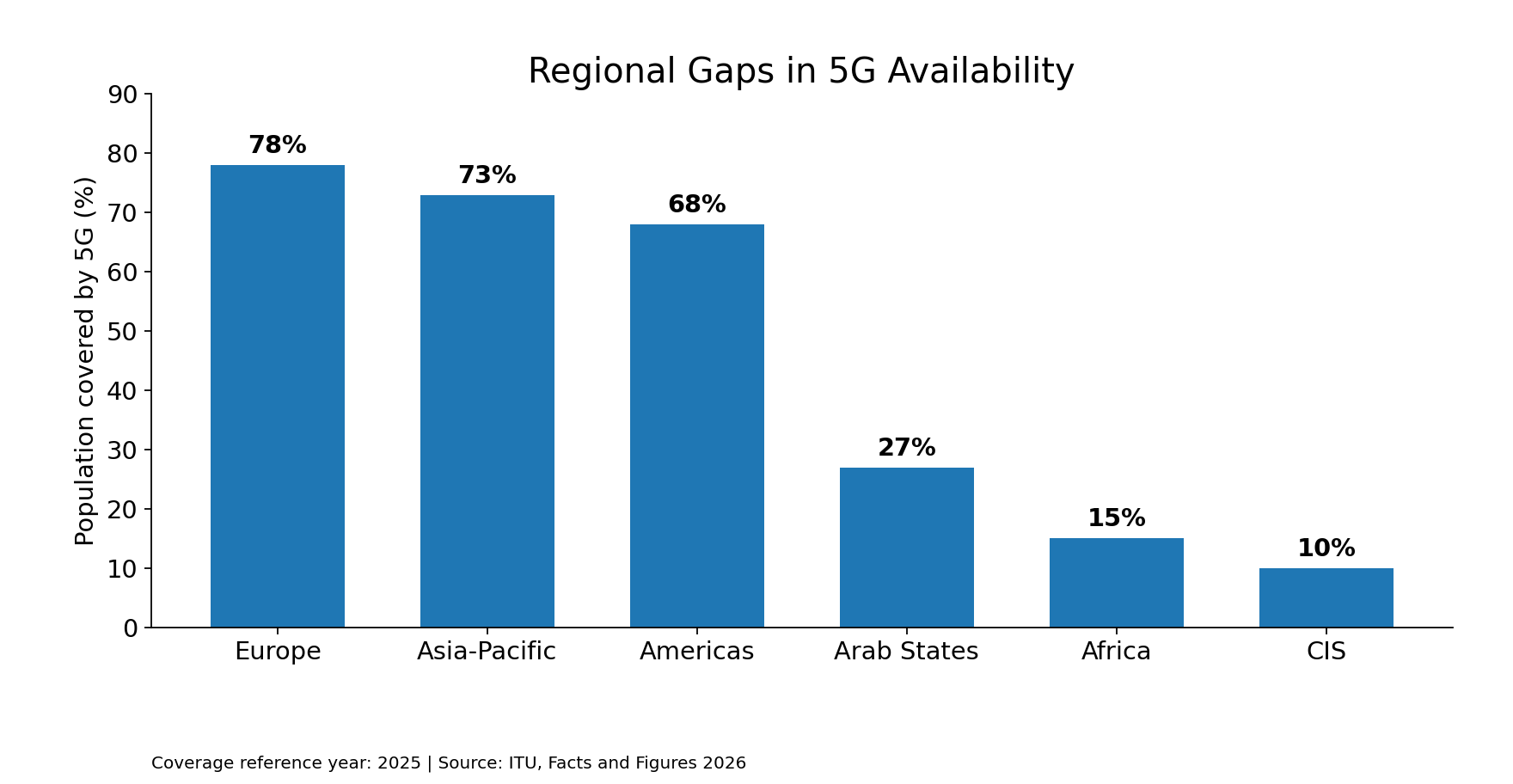
Europe led with 78% 5G population coverage in 2025, followed by Asia-Pacific at 73% and the Americas at 68%. The Arab States registered 27%, Africa 15% and the Commonwealth of Independent States (CIS) 10%. Those percentages use each region’s own population as the denominator. They cannot be interpreted as shares of all 5G connections worldwide.
Older wireless generations remain essential. The ITU estimates 4G coverage at 94% worldwide but 68% in low-income countries. At least 3G reaches 97% globally. Deploying 5G radios also requires spectrum, backhaul, power, construction and device ecosystems. BitcoinVersus.Tech’s coverage of a proposed national 5G tower network describes infrastructure plans rather than proof of operating coverage.
Subscriptions and data use tell a different story
The report estimates that 5G accounts for 40% of worldwide mobile-broadband subscriptions in 2026. Network coverage and subscription share are separate denominators: a person can live inside a 5G footprint while using 4G, and one person can maintain several SIM subscriptions. The ITU estimates 9.5 billion mobile-cellular subscriptions overall, which does not mean 9.5 billion unique subscribers.
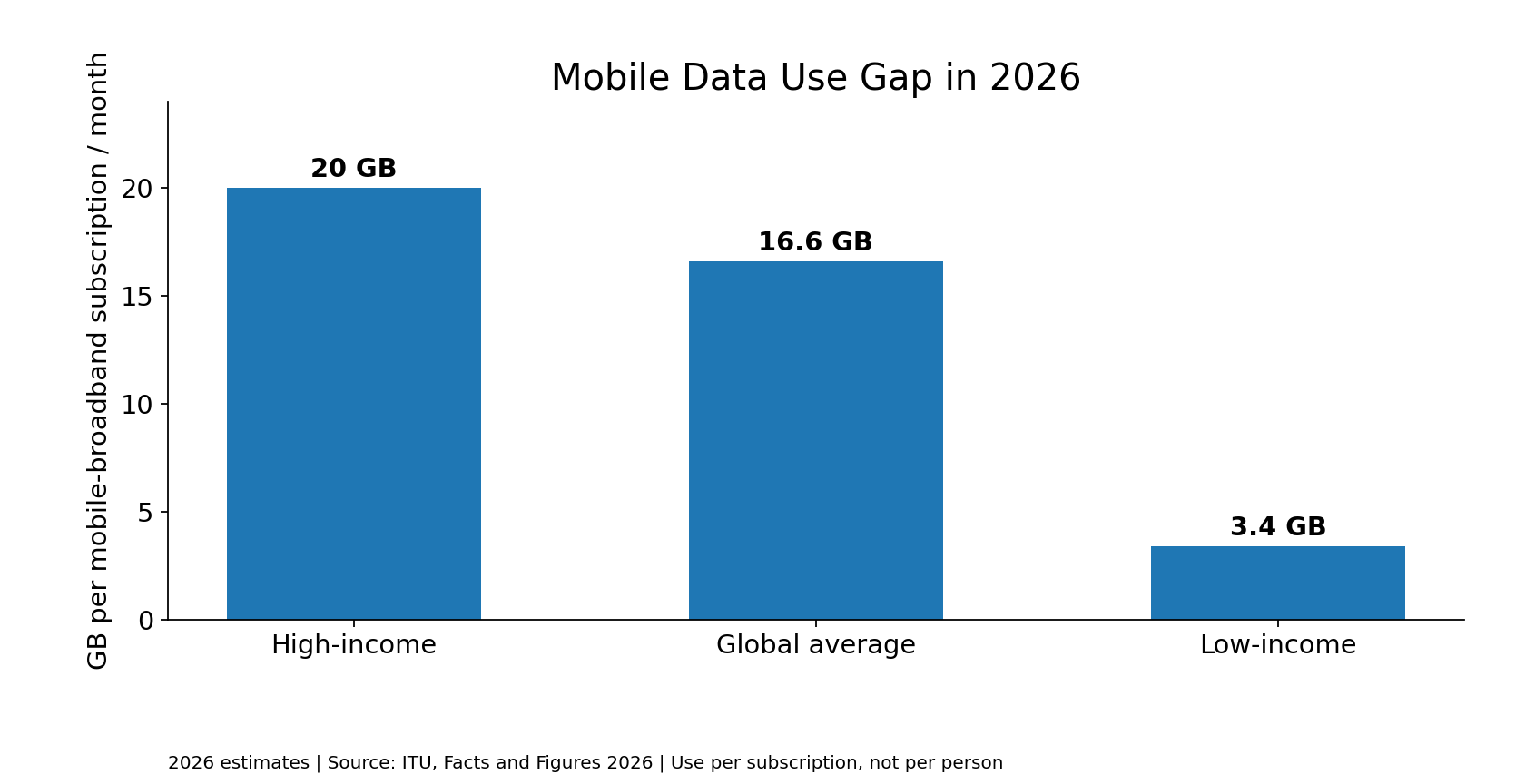
Usage remains unequal even among active mobile-broadband connections. High-income economies averaged 20 GB of mobile data per subscription per month, compared with 3.4 GB in low-income economies, or approximately 5.9 times as much. The worldwide average was 16.6 GB. These are estimated traffic volumes, not guaranteed data allowances, broadband speeds or measurements of each individual’s consumption.
The next barriers are economic and physical
Globally, 6.3 billion people, or 76% of the population, were estimated to use the Internet in 2026, leaving about 2 billion offline. A newer radio standard alone cannot eliminate the access gap. Carriers must secure financing, dependable electricity and transport links. Technical background on beam-steering antennas, fiber-optic transceivers and open radio-network software shows why connecting a tower requires more than adding an antenna.
The ITU’s figures are global estimates, compiled from national and industry reporting, with historical revisions possible. Differences in reported radio coverage do not establish equivalent differences in measured service quality or explain every local financing obstacle. Future progress will need assessment of affordable access, actual adoption and consistent network performance, not coverage percentages alone.
Primary sources: ITU release, November 3, 2026; mobile network coverage; mobile subscriptions; and Internet traffic.
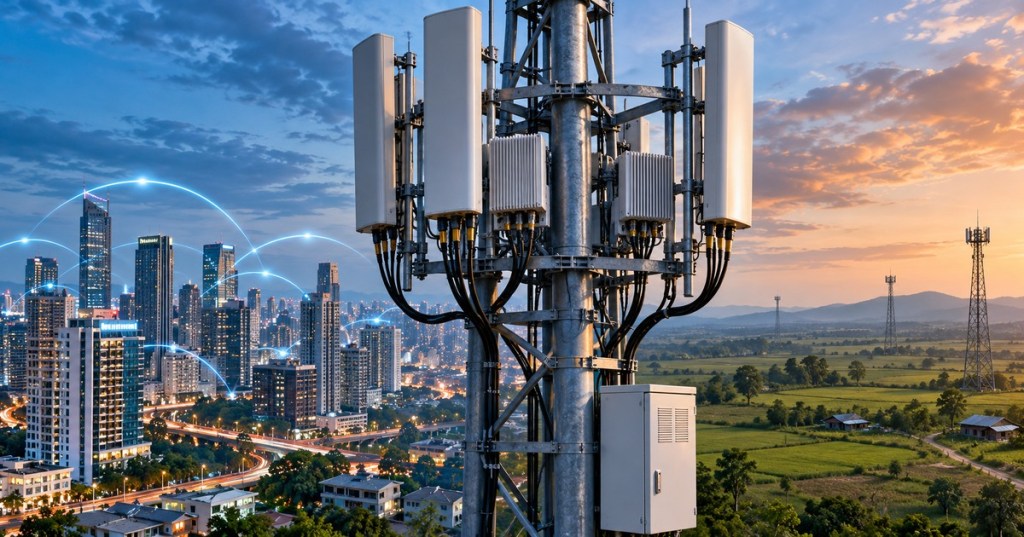
Editor’s Note: All statistical values follow the ITU’s November 3, 2026 Facts and Figures 2026 release and its underlying sections. The cited 5G population-coverage estimates refer to 2025; subscription and traffic estimates refer to 2026. Illustrative featured artwork represents telecom infrastructure generically and does not depict a verified cell site. Source survey microdata and real-world service quality have not been independently audited.
Support BitcoinVersus.Tech
To donate 5,000 satoshis to independent research, scan the original BitcoinVersus.Tech donation QR below with a compatible Bitcoin wallet. On mobile, open the article on a second screen for scanning, or use a wallet’s supported image-import scanning feature. Verify the destination and amount before sending funds.
We volunteer daily to ensure the information on this platform is Verifiably True. If you would like to support the research, please scan QR code.


Leave a Reply