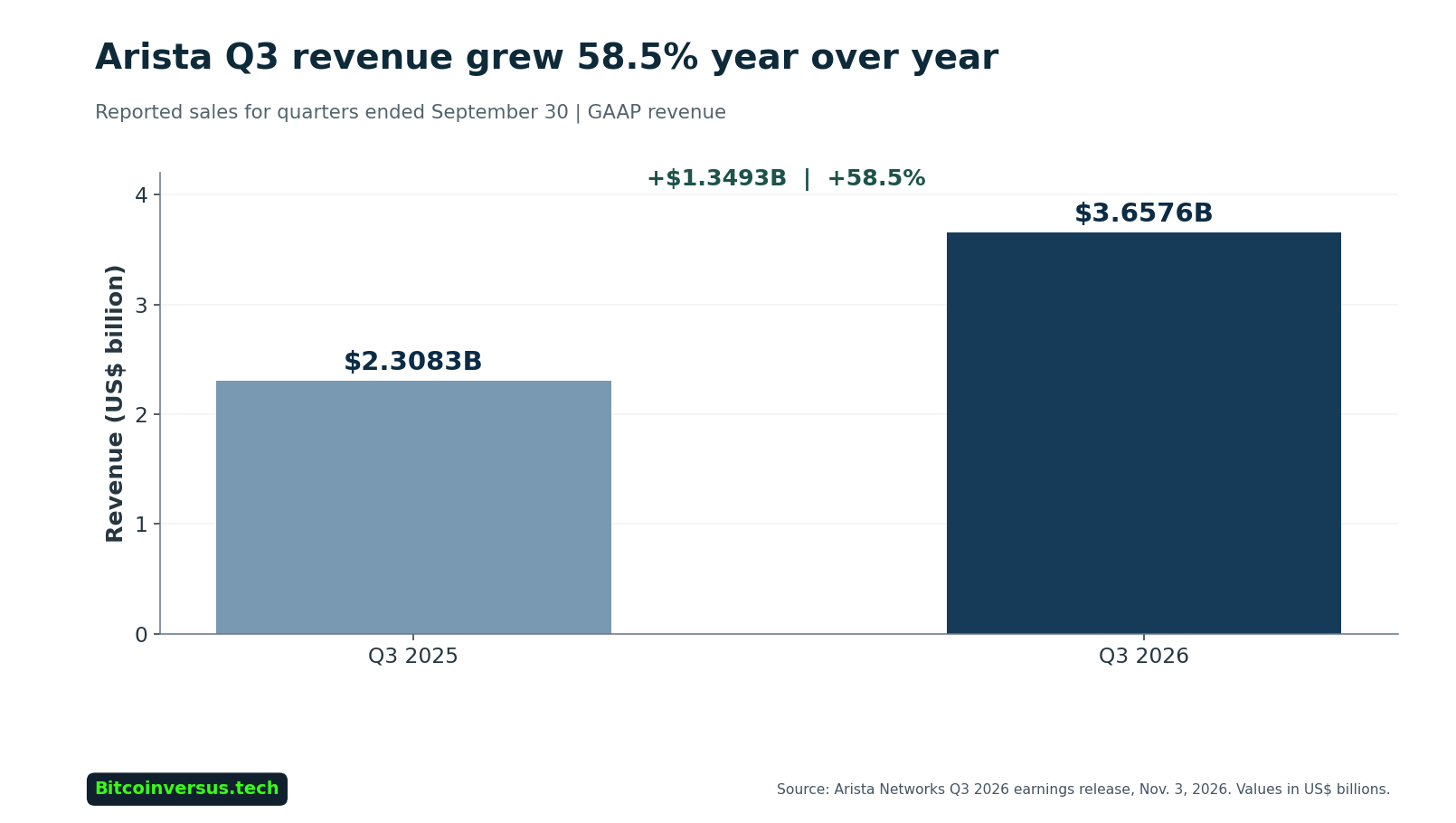
Arista Networks reported third-quarter 2026 revenue of $3.6576 billion on November 3, a 58.5% increase from $2.3083 billion a year earlier. The $1.3493-billion gain was the company’s fastest year-over-year revenue growth since its 2014 initial public offering, according to Arista. Sales also grew 20.5% from the preceding quarter and exceeded the company’s $3.3-billion guidance by $357.6 million, or 10.8%. The figures cover the quarter ended September 30, not full-year 2026 revenue.
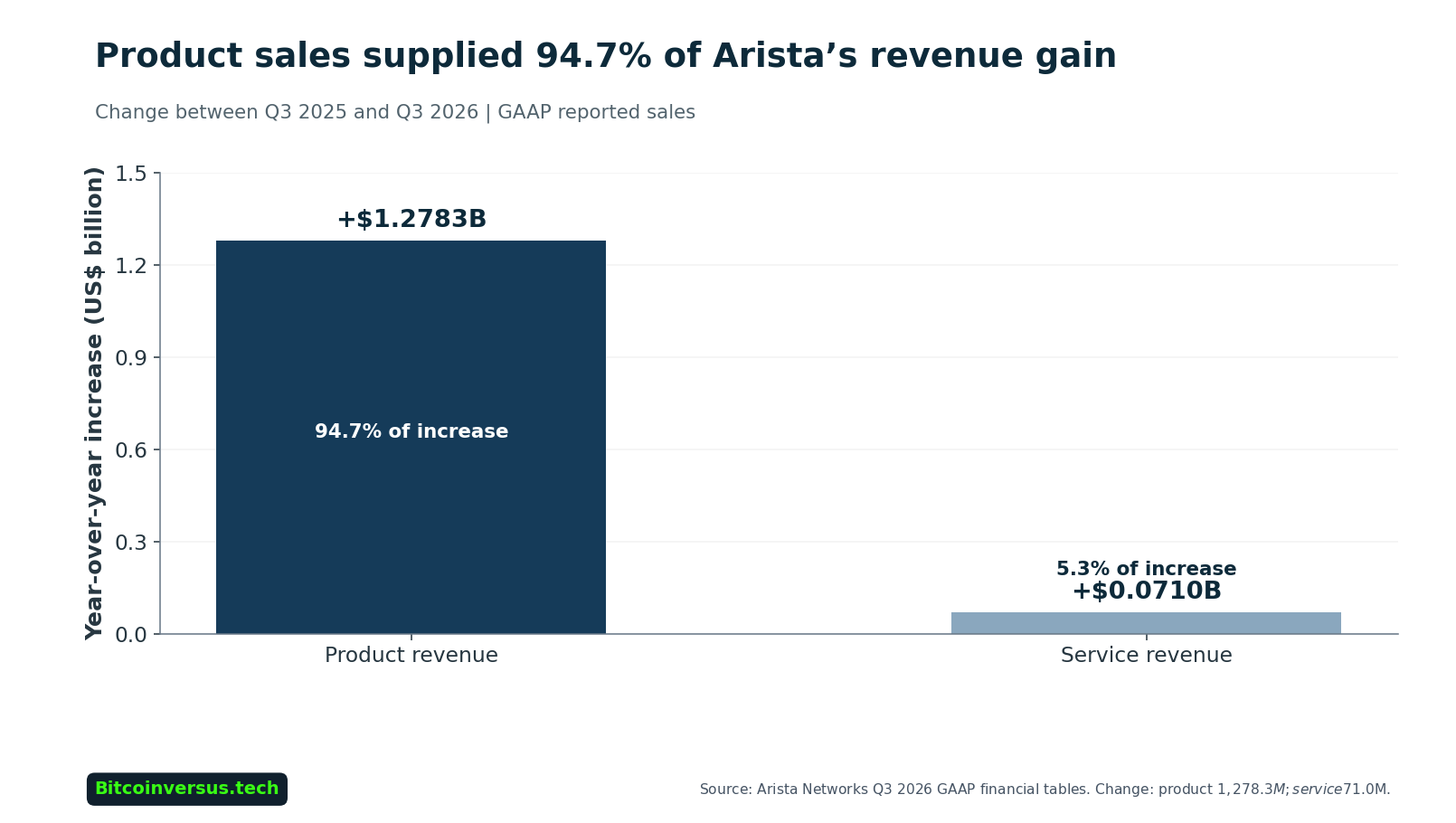
Products delivered almost 95% of the revenue increase
Arista’s filing separates equipment and software-related product sales from services. Product revenue reached $3.1900 billion, up from $1.9117 billion, while service revenue rose to $467.6 million from $396.6 million. Product sales therefore contributed $1.2783 billion of the total $1.3493-billion increase: 94.7% of incremental revenue. Services contributed $71.0 million, or 5.3%. Product revenue grew 66.9% year over year, substantially faster than the 17.9% increase in services.
The breakdown reveals a product-led expansion rather than an evenly distributed advance across revenue categories. It does not establish what share of sales came specifically from artificial intelligence. Arista also supplies networking infrastructure to enterprise, campus, cloud and routing customers, and the earnings release does not provide a standalone, audited AI-revenue line.
AI Ethernet expands beyond top-of-rack switching
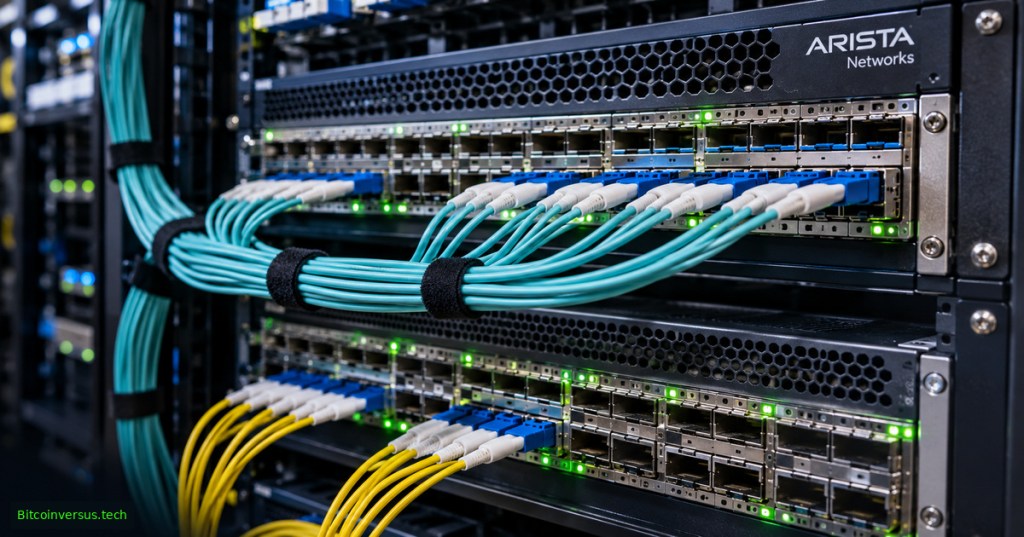
AI training and inference clusters require frequent transfers among accelerators, storage and servers. Top-of-rack switches aggregate server links, while larger spine fabrics distribute traffic among racks. Arista is pushing Ethernet deeper into accelerator-level scale-up networks, alongside conventional scale-out and data-center interconnects. Its October 7 rack-scale announcement described an Etherlink SU-144 architecture supporting up to 144 accelerators per rack and proposed cross-rack scaling to 1,024 accelerators.
Arista’s previously reported 2027 trial and 2028 production targets underscore a deployment distinction: newly announced architectures and planned capacity are not equal to delivered commercial installations. The company’s high-density switch portfolio competes on port capacity, reliability and fabric design, while 800G and 1.6T optical interfaces bring separate lane-rate and power-budget challenges. Industry OIF standards initiatives may improve interoperability, but require validation before deployment claims can be made.
Profitability improved, but gross margin narrowed
GAAP operating income increased from $978.2 million to $1.6424 billion, a gain of 67.9%. Operating margin improved from 42.4% to 44.9%, a 2.5-percentage-point increase. However, dividing gross profit by revenue shows GAAP gross margin edged down from 64.6% to 63.6%. Diluted GAAP earnings per share rose from $0.67 to $1.22. Revenue momentum therefore coincided with stronger operating leverage, not an improvement in every profitability measure.
Arista projects fourth-quarter revenue of $3.9 billion to $4.0 billion and non-GAAP operating margin of 48% to 49%. Guidance is a management forecast, not revenue already earned. The company’s SEC risk disclosures identify dependence on large customers, constrained components, a principal merchant-silicon supplier, competition and variable order timing. Those risks can interrupt purchasing even as AI infrastructure demand expands.
Arista’s reported 58.5% growth is measurable; the precise portion attributable to AI is not isolated in the published income statement. Future tests include customer diversification, product availability, realized 1.6T deployments and whether gross margins hold as the networking mix shifts.
Sources and calculations: Arista Networks, third-quarter earnings release, November 3, 2026; SEC Form 8-K Exhibit 99.1; SEC Form 10-Q, period ended September 30, 2026; Arista rack-scale announcement, October 7, 2026. Growth = ($3,657.6M − $2,308.3M)/$2,308.3M = 58.45%; product contribution = ($3,190.0M − $1,911.7M)/$1,349.3M = 94.74%. Calculations reflect reported unaudited quarterly statements, with rounding.
Editor’s Note: All Q3 financial values come from Arista’s unaudited company-reported statements filed with the SEC. The 58.5% revenue growth and 94.7% product-revenue contribution are supported by published figures and independently recalculated. Arista does not provide a separately audited Q3 AI-revenue figure; the article does not attribute the entire increase to AI. Product architecture targets, testing timelines and fourth-quarter guidance are distinguished from achieved deliveries. The original cover is a conceptual Arista-themed illustration rather than a photograph of an identified shipping system. Both in-story charts use source-labeled GAAP numbers and zero baselines. The official Arista YouTube video was identified through public metadata; hands-on playback and mobile-browser testing were unavailable.

BitcoinVersus.Tech is volunteer-run and publishes independent educational technology reporting. An optional 5,000-satoshi donation supports continued research. Scan the original QR from a second screen using a compatible Bitcoin wallet; on mobile, use a wallet supporting QR scanning from a saved image. Independently verify the recipient address 3C9o19EH5HSiwEPyCTmEKzxhNCbo2X6TTb and the amount before payment. Bitcoin transactions are generally irreversible.
We volunteer daily to ensure information on the BitcoinVersus.Tech platform is Verifiably True. Coverage is for educational and informational purposes and does not constitute financial or investment advice.


Leave a Reply