
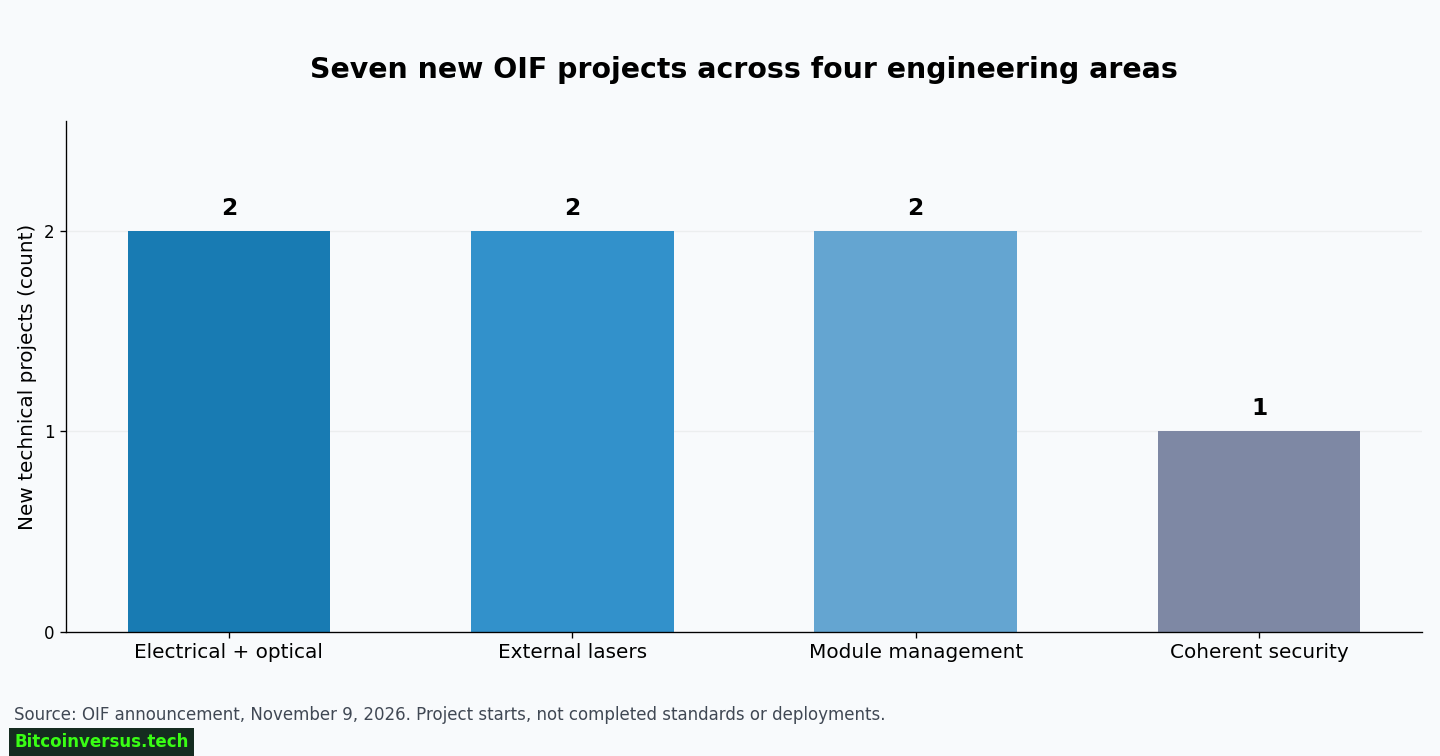
The Optical Internetworking Forum (OIF) announced seven new technical projects on November 9, 2026, targeting faster electrical links, bidirectional fiber connections, external lasers, module management and coherent optical security. The projects began at OIF’s November 2–5 meeting in Bangkok, attended by more than 200 member-company representatives, including approximately 40 first-time attendees. They establish work programs for future specifications; OIF did not announce seven finished standards or seven commercial products.
448G electrical links and 200G bidirectional fiber
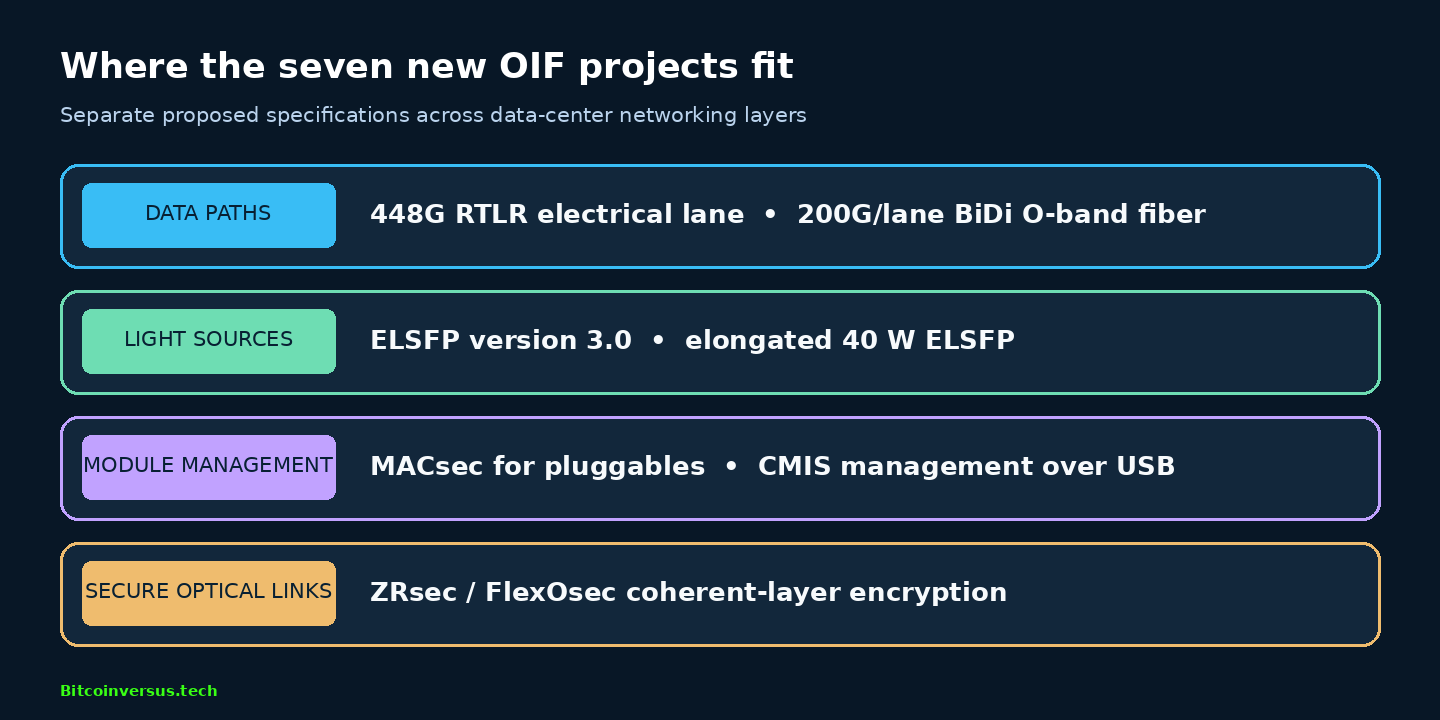
Two projects target the movement of data. The first will define an Energy Efficient Interfaces (EEI) implementation agreement for a 448-gigabit-per-second electrical lane using a retimed-transmit, linear-receive (RTLR) architecture. Retiming on the transmit side and a more linear receive path present different signal-integrity and power trade-offs from fully retimed designs. OIF already has a broader 448G and coherent-optics standardization program; the new RTLR effort adds a particular interface architecture rather than announcing a universally deployed 448G port.
The second will pursue 200 Gb/s per lane of bidirectional transmission over O-band single-mode fiber. A bidirectional approach can use a fiber path for traffic moving both ways, but engineers must still account for wavelength separation, optical power budgets, reflections and supported reach. A 200G optical lane and a 448G electrical lane describe different interfaces and cannot be added together as a single product-speed claim. BitcoinVersus.Tech’s optical transceiver guide explains the distinction between electrical host signals and optical line transmission.
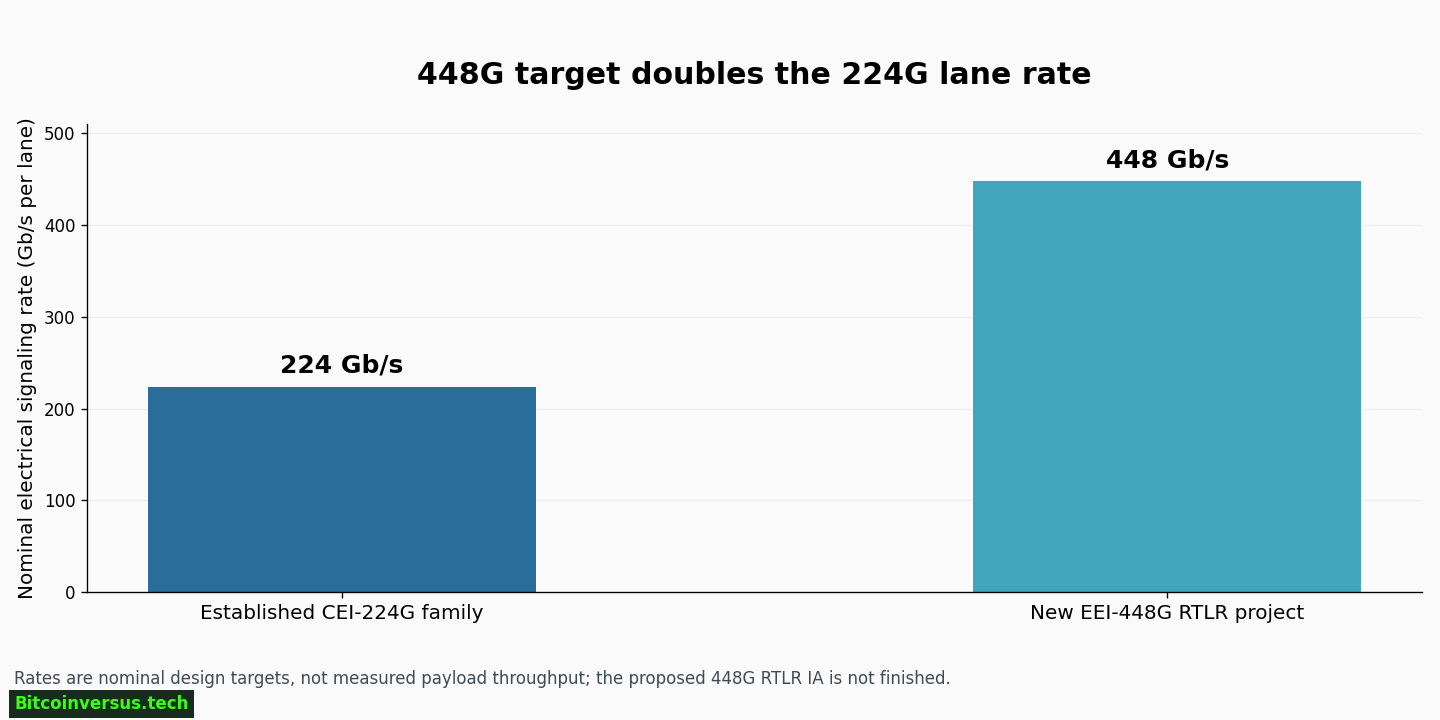
For comparison, 448 ÷ 224 = 2, or a 100% increase in nominal lane rate relative to the 224G generation. Higher signaling speed also creates tougher requirements for channel loss, equalization, bit-error rates, connectors and forward-error correction. An existing 800G-versus-1.6T optics comparison illustrates how nominal interface capacity depends on lane counts and supported signaling schemes.
Laser power and pluggable control
Two more projects address external laser sources. One will revise the External Laser Small Form Factor Pluggable (ELSFP) implementation agreement to version 3.0. Another proposes a Type-3 elongated ELSFP form factor supporting Electrical Power Class 8 high-power operation at 40 watts. The 40-W specification is an intended power-class capability, not evidence that every external laser draws 40 W or that an operating data center has reduced electricity consumption.
External lasers can serve optical engines located close to switching silicon, including co-packaged architectures. Their power, thermal, connector and serviceability constraints affect rack design. A separate 12.8-Tb/s optical module analysis demonstrates why nominal bandwidth and component watts must be evaluated together rather than treated as interchangeable performance measures.
Management receives two separate workstreams: MACsec functionality management within pluggable modules and a USB-based Management Communication Interface for the Common Management Interface Specification (CMIS). MACsec relates to link-layer encryption; management of its functions is not equivalent to proving secure deployment across competing vendors. USB transport for CMIS similarly establishes a proposed management route, not instant compatibility with every installed module.
Coherent-link security still needs interoperability proof
The seventh project, ZRsec (FlexOsec), will work toward a shared method for FlexOsec layer-one encryption in coherent ZR optical interfaces. The goal is interoperable link protection in optical transport, separate from application-layer encryption or the security of endpoints. Operators will still need key management, authentication policies, lifecycle procedures and independent implementation testing.
OIF’s September ECOC 2026 demonstration program described multi-vendor experiments involving 448G signaling, 224G, CMIS and energy-efficient optics. A laboratory showcase of related concepts does not verify the newly initiated November agreements. OIF provided no completion dates, cross-vendor qualification matrix, measured energy-per-bit savings or commercial shipment timetable for the seven projects.
The practical development to watch is a published implementation agreement followed by independent multi-vendor testing: identical lane definitions, connector requirements, error handling, firmware behavior and sustained thermal performance. As the site’s earlier fiber-optic technology review explains, deployment value depends on interoperability and operating constraints as much as advertised data rates. OIF has opened seven workstreams; proof of market readiness remains ahead.
Sources and method: OIF announcement, November 9, 2026; IEEE Communications Society technology coverage, November 9, 2026; OIF ECOC demonstration background, August 26, 2026. Calculated nominal rate ratio: 448 Gb/s ÷ 224 Gb/s = 2.00. Graphics classify seven project starts from the primary OIF release.
Editor’s Note: OIF’s November 9 announcement establishes seven newly initiated projects, not seven completed implementation agreements or deployed products. Figures of 448 Gb/s, 200 Gb/s and 40 W are project targets or stated power-class capabilities; no independent operating benchmarks were supplied. The featured illustration depicts representative optical networking equipment, not the Bangkok meeting or a verified future product. Three original in-story explanatory graphics are based on sourced project descriptions. A relevant official YouTube video with a verified playable ID was not established, so no unverified video embed was added. Real-device visual checks and actual media playback testing have not been performed.

BitcoinVersus.Tech is volunteer-run and publishes independent educational technology reporting. An optional 5,000-satoshi donation can support continued research. Scan the original QR from a second screen using a compatible Bitcoin wallet, or on mobile use a wallet supporting image-based QR scanning. Independently verify recipient address 3C9o19EH5HSiwEPyCTmEKzxhNCbo2X6TTb and the amount before sending; Bitcoin transactions are generally irreversible.
We volunteer daily to ensure information on the BitcoinVersus.Tech platform is Verifiably True. Coverage is for educational and informational purposes and does not constitute financial or investment advice.


Leave a Reply