
Applied Optoelectronics (AOI) announced on November 24, 2026, a multiyear supply agreement with an existing, unnamed hyperscale data center customer. The manufacturer’s announcement identifies approximately $1.5 billion in minimum 800G optical transceiver purchases during 2027 and $700 million in laser diode purchases across 2028 and 2029. The agreement spans December 2026 through December 2030. The commitments illustrate demand for optical infrastructure beyond the processors themselves, following developments such as Lambda’s optical switching deployment.
What an 800G optical transceiver does
A pluggable transceiver connects a switch or network interface to optical fiber. On transmission, circuitry encodes electrical data and drives optical emitters or modulators; the receiving side converts light back into electrical signals. An 800 Gb/s nominal aggregate rate corresponds to 100 GB/s in one direction before higher-layer overhead. Actual application throughput depends on protocol framing, congestion and end-system capabilities.
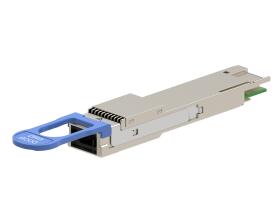
The manufacturer’s optical portfolio includes multiple pluggable families. An example 800G design distributes bandwidth among eight 100 Gb/s lanes; other designs employ different lane arrangements or wavelength multiplexing. A common link between switches uses a transceiver at each endpoint, so module counts cannot automatically be interpreted as completed links. Reach, optical budget, fiber type and connector compatibility must all match. Our ScaleFibre 1.6T optics coverage examines the next bandwidth class.
Why laser diodes receive a separate commitment
The subsequent laser purchases amount to approximately 31.8% of the announced $2.2 billion minimum. Conventional pluggable optics place optical components inside a removable module at the equipment faceplate. Co-packaged optics, or CPO, instead position optical engines near the switching ASIC, reducing the distance that high-speed electrical signals must travel. External laser sources can feed light to nearby modulators while keeping laser modules accessible for servicing. The precise architecture varies among implementations.
AOI expects some contracted lasers to serve CPO systems beginning in 2028. That expectation is not evidence of a commissioned customer network. The earlier OIF interoperability projects show why electrical interfaces, optical sources and module management specifications matter for such designs.
Manufacturing capacity determines delivery
AOI plans to begin supplying an agreed quantity of US-made products in early 2027 and increase output during the year. The company also disclosed a $2 million qualification expense that it will fund. Customer discussions indicate possible demand above $10 billion over the agreement period, but the manufacturer explicitly distinguishes that forecast from additional binding orders. Independent trade reporting corroborates the announced purchase commitments.
For network deployment teams, useful indicators include qualified module shipments, optical failure rates, lead times, manufacturing yields and the actual availability of compatible optics. Long-term contracts can improve supply visibility without eliminating qualification or production risk. Alongside investment in fiber-array manufacturing, AOI’s agreement highlights the need to expand the optical supply chain as AI infrastructure scales. Realized shipment volumes, not headline demand forecasts, will determine how much new network capacity the agreement ultimately supports.


Leave a Reply