
ScaleFibre has introduced a family of pluggable optical transceivers spanning 10 Gb/s to 1.6 Tb/s and opened an early-access program for near-packaged optics (NPO). The Dallas-based supplier announced the expansion on November 11, 2026, following a partnership with an unnamed silicon-photonics manufacturer. The partner designs and manufactures the optical modules; ScaleFibre supplies them alongside fiber connectivity. The pluggable range is available now, while NPO is an early-access development effort, not an announced volume-shipping product.
At the high end, ScaleFibre lists a 1.6T OSFP224 module that aggregates two independent 800G links in a single faceplate slot. Its twin-port 2×DR4 design uses two MPO-12 interfaces and supports links up to 500 meters over single-mode fiber. An alternative 2×FR4 configuration uses two duplex-LC ports and reaches a claimed 2 kilometers. For the underlying terminology, see BitcoinVersus.Tech’s guide to optical transceivers.
Authentic demonstration of a 1.6T OSFP 2×DR4/DR8 optical transceiver, including dual MPO connectors and diagnostic monitoring. Credit: FiberMall/YouTube, June 15, 2026. The demonstrated hardware is not identified as ScaleFibre’s product.
Power figures depend on the optics design
ScaleFibre’s published OSFP224 product specifications distinguish a 19 W transmit-retimed Ethernet 2×DR4 variant from a 24–27 W fully-retimed Ethernet variant. A fully-retimed InfiniBand XDR configuration is listed at 33.5 W. The vendor separately lists a 2×FR4 Ethernet option at no more than 21 W. Those are module-level supplier specifications, not independently tested complete-link power measurements.
A transmit-retimed optic handles electrical signal conditioning differently from a fully-retimed design, creating a trade-off among energy use, error margin and deployment flexibility. An engineer comparing the modules must check the host switch’s electrical interface, firmware, error-correction support and thermal allowance. Form-factor resemblance alone does not guarantee port compatibility, as discussed in the site’s OSFP versus QSFP-DD compatibility lesson.
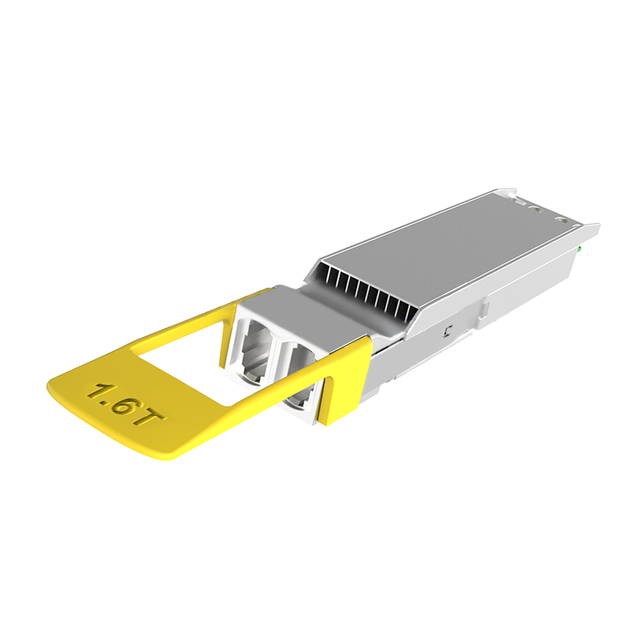
Why two 800G links do not mean 1.6T per port
The aggregate 1.6 Tb/s rating comes from eight nominal 200G electrical lanes; it does not mean each DR4 output independently carries 1.6T. Each optical port supplies 800G, and both together occupy one 1.6T host slot. ScaleFibre advertises vendor coding options for NVIDIA, Cisco, Juniper and Arista, among others. EEPROM coding may help identification, but actual interoperability still requires switch-specific validation, including supported breakout modes, optics management and forward-error correction.
The company says its product family can support AI training fabrics, cloud networks and metro connectivity. Bandwidth demand is substantial, but reach and application vary: a 500-meter DR4 rack-to-rack connection is not equivalent to a long-haul coherent optical service. For comparison, Uniti and Nokia’s 800G trial concerned a geographically separated carrier service, not a local twin-port OSFP module.
Marvell Technology explains an eight-lane 1.6T DR8 silicon-photonics integrated circuit and supporting digital signal processing. Credit: Marvell Technology/YouTube, April 10, 2026. The video illustrates relevant optical technology, not ScaleFibre’s unnamed manufacturing partnership.
Near-packaged optics are a different development stage
Near-packaged optics move optical engines from removable faceplate transceivers toward the switch ASIC package, shortening high-speed electrical paths. ScaleFibre expects to supply NPO components and associated MPO assemblies, ribbons and ThinSHUFFLE fiber-routing products through an early-access program. The company did not disclose customer names, field results, shipping volumes or a general-availability date for NPO.
Packaging brings new challenges as well as possible energy savings. Designers must consider repairability, heat removal, fiber access, connector loss and lifetime reliability. The site’s earlier report on Coherent’s near-packaged PhotonLink platform illustrates a separate supplier approach. Standards work described in the Optical Internetworking Forum’s seven new projects underscores the importance of electrical and optical interoperability.
The verified commercial development is an expanded pluggable catalog, not evidence that NPO has replaced field-serviceable optics. Independent module testing, pricing, interoperation reports and volume-shipment data will determine how competitive ScaleFibre’s 1.6T offerings prove in production GPU clusters.
Sources and methodology
Primary references: ScaleFibre’s November 11 announcement; OSFP224 specifications and configuration table; optical transceiver family; pluggable product catalog; FiberMall’s physical-module demonstration; and Marvell’s silicon-photonics explainer. All power and reach values are attributed vendor specifications. No third-party interoperability or power test is claimed.
Editor’s Note: Reporting separates available ScaleFibre pluggable optics from its NPO early-access program. The silicon-photonics manufacturing partner was not named in the November 11 announcement. The original 1200 × 630 oil-painting cover depicts a conceptual network technician and optical module, not an actual ScaleFibre facility or employee. The in-story FiberMall photograph and two original-source YouTube videos illustrate relevant third-party hardware and photonics; they do not independently verify ScaleFibre’s advertised power, reach or compatibility. Embedded-player rendering and end-user playback are separate tests.
Support BitcoinVersus.Tech
Optional 5,000-satoshi contributions help fund independent reporting on networking and data-center engineering. Scan the original QR with a compatible Bitcoin wallet from a second device. On mobile, save the image and import it through a wallet that supports scanning stored QR images. Verify the recipient and amount before authorizing payment.

BitcoinVersus.Tech is volunteer-run and strives to ensure the information on its platform is verifiably true. Support is entirely optional. Confirm Bitcoin recipient 3C9o19EH5HSiwEPyCTmEKzxhNCbo2X6TTb and the intended 5,000-satoshi amount before sending. Bitcoin transactions are generally irreversible. Product specifications are informational and not an equipment certification or procurement guarantee.


Leave a Reply