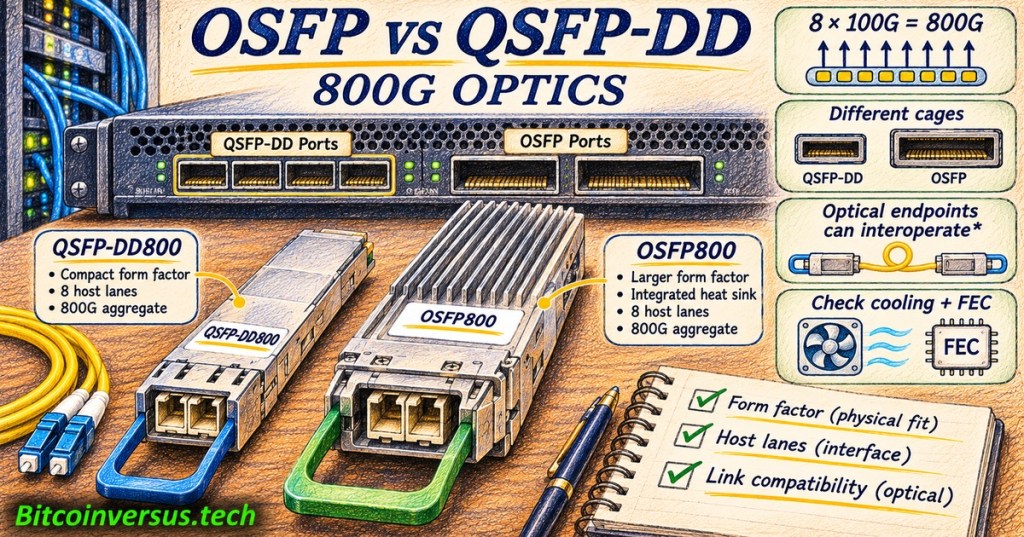
OSNTC.042 explains a common 800-gigabit data-center hardware mistake: treating OSFP and QSFP-DD as physically interchangeable because both can carry 800 Gigabit Ethernet. The labels describe distinct pluggable-module families, connector/cage systems and thermal arrangements. Two devices equipped with different cages may still communicate across a compatible optical link, provided each uses an approved local module and both endpoints implement the same optical Ethernet specification.
HUBER+SUHNER, “QSFP-DD vs OSFP Transceiver (04-04-03),” October 30, 2024. Manufacturer-hosted explanation of why two high-speed transceiver form factors coexist. Credit: HUBER+SUHNER / YouTube.
The cages are different
QSFP-DD800 extends the QSFP double-density family, using an eight-lane electrical interface while preserving a migration path for supported older QSFP modules. The Cisco QSFP-DD800 datasheet identifies host compatibility with supported QSFP+, QSFP28, QSFP56 and QSFP-DD 400G modules; platform recognition and approved speed remain separate requirements.
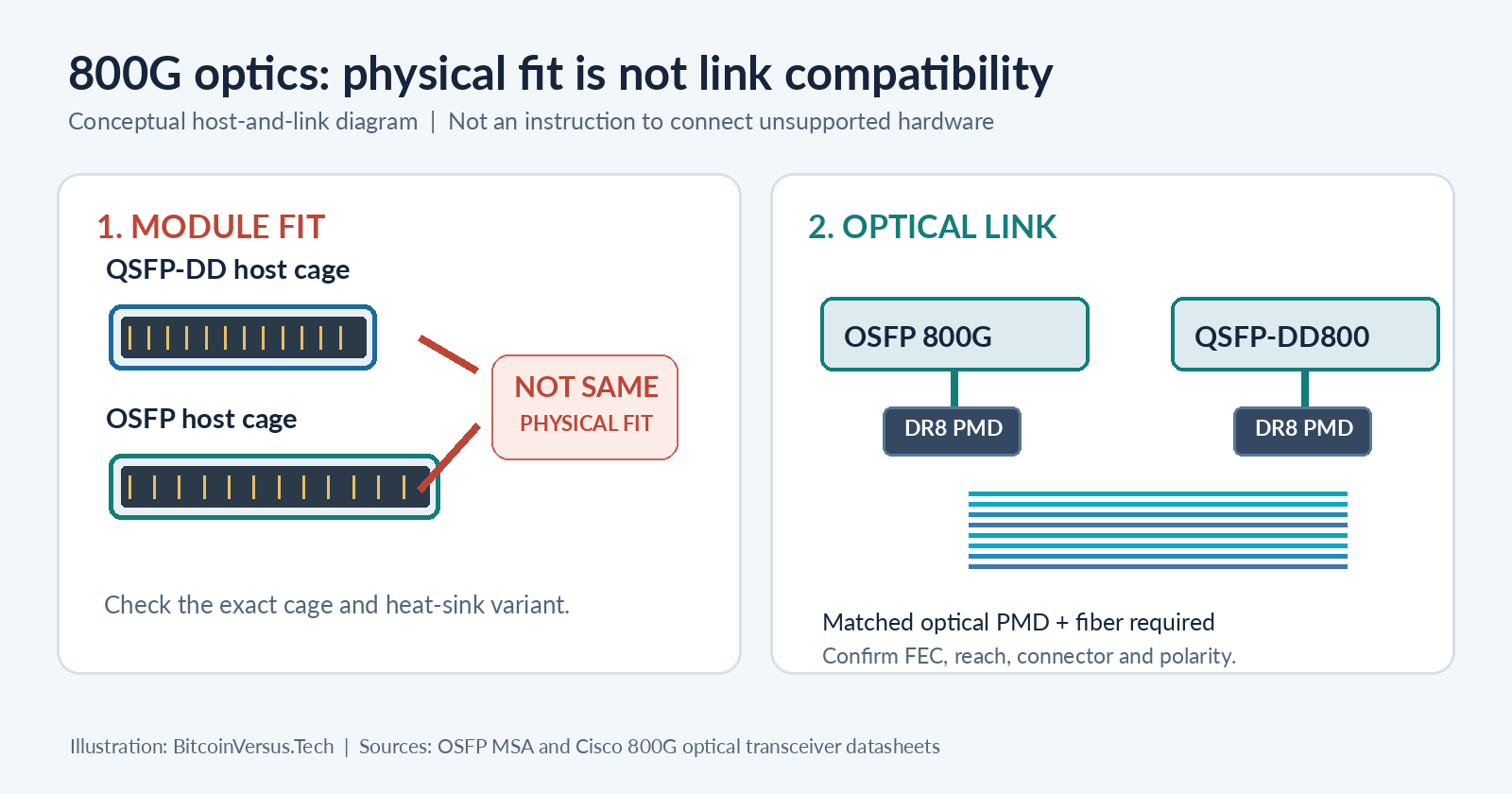
OSFP800 uses the larger Octal Small Form Factor Pluggable mechanical family. The OSFP MSA Revision 5.22 distinguishes variants with an integrated heat sink from OSFP-RHS, which relies on a riding heat sink in the host. OSFP and OSFP-RHS cages are mechanically keyed for their intended module styles. An OSFP optical engine cannot simply be inserted into a QSFP-DD slot, and even two OSFP-family modules may require different cages.
Eight electrical lanes do not define every optical design
A conventional 800G host attachment can use eight 100-Gb/s-class electrical lanes, or 8 × 100 Gb/s = 800 Gb/s of aggregate Ethernet capacity. Those units are gigabits, not gigabytes; dividing by eight gives a nominal 100 GB/s before protocol overhead. The host electrical lane count must not be confused with the number of fibers or optical wavelengths. Some modules transmit parallel optical lanes; coherent modules can aggregate traffic into a different optical architecture.
Cisco lists both OSFP and QSFP-DD800 modules supporting 800GE and selected 2×400GE, 4×200GE or 8×100GE breakout modes. Breakout capability depends on the exact optic, host ASIC, firmware, interface configuration and cabling. For the physical signaling background, see OSFOEC.004 on PAM4.
When mixed ends can communicate
Suppose one switch has an approved OSFP 800GBASE-DR8 module and the peer has an approved QSFP-DD800 800GBASE-DR8 module. The endpoints may interoperate over correctly arranged single-mode fiber because their optical physical-medium-dependent (PMD) interfaces match, even though their host-side shells differ. Cisco documents DR8 optical interoperability regardless of module form factor. The connector type, fiber count, MPO gender/polish, polarity, reach, receive-power budget and host FEC mode must still satisfy the respective product specifications.
The same caution applies to SR/VR, FR and coherent optics: matching an advertised aggregate rate does not establish an optical match. OSFOEC.003 on optic selection examines reach, wavelength, media and interoperability checks. OSNTC.041 covers FEC compatibility and error counters.
QSFPTEK, “How to Interconnect OSFP and QSFP DD Ports in 400G800G AI Networks,” June 18, 2026. Manufacturer demonstration of cross-form-factor optical links, direct-attach and breakout options; confirm compatibility per equipment vendor. Credit: QSFPTEK / YouTube.
A technician’s read-only acceptance checklist
- Record the exact switch or adapter model, installed port type, operating software and approved module product IDs.
- Confirm integrated-heat-sink versus riding-heat-sink cage rules and sufficient power/airflow for each optic.
- Match the full optical PMD, fiber type, connector, lane mapping, polarity and allowed reach across both ends.
- Verify reported speed, breakout mode, FEC, optical power and error counters without changing production settings.
- Follow OSFOTC.010 installation guidance for inspection and controlled troubleshooting; never force an optic into an incompatible cage.
The operational lesson is simple: mechanical interchangeability, host support and optical interoperability are different tests. A correct connector shape cannot guarantee a healthy link, and a standards-compatible optical link does not make two pluggable shells interchangeable.
Primary references: OSFP MSA, Module Specification Rev 5.22 (August 9, 2025); Cisco OSFP 800G Datasheet (January 5, 2026); Cisco QSFP-DD800 Datasheet (2026). Module installation and compatibility always remain platform-specific.
Editor’s Note: OSNTC.042 is a focused educational continuation of the published Ethernet FEC and optical-transceiver lessons, not an announcement of a new interface standard. Electrical rates and mechanical requirements were cross-checked against MSA and Cisco documents; the 8 × 100 Gb/s calculation represents an aggregate nominal rate rather than application throughput. The original 1200 × 630 colored-pencil cover bears the neon-green Bitcoinversus.tech watermark, and the in-story interface drawing is conceptual. Official supplier video titles were checked against public YouTube listings; WordPress iframe rendering and actual playback are separate verification steps. No production hardware was installed, modified or tested.

BitcoinVersus.Tech is volunteer-run and publishes independent technical education. An optional 5,000-satoshi donation supports further research. Scan the original QR from a second screen using a compatible Bitcoin wallet. On the same phone, use a wallet able to import a saved QR image when supported. Independently verify recipient 3C9o19EH5HSiwEPyCTmEKzxhNCbo2X6TTb and 5,000 sats before sending; Bitcoin transfers are generally irreversible.
We volunteer daily to ensure the information on BitcoinVersus.Tech is Verifiably True. The material is for education and information, not an authorization to change production-network hardware, certified engineering advice, financial advice or investment advice.


Leave a Reply