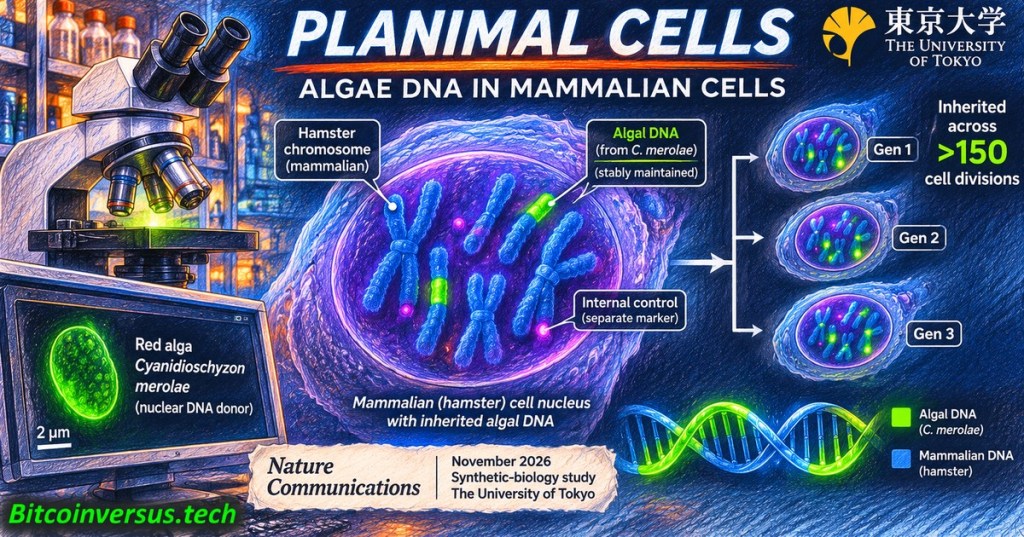
Japanese researchers have created experimental mammalian cells capable of retaining extensive algal DNA through more than 150 cell generations. The team fused the single-celled red alga Cyanidioschyzon merolae with cultured animal cells and recovered a hamster-derived line containing approximately 16.3 million base pairs of algal nuclear DNA. The findings, published in Nature Communications on November 12, 2026, demonstrate genome-scale transfer of genetic material between evolutionarily distant eukaryotic cells. The resulting “planimal” cells did not become photosynthetic.
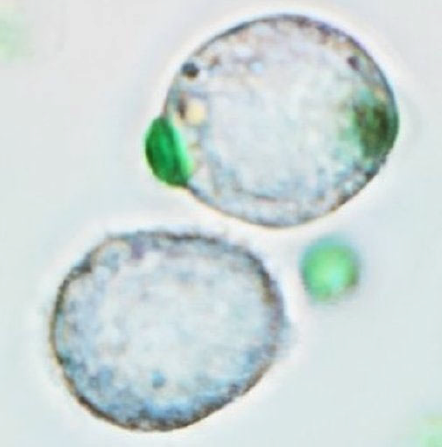
A compact 20-chromosome alga enters a mammalian cell
The researchers used an alga with a compact nuclear genome organized into 20 chromosomes. Polyethylene glycol helped merge algal and Chinese hamster ovary cells. Sequencing and fluorescent chromosome imaging showed algal DNA within the mammalian nuclear environment, including regions connected to hamster chromosomes. Lower-frequency transfer also occurred when host cells engulfed intact algae. The researchers call the resulting cultured hybrids “planimal cells,” combining plant and animal terminology; no organism was bred or produced by reproduction between species.
The experiment required more than detecting foreign DNA once. One laboratory line continued dividing to the 155th generation with algal DNA retained. Substantial imported sequences persisted for 95 generations without antibiotic selection, offering evidence of inheritance beyond short-term fusion. Techniques described in BitcoinVersus.Tech’s DNA-sequencing guide provide background for distinguishing transferred genetic material from microscope-only observations.
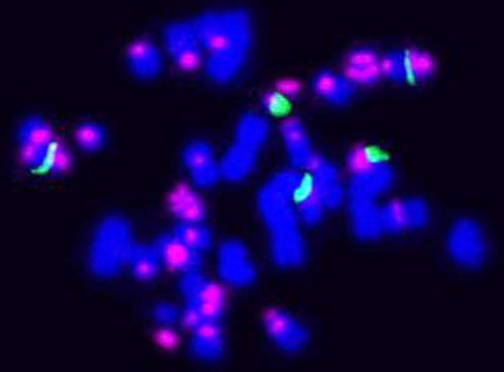
The key finding is gene silencing
The foreign genome did not simply begin operating as an algal program inside the hamster cells. RNA sequencing found approximately 96% of 4,770 imported protein-coding genes lacked detectable expression under the tested conditions. The DNA acquired methylation and repressive histone modifications associated with quiet chromosomal regions. Researchers describe the process as epigenetic gatekeeping: the host can tolerate large quantities of unfamiliar DNA while restricting most of its activity.
When scientists disabled the mammalian DNA-methylation enzyme DNMT3A, stable establishment and retention of the imported genome fell. The intervention supports a role for methylation in maintenance, but does not prove DNMT3A causes the initial chromosome-fusion event. Related genetic techniques differ from targeted gene-editing approaches, such as the early CRISPR clinical research covered by BitcoinVersus.Tech.
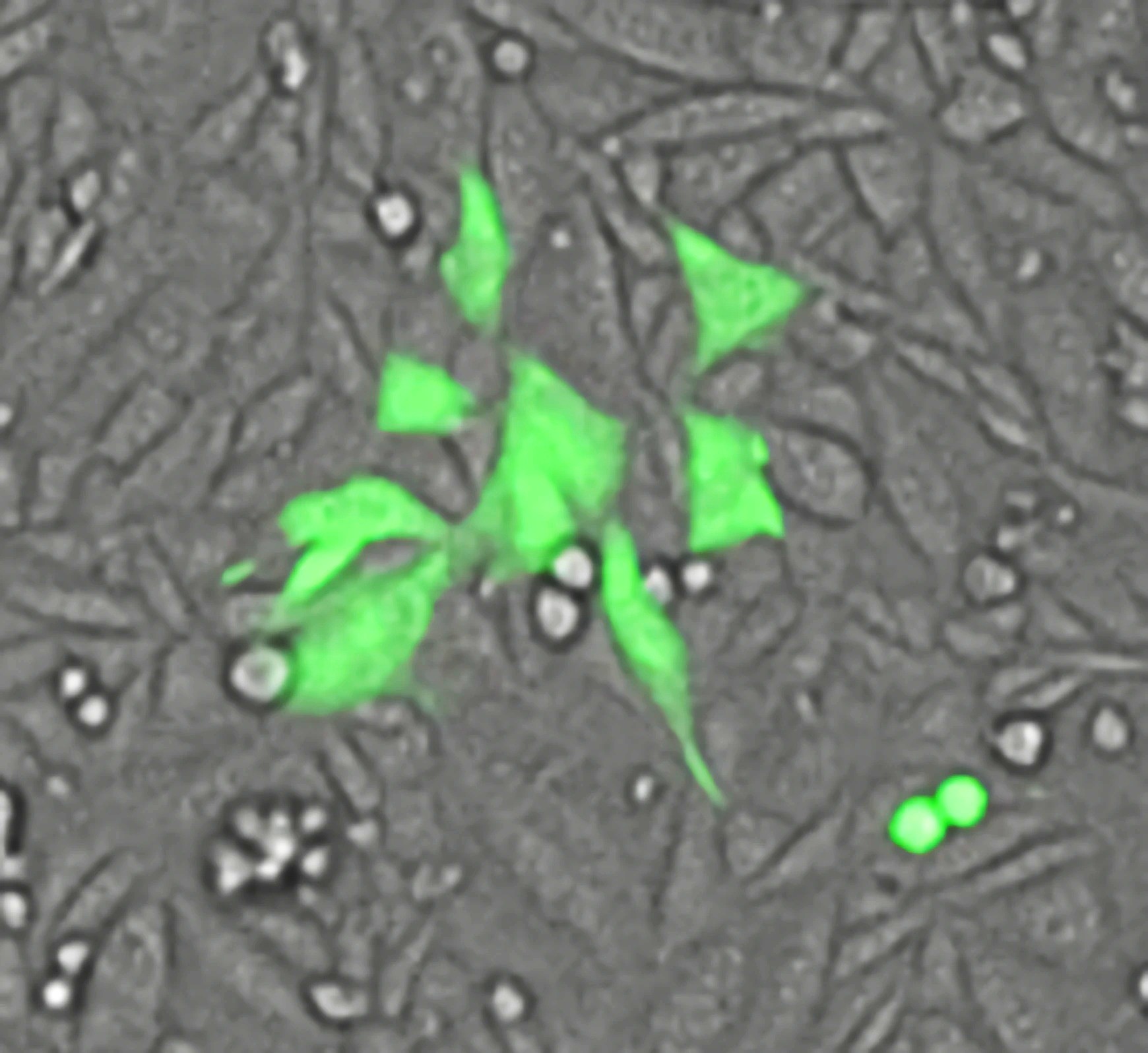
No photosynthetic hamster cells were demonstrated
Scientists ultimately hope to activate selected imported pathways for biomanufacturing, carbon utilization or other metabolic functions. The present experiments establish DNA transfer and maintenance—not a self-feeding animal cell, commercial production system or new medical treatment. Earlier work from the group kept transplanted chloroplasts photosynthetically active for a limited period, but stable photosynthesis requires substantially more than simply retaining an algal nuclear genome.
The work fits a broader effort to combine biology and advanced engineering. BitcoinVersus.Tech has separately examined living neurons grown with silicon computing systems and genomics analysis powered by AI. Neither development should be confused with the new cell-fusion result: the Tokyo team demonstrated a physical genome-transfer mechanism, not a machine-learning prediction.
The university’s November 13 research statement also describes future possibilities for expressing selected algal proteins and reducing biological manufacturing costs. Such outcomes are projections that require experimental verification. The fluorescence images deserve careful interpretation, especially after recent debate over authenticity standards for scientific microscopy; all three photographs above were obtained from the university’s actual study release.
Bottom line: Mammalian cells demonstrably retained chromosome-scale algal DNA across many divisions. Their ability to inherit foreign genetic material is the discovery. Any useful algal metabolism inside those cells remains an open research challenge.
Primary sources and method: Aoki et al., Nature Communications 17, 11571, published November 12, 2026; DOI 10.1038/s41467-026-78753-w; University of Tokyo English-language research announcement, November 13, 2026. Generation counts refer to laboratory cell divisions, not animal generations. The 96% figure describes transcription below detection thresholds in the measured cell line, not destruction of imported genes.
Editor’s Note: The study demonstrates experimental transfer and retention of algal nuclear DNA inside cultured mammalian cells. No photosynthetic animal, clinical treatment or commercial bioprocess resulted. The featured colored-pencil illustration is original conceptual art and not microscope footage. Three authentic university microscopy images are individually credited and labeled. No official, event-specific video or social post could be independently verified for functioning playback; none was fabricated or presented as confirmed.

BitcoinVersus.Tech is volunteer-run. To support independent research, scan the original QR code using a compatible Bitcoin wallet from another screen. When viewing on a mobile phone, use the wallet’s saved-image scanning feature if available. Independently verify destination address 3C9o19EH5HSiwEPyCTmEKzxhNCbo2X6TTb and optional amount of 5,000 satoshis. Bitcoin payments are generally irreversible.
We volunteer daily to ensure information on BitcoinVersus.Tech is Verifiably True. All reporting is educational and informational, not individualized financial, investment or medical advice.


Leave a Reply