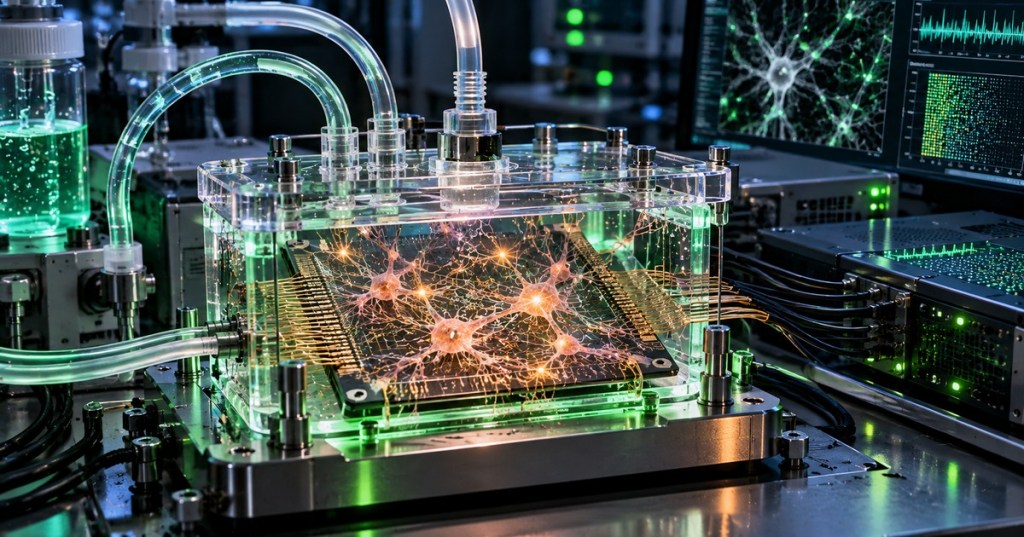
Australian biotech company Cortical Labs is building computers that combine living human neurons with silicon electronics. Its CL1 platform grows neural cells directly on a custom chip, where electrodes send signals into the network and record the neurons’ electrical responses.
Cortical Labs markets the idea as “Actual Intelligence” rather than artificial intelligence. That phrase is branding, not evidence that the system thinks like a person. The technical breakthrough is more specific: researchers can now deploy software into a closed loop with a living neural network and study how that network adapts.
What The CL1 Actually Is
Cortical Labs describes the CL1 as the world’s first code-deployable biological computer. Living neurons grow in a nutrient-rich environment across a silicon chip equipped with electrodes that can stimulate the cells and record neural activity.
The device includes the support hardware needed to maintain the culture, including fluid handling, temperature control, gas regulation, recording electronics, and software. Cortical says the system can maintain cultures for months while applications interact with the neurons in real time.
Silicon Talks To The Neurons
The silicon side supplies the digital interface. Software converts information from a task into patterns of electrical stimulation. The neurons react, generate their own electrical activity, and those responses are recorded back into the program.
Cortical’s Biological Intelligence Operating System, or biOS, manages that closed loop. Developers can use a Python API to record activity, stimulate the culture, and build experiments around the biological neural network.
That is very different from the conventional CPU architectures used in normal computers. In a CPU, logic and memory are implemented entirely in electronic hardware. CL1 adds a living adaptive layer to that electronic stack.
From Pong To A Programmable Product
Cortical Labs first became widely known for its DishBrain work, in which cultured neurons were placed inside a closed-loop Pong environment and changed their activity as they received feedback.
CL1 packages that research into a self-contained platform that outside developers and laboratories can access. The company also offers Cortical Cloud so researchers can run code against biological hardware remotely rather than maintaining the cells themselves.
Nature Physics: “Life In The Machine”
A September 2026 Nature Physics article highlighted Cortical Labs as an example of bringing real biological neurons directly into contact with silicon hardware. One motivation is energy efficiency: biological brains perform complex information processing with dramatically less electrical power than modern large-scale AI infrastructure.
The comparison is not one-to-one, because brains and GPU clusters solve different problems. But the energy gap is a major reason researchers are exploring biological and neuromorphic approaches.
BitcoinVersus.Tech explored the same efficiency problem from another direction in How Close Can Computer Memory Get to Physics’ Energy Limit? Conventional systems spend substantial energy moving data among processors, memory, and interconnects, while biological neurons combine learning, storage, and processing locally.
Is “Actual Intelligence” Really AI?
The better technical description is Synthetic Biological Intelligence: a hybrid system that uses biological neural networks as part of the information-processing hardware.
Artificial neural networks imitate selected properties of biology in software. Cortical Labs starts with the biological neurons and builds the silicon interface around them.
Why The Energy Question Matters
AI hardware is becoming an enormous electricity load because modern models depend on GPUs, high-bandwidth memory, networking, cooling, and dense data-center power systems. Biological neurons operate under a completely different energy budget.
That does not mean a CL1 is about to replace an Nvidia rack. Biological systems are slower and harder to standardize for many conventional computing tasks. Their potential advantage is adaptability and learning efficiency rather than brute-force arithmetic throughput.
BitcoinVersus.Tech recently explored that tradeoff in our look at neural architecture versus ASIC-style computing.
Medicine May Be The Near-Term Killer App
The most immediate value may be medical research. A programmable network of living human neurons could help researchers study neurological disease, neural learning, drug response, and cell behavior in ways that ordinary silicon cannot reproduce.
The concept also overlaps with brain-computer interface technology, but in reverse. Instead of connecting electronics to a person’s nervous system, the CL1 grows a neural network directly on the computing hardware.
The Ethical Questions Grow With The Technology
Today’s neural cultures are vastly simpler than a human brain, and there is no evidence that a CL1 has human-like awareness. Still, biological computing creates ethical questions that ordinary semiconductor development does not.
As researchers build larger and more complex living networks, the field will need clear standards for experimental design, cell sourcing, monitoring, and the point at which additional ethical review becomes necessary.
Silicon Is Not Going Away
CL1 itself still depends on silicon electronics, software, networking, pumps, sensors, and laboratory hardware. The likely future is therefore hybrid computing rather than biology replacing semiconductor technology.
Silicon can handle fast deterministic digital operations while biological networks are used where adaptation and learning offer something different.
Actual Intelligence Is Now Programmable Hardware
The headline sounds like science fiction, but the hardware is real: living human neurons are growing on silicon, receiving electrical inputs, generating outputs, and changing their behavior through experience.
Artificial intelligence spent decades imitating biological neural networks in software. Cortical Labs is testing the opposite approach: keep the biology, then build the computer around it.
BitcoinVersus.Tech
Editor’s Note
We volunteer daily to ensure the credibility of the information on this platform is Verifiably True.
BitcoinVersus.tech is not a financial advisor. This media platform reports on financial, scientific, and technology subjects purely for informational purposes.


Leave a comment