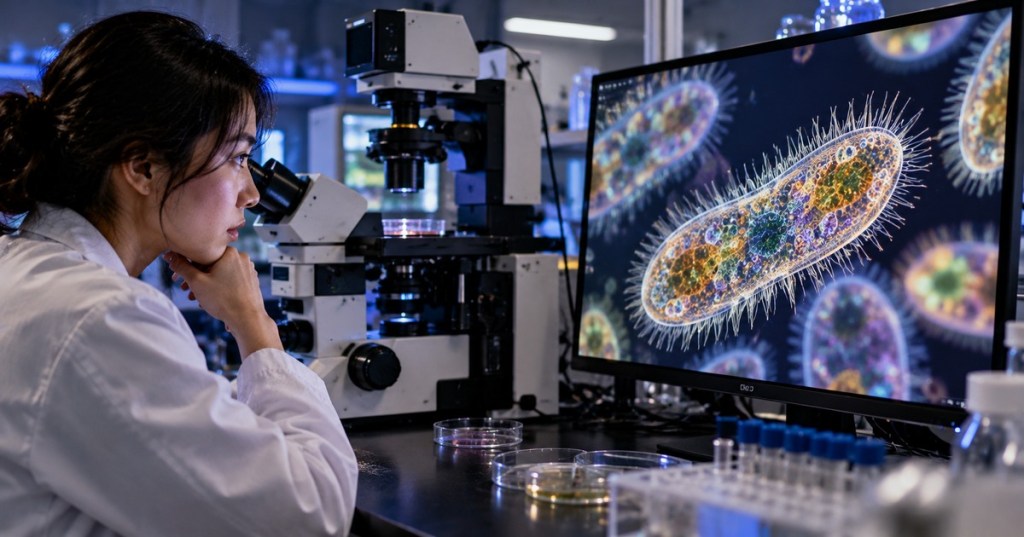
Nikon has stripped the first-place prize from its 2026 Small World in Motion microscopy competition after concluding that the winning video did not comply with the contest’s rules on generative AI.
In its official statement, Nikon said it re-evaluated the video and supporting materials, consulted members of the judging panel, and adjusted the rankings. The company stressed that the decision concerned eligibility under the competition rules and was not a judgment of the entrant’s professional reputation, scientific contributions, or intent.
The disqualified entry by optical researcher Ning Xu had originally taken first place for a video presented as abnormal beating of airway cilia from a child with primary ciliary dyskinesia, a rare genetic condition that affects the tiny hair-like structures responsible for moving mucus and debris out of the airways.
The new winner is a microscopic fight caught on camera
Vietnamese researcher Nguyen Nam Nhat has moved from second place to first. His 52-second video shows a tiny roundworm interacting with a single-celled organism called a Dileptus under 40× differential interference contrast microscopy.
The new winner matters because it brings the contest back to its core premise: capturing something that actually happened through a light microscope. Nikon’s competition rewards originality, informational content, technical proficiency, and visual impact, but the underlying footage still has to represent real microscopy rather than synthetic visual content.
Scientists questioned whether the images matched real biology
Concerns began when microscopy researchers noticed structures that appeared to change, disappear, or move in ways they said did not match expected cell biology. Xu acknowledged using an AI model during post-processing, while maintaining that AI had not generated the original experimental movie, the cilia, or their motion.
Ars Technica reported that researchers also raised questions about what appeared to be AI-associated artifacts and that Nikon ultimately concluded the submitted video crossed the competition’s generative-AI boundary.
AI itself is not the problem
The controversy is not a simple “AI versus microscopy” story. Modern microscopy already uses machine learning for denoising, segmentation, reconstruction, object detection, and image analysis. Nikon itself sells AI-assisted imaging software.
The key distinction is whether software helps researchers extract information that is present in the measured data or introduces structures that the instrument never actually recorded. That boundary matters more in scientific imaging than in ordinary creative photography because a microscopy image can function as evidence.
Why raw data matters
Microscopy always involves processing. Cameras capture signals, software reconstructs images, researchers adjust contrast, and advanced techniques can combine multiple measurements into a clearer representation. The scientific question is whether each transformation stays traceable to the underlying measurement.
That verification mindset applies across imaging technologies. BitcoinVersus has previously explained how scanning electron microscopy builds images from electron interactions and how transmission electron microscopy reveals structures by passing electrons through extremely thin samples. Small World in Motion uses light microscopy instead, but the same principle holds: the displayed result should remain defensible against the raw measurement.
The problem also resembles a broader authenticity issue BitcoinVersus covered in 2024 when AI-generated deepfake videos raised questions about what viewers can trust. Scientific imaging raises the stakes because an image can shape conclusions about biology, disease, or experimental results.
Nikon says the rules need another look
Nikon’s current rules already say AI-generated videos are not permitted and allow organizers to request original footage for verification. Even so, the company now says advances in imaging and artificial intelligence are creating new challenges and that both Small World competitions need to revisit their rules and evaluation procedures.
That may be the lasting consequence of this episode. “No AI-generated video” sounds clear until modern reconstruction, denoising, segmentation, false coloring, predictive imaging, and generative tools begin to overlap. Future competitions may need much more specific disclosure rules describing exactly which algorithms touched the data and what each one changed.
What comes next
Nguyen Nam Nhat is now the 2026 Small World in Motion winner, while the rest of the rankings have moved up accordingly. For microscopy competitions and research labs, the larger challenge is provenance: preserving raw data, documenting processing steps, and making sure increasingly powerful AI tools clarify measurements rather than silently replacing them.
Editor’s Note: Nikon’s decision concerns competition eligibility. BitcoinVersus.Tech is not making an independent finding about the entrant’s intent or scientific record.
Support independent technology reporting: Bitcoin donations help fund BitcoinVersus.Tech research and publishing.
Disclaimer: BitcoinVersus.Tech provides technology news and analysis for informational purposes only.


Leave a Reply