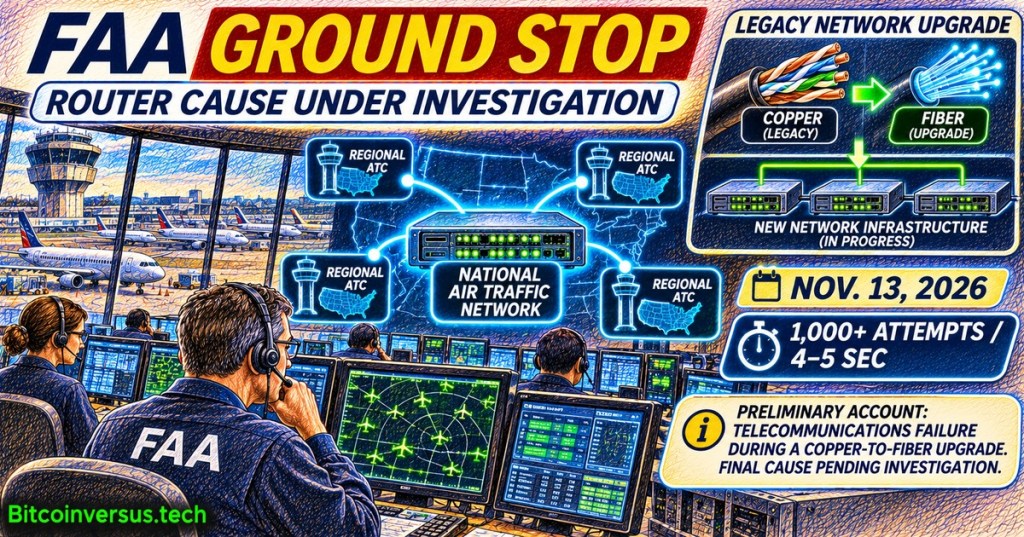
A telecommunications problem during an air-traffic network upgrade led the Federal Aviation Administration to stop departures across the United States on November 13, 2026. In a November 14 briefing, Transportation Secretary Sean Duffy said a router involved in a copper-to-fiber transition generated more than 1,000 connection attempts every four to five seconds, interfering with communications and radar-data delivery. Investigators have not established whether faulty hardware, an installation error or another specific defect caused the incident.
CBS News coverage of the November 14 press briefing on the nationwide FAA ground stop. The video identity and date appear on CBS News’ own Paramount publisher page; it documents officials’ preliminary account, not a completed technical root-cause investigation. Credit: CBS News / YouTube.
A local network change, nationwide consequences
Duffy said L3Harris, the longtime FAA telecommunications contractor, was replacing an aging copper connection with fiber at a remote location. The modernization shifts traffic away from legacy time-division-multiplexed communications toward IP-based networking. Affected equipment then reportedly overwhelmed other routers with repeated connection attempts, creating unstable data at regional air-traffic facilities.
The reported rate translates to more than roughly 200–250 connection attempts per second, assuming the interval and count are representative. Officials have not published packet captures, router logs, the connection protocol or a complete network topology. The volume alone therefore cannot establish a denial-of-service attack, malicious activity or a particular router firmware flaw.
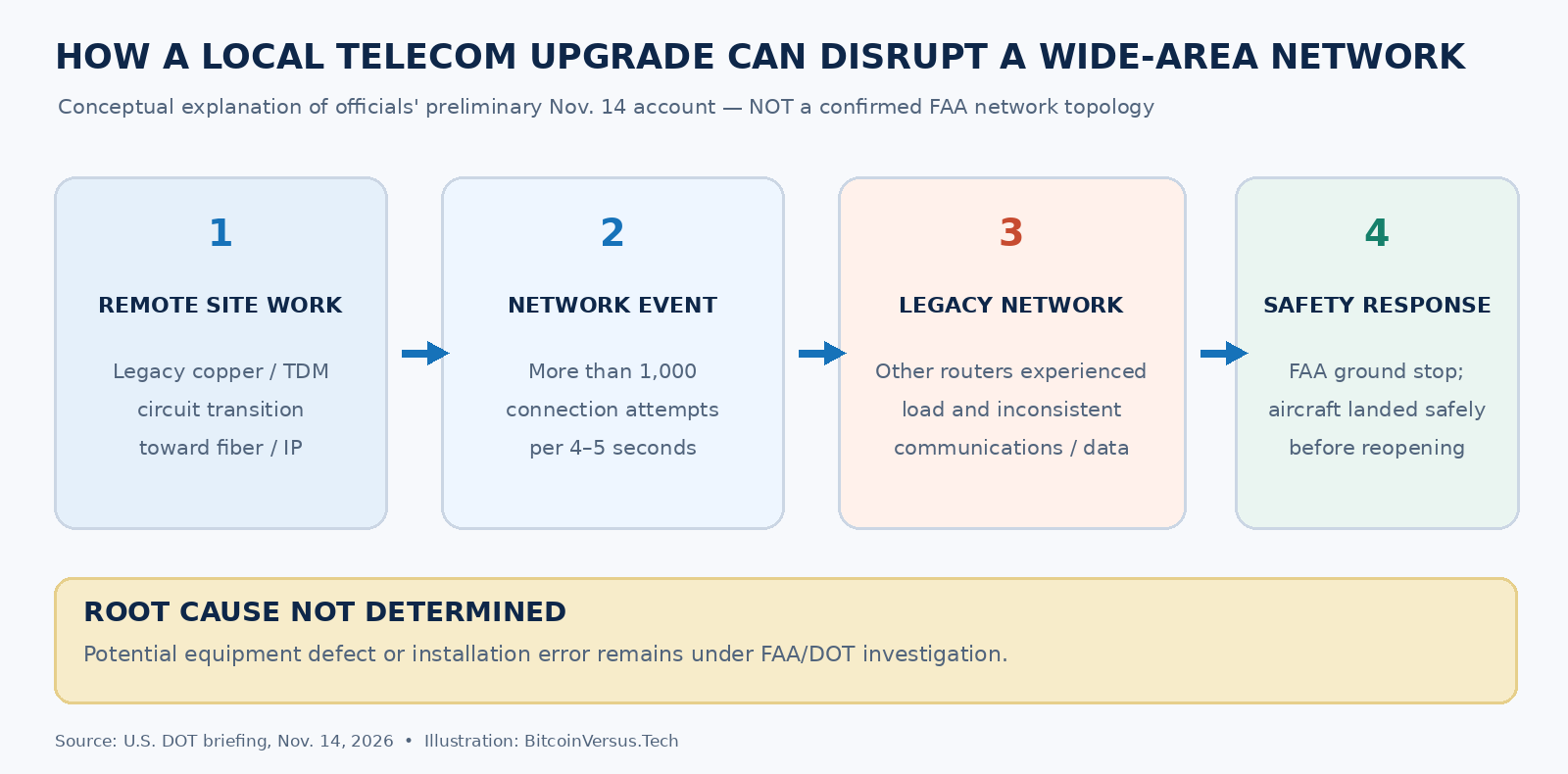
Reuters reported that communications at 17 of 22 en route centers were affected. The FAA stressed that the centers did not go completely dark: inconsistent radar and voice-data availability was enough to make normal departures unsafe. The agency used established safety procedures while controllers and pilots safely recovered approximately 3,500 aircraft already in the air.
The FAA reopened airspace but airlines still faced delays
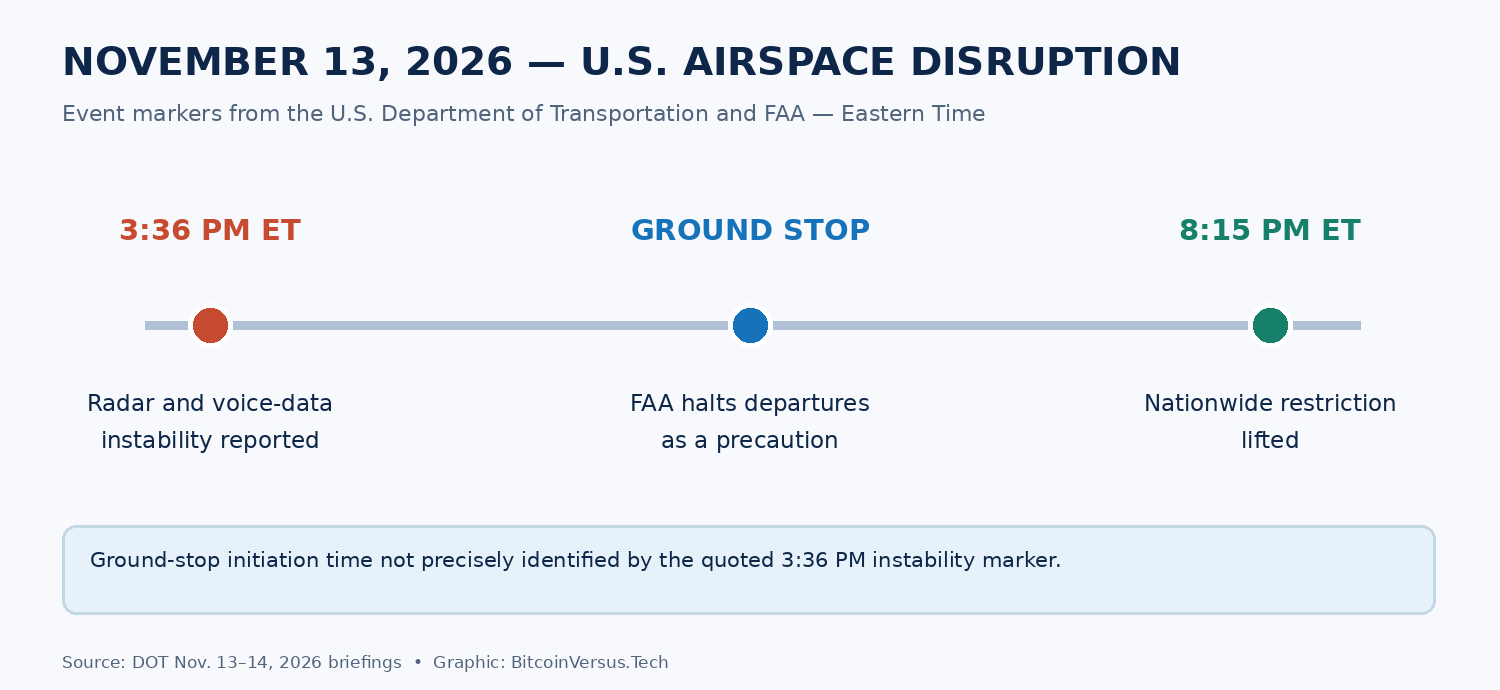
The FAA recorded radar and communications instability beginning around 3:36 p.m. Eastern Friday. The nationwide restriction was lifted at approximately 8:15 p.m. Eastern, confirmed in a formal FAA Command Center advisory timestamped 01:19 UTC November 14. The earlier instability timestamp is not necessarily the precise moment the ground stop began.
The Department of Transportation said more than 8,000 flight operations resumed on Friday night after reopening, though stranded crews, displaced aircraft and airline schedules continued to cause delays and cancellations. The FAA said its separate SMART airspace-management software was not connected to the failed legacy telecommunications equipment; officials also reported no evidence suggesting a cyberattack. Neither statement replaces a completed public technical investigation.
Why replacing an old router is not a routine risk-free task
Network change management matters because legacy and modern systems can share dependencies even when facilities appear physically distant. Device compatibility, configuration validation, rate limiting, monitoring, rollback capability and failure-domain isolation must all be tested before broad deployment. BitcoinVersus.Tech previously covered an earlier FAA backup-network failure and the difference between redundant links and truly independent paths.
Our router fundamentals guide explains forwarding between networks, while Ethernet storm control concerns a related but distinct class of excessive Layer-2 traffic. The FAA account does not identify Ethernet broadcasts, so the problem must not be labeled a broadcast storm without evidence.

The operational response also echoes fiber restoration procedures and incident-command practices: isolate the failing change, verify recovery across dependent services and publish findings without assuming the first plausible explanation is final.
L3Harris said it was cooperating with the FAA investigation and had completed more than 70% of its planned copper-to-fiber transition. The company’s own FTI infrastructure description describes resilient multi-carrier networking, but the November incident demonstrates that published design goals do not prove every change is isolated from wider services.
Bottom line: The nationwide ground stop was a verified safety response to telecommunications instability. The network-upgrade context and reported connection flood are established in official briefings; the equipment fault, configuration error and exact causal chain remain under investigation.
Primary sources: FAA statement, November 13; DOT and FAA press conference transcript, November 14; DOT reopening briefing, November 13; FAA ground-stop cancellation advisory, November 14; Reuters independent reporting, November 14; CBS News publisher-verified briefing video. Figures and technical claims are attributed to officials or named reporting; the approximately 200–250 attempts per second is arithmetic based on the reported interval.
Editor’s Note: Officials have not reached a final technical root-cause determination. The November 13 event should not be presented as a proven cyberattack, an identified router defect, or a specific protocol failure. The 3:36 p.m. ET instability marker does not conclusively establish ground-stop issuance time. The original 1200 × 630 colored-pencil cover, network diagram and timeline are conceptual editorial works; the CBS video and its thumbnail are authentic contemporaneous media, not views of the failed equipment. The editorial team verified the publisher’s video identity and checked WordPress rendering separately; actual end-user playback and mobile layout are not presumed. No unverified X embed is represented as a functioning player.

BitcoinVersus.Tech is volunteer-run and publishes independent educational technology reporting. An optional 5,000-satoshi donation supports ongoing research. Scan the original QR from a second screen with a compatible Bitcoin wallet; on mobile, use a wallet that supports scanning a saved image. Independently verify the recipient address 3C9o19EH5HSiwEPyCTmEKzxhNCbo2X6TTb and the payment amount before sending. Bitcoin transfers are generally irreversible.
We volunteer daily to ensure information on the BitcoinVersus.Tech platform is Verifiably True. Coverage is educational and informational and does not constitute financial or investment advice.


Leave a Reply