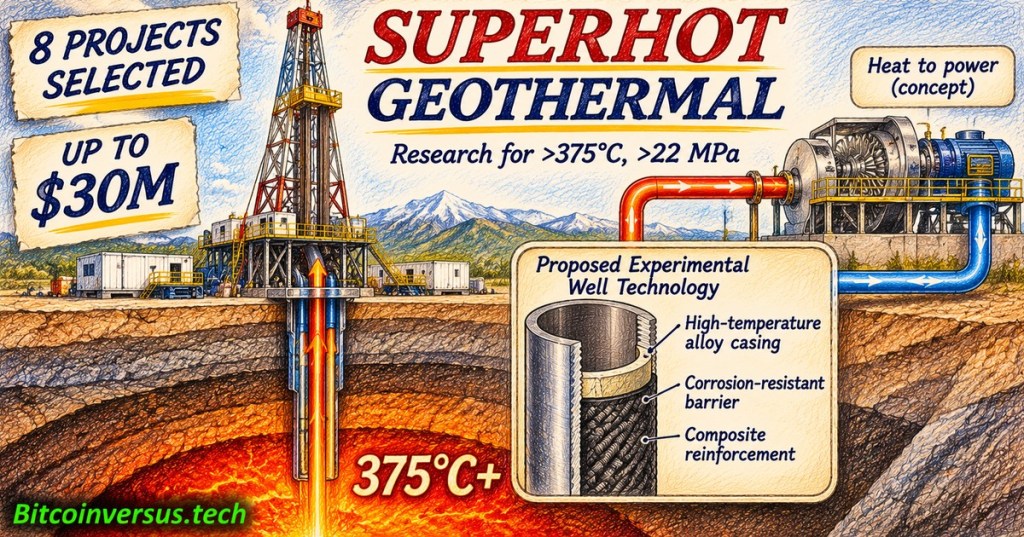
The U.S. Department of Energy’s Advanced Research Projects Agency–Energy (ARPA-E) announced on November 12, 2026 that eight research teams were selected for up to $30 million to develop superhot geothermal technology. The SUPERHOT program targets underground reservoirs hotter than 375°C and at pressures above 22 megapascals. The announcement marks research selections, not operating power capacity or completed grant payments.
Quaise Energy, “Hotter is Better | The Superhot Blueprint | Part 1,” April 15, 2025. Developer overview of the broader superhot-geothermal concept; Quaise is not among the eight teams named in ARPA-E’s November 2026 selection. Credit: Quaise Energy / YouTube.
Eight research selections, not eight power plants
Selected organizations are Blade Energy Partners, Lawrence Livermore National Laboratory, Los Alamos National Laboratory, the University of Oklahoma, Oak Ridge National Laboratory, the University of Southern California, XGS Energy, and Pacific Northwest National Laboratory. Their listed proposed funding amounts are $6.3 million, $5.5 million, $3.5 million, $3.1 million, $3 million, $3 million, $3 million and $2.6 million, respectively—a $30 million total.
ARPA-E explicitly cautions that selection for award negotiations is not a binding funding commitment; negotiations may be canceled. The distinction separates a research pipeline from commissioned geothermal generation. Earlier BitcoinVersus.Tech analysis of untapped energy sources outlined superhot rock’s theoretical appeal, whereas the latest agency action identifies specific engineering teams.
Heat extraction is only half the engineering problem
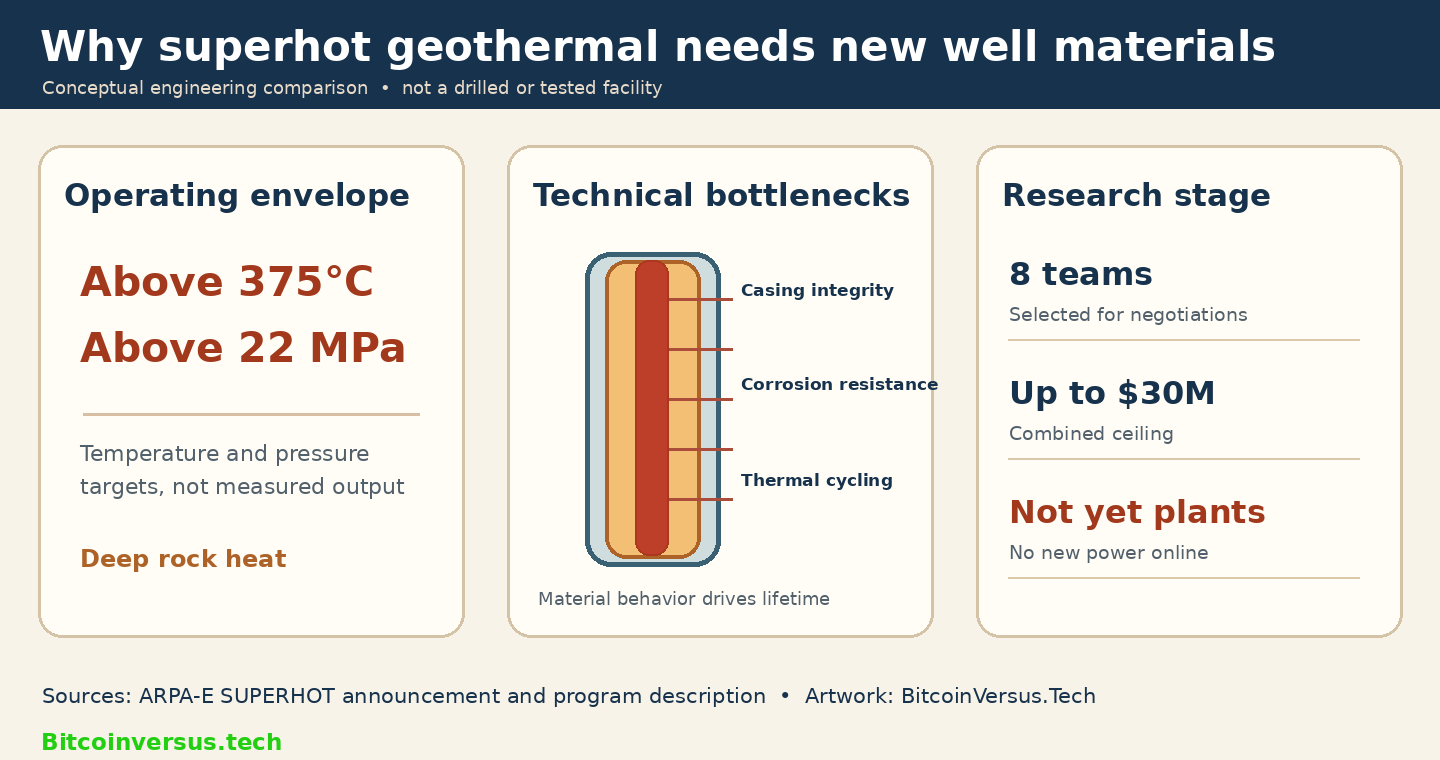
Conventional geothermal projects exploit accessible underground heat and natural or engineered fluid pathways. Higher-temperature rock could move more thermal energy through a well, but extreme conditions increase thermal stress, corrosive attack, material creep, and the challenge of maintaining pressure barriers for years. ARPA-E seeks designs capable of surviving 15 years or longer, rather than accepting short-lived laboratory performance.
Blade proposes advanced steel alloys, iron-chromium-aluminum alloys, ceramic liners and cement systems. Oak Ridge and USC will investigate composite casing concepts, while Los Alamos and Pacific Northwest National Laboratory plan testing and simulation systems for degradation and operating conditions. XGS Energy intends to evaluate conductive cement and well design for superhot service; Lawrence Livermore and Oklahoma will examine heat extraction and predictive modeling. The agency’s program description covers both well construction and heat-transfer pathways.
A target of 10–20 GW by 2040 remains conditional
ARPA-E says the development pathway could eventually support 10–20 gigawatts of geothermal baseload electricity at costs below $30/MWh by 2040. Those figures are program ambitions, not measured results, approved projects or a forecast guaranteed by funded work. The agency contrasts an estimated 15,000 GW of U.S. geothermal resource potential with less than 4 GW of existing utility-scale generation; geological potential is not economically dispatchable capacity.
For perspective, Fervo’s 396 MW power agreement involves a separate geothermal technology and commercialization pathway. Sage’s Nevada enhanced-geothermal plan offers another comparison. Neither is an award recipient under the new SUPERHOT selection.
TDC, “Enhanced Geothermal: A Groundbreaking Energy Source,” December 3, 2024. Independent reporting on drilling, engineered reservoirs and the Utah FORGE research facility; ordinary EGS operating temperatures should not be confused with ARPA-E’s superhot threshold. Credit: TDC / YouTube.
Engineering and environmental constraints
The potential advantage is steady, weather-independent power from a much larger geographic resource. Major unknowns include deep-drilling cost, casing lifetime, fluid loss, thermal drawdown, induced seismicity in stimulated-reservoir designs, and whether plants can be connected economically. Closed-loop methods may avoid some reservoir-stimulation risks but face different heat-transfer trade-offs.
Rising electricity demand helps explain the timing: data-center load growth is putting pressure on long-term generation planning. Research awards alone will not solve grid interconnection queues or construction timelines. Commercial claims require independently verified pilot performance, cost evidence, permitting and actual electricity deliveries.
Primary sources: ARPA-E November 12 announcement; SUPERHOT program description; DOE’s October 21 program scope notice; ThinkGeoEnergy project summaries. Amounts reflect announced project selections, not disbursements.
Editor’s Note: The report distinguishes ARPA-E award negotiations from finalized funding and future geothermal generation. Reported temperatures, pressure thresholds and development targets were checked against the agency’s primary announcement and program documents. The 1200 × 630 featured image and in-story technical diagram are original conceptual illustrations, not photographs of any funded research project. The Quaise and TDC videos provide historical technology background rather than coverage of the eight selections. WordPress-rendered players were checked separately; actual browser playback and phone layout may remain unverified.

BitcoinVersus.Tech is volunteer-run and publishes independent technical journalism. Optional support of 5,000 satoshis helps maintain research and educational coverage. Scan the original QR from another screen using a Bitcoin wallet; on the same phone, use a compatible wallet’s import-from-image function when supported. Verify the recipient 3C9o19EH5HSiwEPyCTmEKzxhNCbo2X6TTb and intended 5,000 sats before approval. Bitcoin transfers are generally irreversible.
We volunteer daily to ensure the information on BitcoinVersus.Tech is Verifiably True. Articles are for education and information, not a guarantee of research results, an engineering certification, a financial recommendation, or investment advice.


Leave a Reply