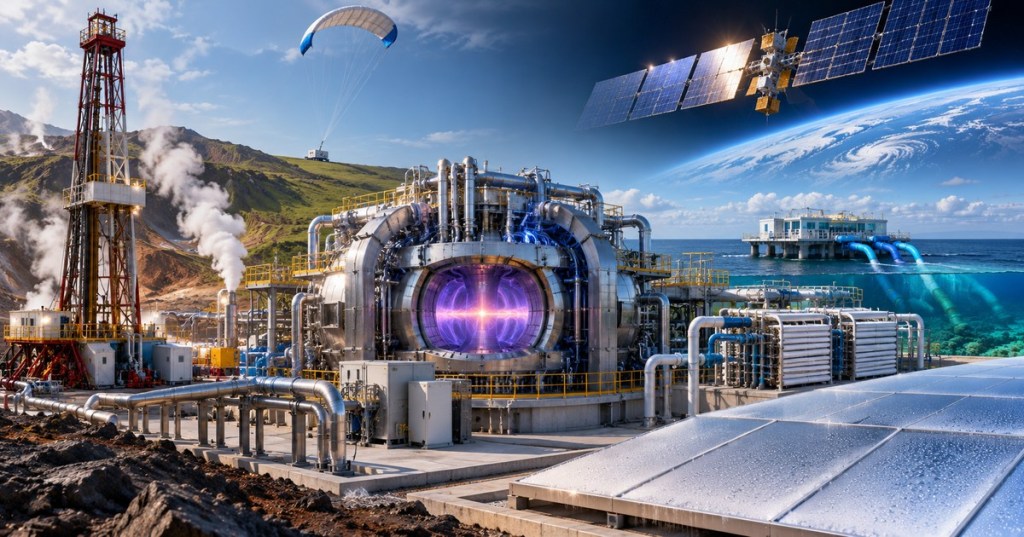
Humanity has not exhausted the energy available around Earth. Deep volcanic rock retains tremendous heat, rivers release energy as they mix with the sea, ocean layers contain usable temperature differences, and sunlight can be collected above the atmosphere. Nuclear fusion could eventually supply a fundamentally different form of generation. The obstacle is rarely discovering energy itself. Engineers must extract, convert, transmit and deliver useful electricity at a cost and reliability the grid can accept.
Seven technologies stand out for the gap between demonstrated physics and widespread commercial generation. Several have already powered laboratory equipment or small pilot plants. Consequently, “not yet harnessed” means not yet deployed at meaningful scale, rather than no electricity ever produced. Ordinary geothermal plants, wind turbines, terrestrial solar arrays and nuclear fission already operate commercially; the ranking concerns emerging forms or frontiers of those broader resource families.
The countdown weighs possible future grid contribution, technical maturity, resource geography, reliability, environmental constraints and capital requirements. It is an editorial assessment, not a quantitative forecast or a claim that all seven share equal physical potential. An extreme-weather companion, Top 3 Storm Energies Humanity Cannot Harness Yet, addresses tornadoes, lightning and hurricanes separately; none is repeated here.
#7 — Electricity from the nighttime sky
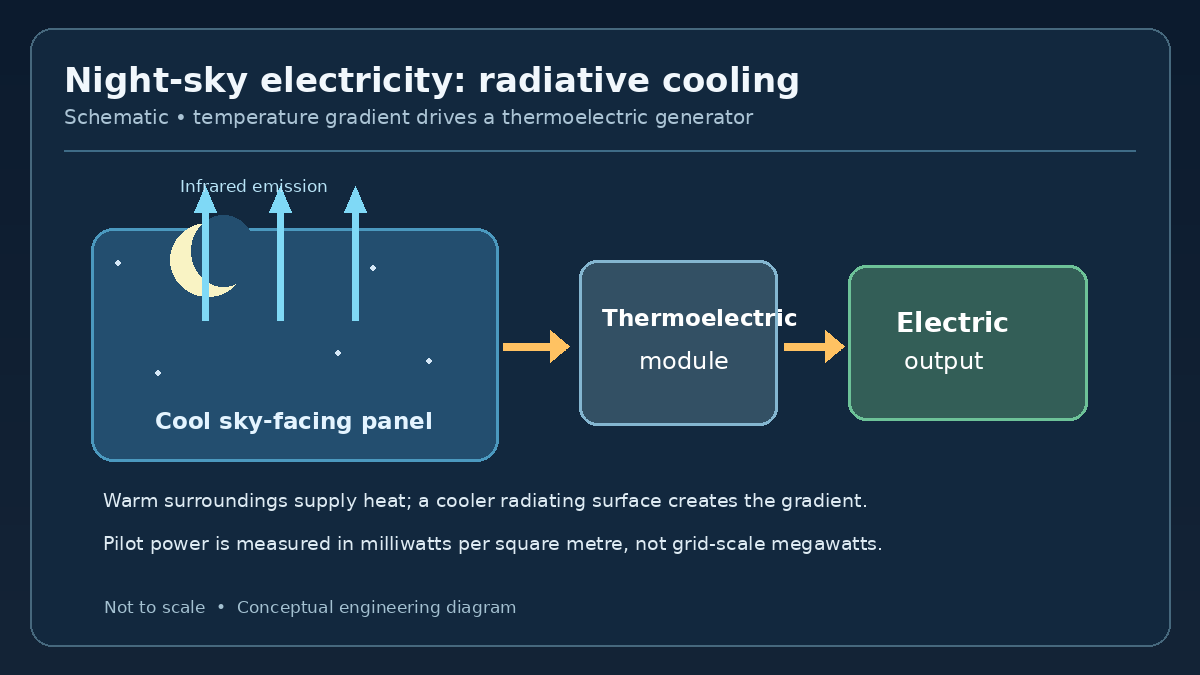
An exposed surface can radiate thermal infrared energy through the atmosphere and cool below nearby air temperature. A thermoelectric generator can exploit the resulting temperature difference: one side stays warmer while the other loses heat toward the sky. The source is heat flowing from warmer surroundings toward a colder radiative sink, not electricity somehow contained inside darkness. Power production depends on clear-sky conditions, device thermal design and available temperature gradient.
The U.S. Department of Energy described a Stanford rooftop demonstration yielding about 0.025 watts per square meter. A later peer-reviewed report published in January 2025 demonstrated 350 milliwatts per square meter, or 0.35 W/m², under its tested conditions. Those are different apparatuses, not a controlled year-by-year efficiency trend. A 2025 Stanford engineering demonstration also reported roughly 50 milliwatts per square meter for modified solar panels operating at night.
Small nighttime harvesters could keep sensors, electronics or off-grid monitoring equipment alive without large batteries. The core limit is low power density: at 0.35 W/m², even a perfectly functioning 1,000-square-meter array would produce only 350 watts at that operating point, before other system losses. It would not approach the output of a typical photovoltaic installation occupying comparable land. Weather sensitivity, temperature control and installation expense further narrow its role. Development stage: measured proof-of-concept systems; useful niches possible, utility-scale generation not established.
#6 — Salinity-gradient power where rivers meet the sea
When freshwater mixes with seawater, nature dissipates a difference in chemical potential. Osmotic or “blue” energy attempts to convert part of that mixing energy into useful electricity before the two waters become equally saline. Pressure-retarded osmosis uses water movement across a membrane to create pressure that can drive a generator. Reverse electrodialysis uses ion-selective membranes to produce an electrical potential from ions moving between saltwater and freshwater streams.
Unlike a hurricane or a lightning strike, an estuary can offer a comparatively continuous resource. France’s CNR and Sweetch Energy established an osmotic pilot near the Rhône delta, and the European Commission’s 2026 marine-energy review reports only 20 kW of operating salinity-gradient capacity in the EU at the end of 2025, excluding pilot projects. The figure illustrates the small present footprint of the technology rather than the limit of river-mouth energy.
The difficult work takes place inside the membranes and the water-handling system. Membrane fouling, salt transport, pressure losses, freshwater availability, pretreatment and ecological effects can erode net output. Water may need to be pumped through extensive facilities; pumping electricity must be subtracted from gross generation. Advanced laboratory membrane power densities cannot be multiplied into countrywide generation without accounting for area, river flow, capital costs and real-world losses. Development stage: pilot installations and very small operating capacity, with scalability not yet demonstrated.
Undecided with Matt Ferrell, “How Desalination Could Power Cities” (December 2025). The explainer discusses osmotic power, membranes and estuary deployment; project claims require independent assessment.
#5 — Ocean thermal energy conversion in tropical waters
Ocean thermal energy conversion (OTEC) exploits warm surface seawater and colder deep seawater. A closed-cycle plant can vaporize a low-boiling working fluid, drive a turbine and condense the fluid again with cold deep water. An open-cycle approach instead evaporates seawater at low pressure and can produce freshwater as a byproduct. The energy comes from a relatively stable temperature gradient, making OTEC theoretically useful for persistent generation near suitable tropical coastlines.
The resource has been demonstrated, not merely proposed. Makai Ocean Engineering reports that a 105-kW turbine-generator at Hawaiʻi’s Ocean Energy Research Center delivered closed-cycle OTEC electricity to a U.S. grid in 2015. That facility is a development platform, not a profitable fleet of commercial plants. The Pacific Northwest National Laboratory’s September 2026 assessment identified opportunities to combine OTEC with seawater cooling, aquaculture, desalination and other products for remote communities.
The small temperature difference limits thermodynamic efficiency, forcing large water flow rates through heat exchangers and long, costly cold-water intake pipes. Pumping, biofouling, corrosion, anchoring and offshore maintenance can consume money and electricity. Thermal discharge and nutrient-rich deep-water movement also require ecological assessment. Hawaiʻi’s demonstrator proves the conversion mechanism; it does not prove that a 100-MW commercial plant can be financed or maintained at competitive cost. A broader tidal and ocean-power explainer compares OTEC with wave and tidal generation. Development stage: grid-connected demonstrations, limited commercialization.
Makai Ocean Engineering, “Ocean Thermal Energy Conversion: The Future of Baseload, Dispatchable Renewable Energy” (2015). The film explains the ocean temperature-gradient cycle and associated equipment.
#4 — Airborne wind from tethered kites and aircraft
Conventional wind turbines harvest winds within the reach of tall towers. Airborne wind-energy systems use tethered kites or aircraft to access wind several hundred meters above ground, potentially using far less steel and concrete. Some designs repeatedly pull a tether from a winch that turns a ground generator; others place electrical generation hardware in the flying craft. The kite must recover its tether or fly a return path, so gross traction is not the same as net electricity.
A 2025 European Commission technical report evaluates airborne wind-energy architectures and their development constraints. The International Energy Agency Wind Task 48’s 2025 report describes operating demonstrations, work on international testing standards and efforts to introduce commercial systems. Kitepower’s 100-kW-class Falcon design was also tested with RWE in Ireland. The stated rating identifies a prototype system class, not guaranteed continuous electricity output.
High-altitude winds may be stronger, but wind shear, turbulent gusts, flight control, tether fatigue, ice, airspace permissions and emergency landing remain difficult. Launch and retrieval systems must operate safely without consuming too much electricity or relying on constant crews. Bird and aviation interactions need site-specific analysis. A kite-powered generator might serve a remote microgrid or temporary location before becoming a large utility plant. Development stage: outdoor prototypes and early field deployment, with reliability, operations and cost still being established.
Kitepower Airborne Wind Energy, “Kitepower — Harnessing the Power of the Wind” (December 2024). The company video shows its airborne system in Ireland; footage is evidence of operation, not audited lifetime economics.
#3 — Solar power collected in orbit and sent to Earth
Terrestrial solar power is mature. Space-based solar power seeks to collect sunlight with photovoltaic arrays in orbit, convert their electrical output into microwaves or another directed-energy carrier, and transmit the beam to receivers on Earth. An appropriate orbit could reduce interruptions from clouds and nighttime compared with a ground installation, but an operational station would still need steering, orbital control, a safe receiving area and transmission into local grids.
Caltech’s 2023 MAPLE experiment transmitted power wirelessly in space and registered detectable power at Earth. Its follow-up reported useful engineering lessons from an orbital demonstrator, not a utility-scale solar station. A 2025 Caltech techno-economic paper proposed a modular orbital architecture and explored hypothetical competitive costs under assumed technological maturation. A modelled cost cannot be treated as a contracted electricity price or measured output.
The system faces repeated conversion losses, deployment mass, launch economics, debris hazards, spacecraft maintenance, radio-frequency allocation, beam safety, receiver land use and weather-dependent delivery design. A small demonstration is an important proof of subsystem behavior, but the biggest remaining question is whether orbital solar beats cheaper terrestrial arrays plus storage, transmission and flexible load. BitcoinVersus.Tech has covered a proposed gigawatt-scale space-solar reservation; reservation capacity must not be confused with an orbiting plant delivering energy. Development stage: orbital power-beaming experiments; no demonstrated utility-scale commercial supply.
California Institute of Technology, “Space Solar Power Demonstrator” (January 2023). The official animation depicts its orbital test concept; the graphic is not footage of a functioning commercial orbital power station.
#2 — Superhot-rock geothermal beneath existing geothermal depths
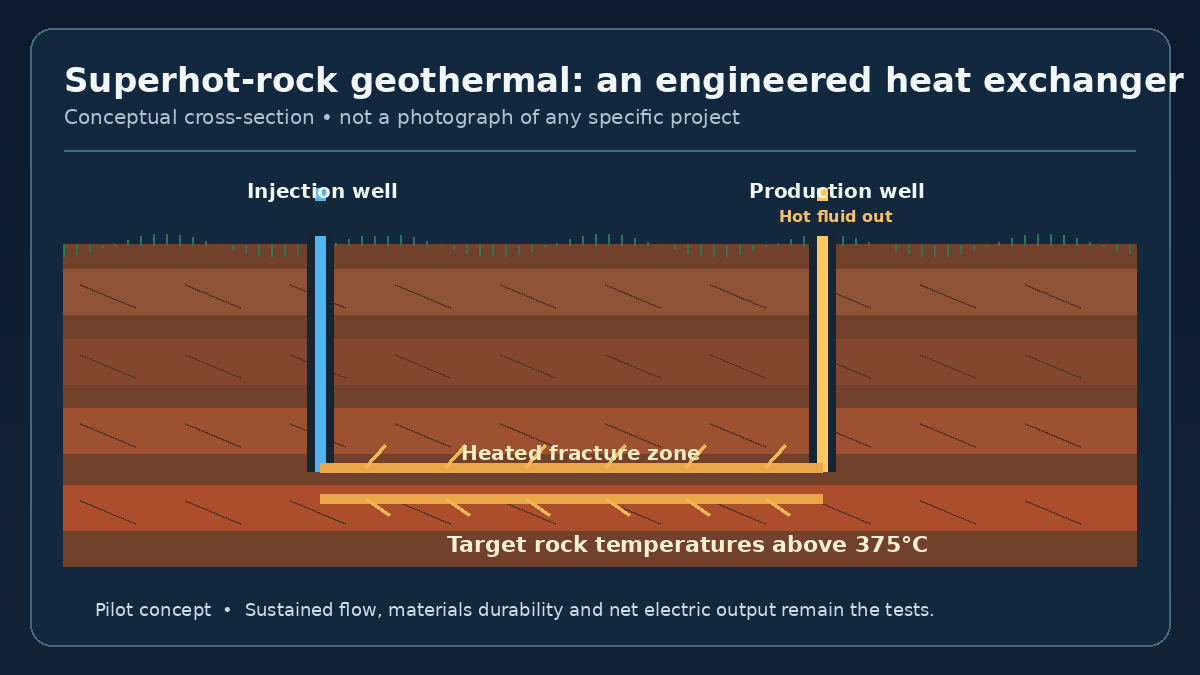
Earth contains vast stores of heat. Conventional geothermal power already turns part of the resource into electricity where geological conditions are favorable. Superhot-rock geothermal targets rock at temperatures above roughly 375°C, much hotter than typical reservoirs. Engineers aim to drill into extreme subsurface conditions and circulate a fluid through naturally permeable or deliberately engineered pathways to extract heat.
The National Laboratory of the Rockies’ 2025 U.S. geothermal report concludes that superhot resources could produce approximately five to ten times more energy per well than conventional geothermal in favorable cases. Its estimate that accessible resources could theoretically meet a large fraction of world electricity demand is a technical potential estimate, not measured generation. A 2026 Pacific Northwest National Laboratory description outlines a Newberry Volcano demonstration planned around 425°C rock at about 4.25 kilometers deep, with the objective of testing sustained connectivity and economically meaningful steam flow.
No amount of underground heat becomes electricity without an engineered reservoir that can last for years. Extreme temperatures damage cement, sensors, valves, seals and drilling tools. Fluid losses, induced seismicity, mineral deposition and thermal drawdown require site-specific safeguards. The Department of Energy’s October 2026 SUPERHOT program is explicitly focused on durable high-temperature wells and long-lived heat extraction. Development stage: active drilling, materials research and demonstrations; a durable commercial superhot reservoir has not yet been established. Compared with other enhanced-geothermal projects, the higher-temperature target increases both the potential output and the engineering difficulty.
#1 — Controlled nuclear fusion that delivers net electricity
Fusion releases energy when light atomic nuclei combine. Stars sustain fusion through extreme gravity; experimental machines on Earth use magnetic confinement or intense laser pulses to create the needed temperature and pressure. A practical plant would convert released energy into heat or another usable form, operate repeatedly or continuously and deliver net electricity after all plant inputs. That last requirement distinguishes a power station from a successful physics experiment.
There has been measurable progress. Lawrence Livermore National Laboratory reports that the National Ignition Facility produced 8.6 megajoules of fusion energy from 2.08 megajoules of laser energy delivered to the target in April 2025. The target gain was approximately 4.13. An additional June 2026 experiment yielded about 7.9 MJ, with an estimated target gain of 3.8. Target gain does not include the much larger electricity required to operate the full laser facility; neither experiment represents a net-electricity power plant.
The U.S. Nuclear Regulatory Commission states that no commercially operational fusion machine in the United States is supplying electricity to the grid. The IEA’s 2026 energy innovation assessment also cautions that the fuel cycle and specialized materials are not ready for broad scale-up. Deuterium-tritium concepts face neutron damage, component replacement and a tritium supply problem; some planned machines would need to breed their own tritium with lithium. Other fuels avoid some challenges but require more demanding plasma conditions or different conversion architectures.
The Department of Energy’s June 2026 fusion roadmap targets progress toward pilot plants and commercialization in the mid-2030s. The roadmap is an aspiration contingent on investment and solved engineering problems, not an operational completion date. Compared with emerging marine or airborne systems, fusion’s potential for large firm output makes it the highest-impact prospect in the ranking, while its technical and financial uncertainty remains exceptionally high. Princeton’s work on reducing the energy needed for ignition is one example of the active research. Development stage: repeated scientific ignition results and integrated pilot-plant development, without verified commercial net-electric production.
Lawrence Livermore National Laboratory, “Big Ideas Lab | Fusion Ignition” (October 2024). The official facility tour describes the laser system and ignition research; the footage does not establish net-electric commercial generation.
The Kardashev connection: how far from planetary-scale power?
Astronomer Nikolai Kardashev introduced a framework for comparing civilizations by energy use. Modern popularized thresholds often place Type I near 1016 watts of planetary-scale power and Type II near 1026 watts of stellar-scale power. The label “Type 0” is shorthand for a society below the commonly used Type I threshold, not a category from Kardashev’s original three-class paper. Thresholds and definitions vary between authors; they should not be mistaken for a universal engineering standard.
The International Energy Agency’s Global Energy Review 2026 estimates 2025 world total energy supply at approximately 655 exajoules. Using 365 days, 655 × 1018 joules divided by 31,536,000 seconds equals about 20.8 terawatts of average power. Under Carl Sagan’s interpolated convention, K = (log10 P − 6)/10, humanity scores about 0.73. The calculation measures annual average primary-energy supply under the IEA accounting method; it is not global electric generation or a forecast of the date a Type I civilization might emerge.
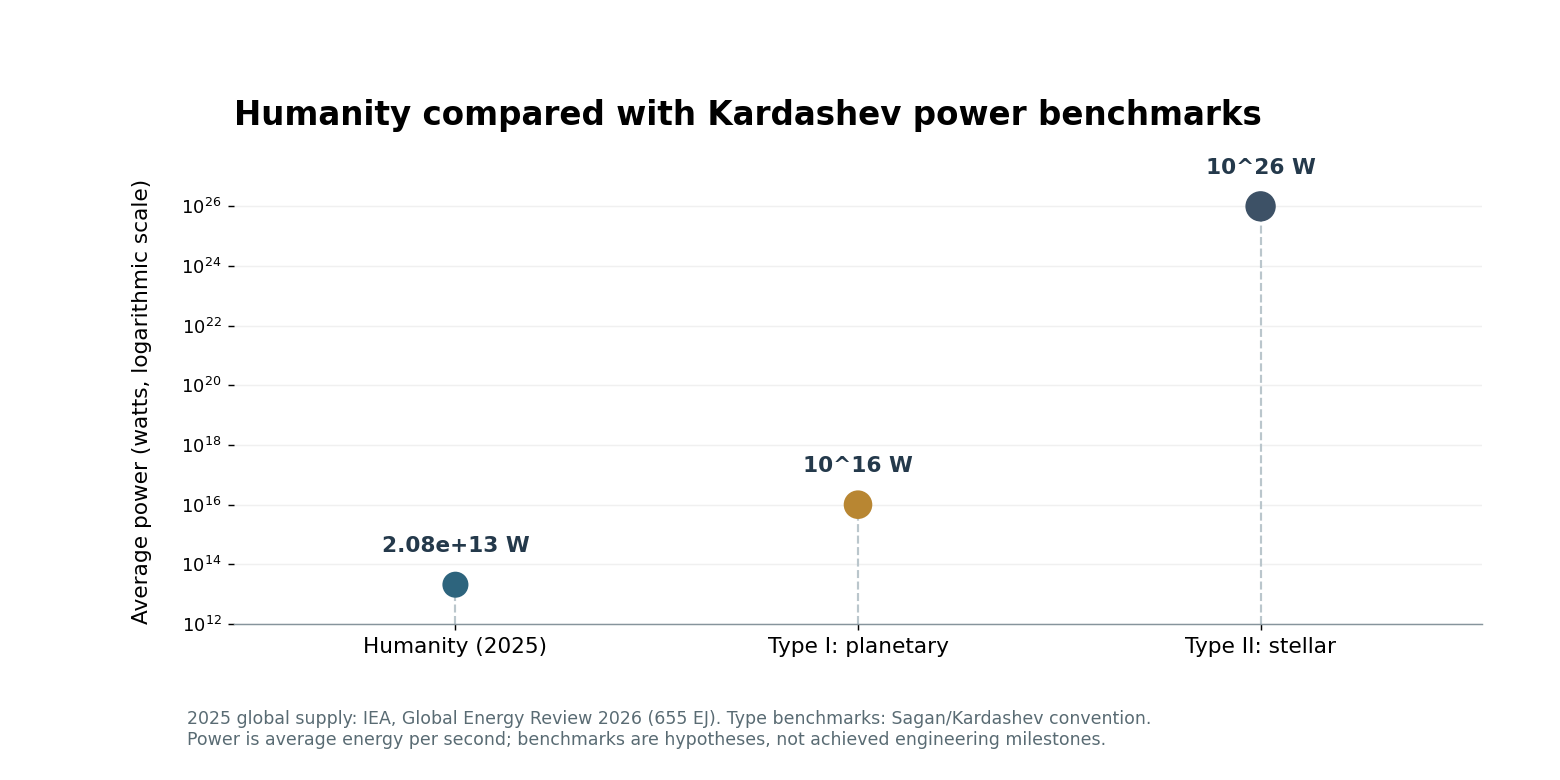
Under the popular 1016-W convention, Type I represents approximately 480 times 2025 humanity’s average energy supply; the Type II threshold is another ten billion times larger. Superhot geothermal, efficient marine systems, fusion and airborne wind may help expand useful energy without requiring the destructive extraction of hurricane or tornado energy. Space solar would add an orbital collection approach. None of the seven alone guarantees a Type I transition, and Type II remains speculative.
Which technologies deserve attention first?
The ranking’s first place measures long-range transformative potential, not the probability of being the next commercially successful project. In a shorter timeframe, airborne wind, salinity-gradient pilot systems and advanced geothermal engineering may have a clearer path to measurable incremental deployment than large orbiting solar stations or a fully integrated fusion plant. Even the higher-readiness projects remain exposed to permitting, financing and maintenance risk.
Technical evidence should determine investment and public policy: net megawatt-hours exported to a grid, annual availability, lifecycle cost per unit of electricity, system-wide environmental effects, reliable equipment service and realistic siting. For marine technologies, a system that claims 100 kW rated capacity should report the electricity generated after pumping power. For fusion, target energy gain is not plant efficiency. For a proposed satellite, beam detection is not a gigawatt-class utility connection. The same measurement discipline appears in BitcoinVersus.Tech’s capacity-factor guide.
The most promising frontier is not automatically the one with the largest theoretical resource. Useful electricity requires controllable collection, sound economics, safe infrastructure and evidence that systems keep working. Those tests, rather than spectacular laboratory outputs or distant civilization labels, will determine which energy frontiers humanity actually captures.
BitcoinVersus.Tech
BitcoinVersus.Tech Editor’s Note: We volunteer daily to ensure the credibility of the information on this platform is Verifiably True. If you would like to support our work and help further secure the integrity of our research initiatives, please scan the QR code below to donate 5,000 sats. For best results, scan the QR code from a laptop or larger screen.

Bitcoin address: 3C9o19EH5HSiwEPyCTmEKzxhNCbo2X6TTb. On a phone, open the QR image on another screen or copy and verify the address in your wallet before sending.
BitcoinVersus.tech is not a financial advisor. This media platform reports on financial subjects purely for informational purposes.


Leave a Reply