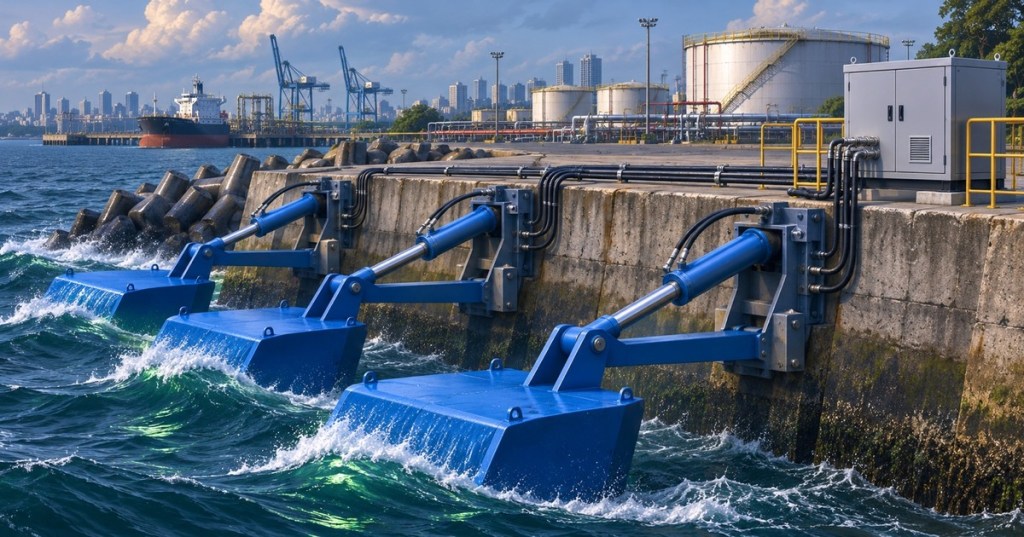
The sea can generate electricity in several fundamentally different ways. Tidal-stream turbines turn in moving currents, tidal barrages capture differences in water level, and wave-energy converters harvest the motion of surface waves. Other systems exploit the temperature difference between warm and cold seawater or the salinity difference between fresh and salt water. Each technology belongs to the broader field of marine renewable energy, but the engineering, output patterns and environmental consequences differ substantially.
Ocean power already has working grid-connected examples, although commercial maturity varies sharply by design. Large tidal-range plants have operated for decades. Tidal-stream machines have progressed from prototypes to operating pilot arrays and individual full-scale turbines. Most wave-energy concepts are still being tested, refined or deployed on a relatively small scale. An ocean-power resource estimate describes physical opportunity, not electricity already produced or a guarantee that development will be economic.
Video: U.S. Department of Energy, “Energy 101: Marine and Hydrokinetic Energy.” The official explainer introduces electricity generation from waves, tides and flowing water.
Tidal-stream energy converts ocean currents into electricity
The Moon and Sun exert gravitational forces that contribute to the ocean’s periodic rise, fall and horizontal flow. Local coastline geometry, seabed contours, weather and other oceanographic conditions determine the actual timing and strength of currents. At certain headlands, narrow straits and passages between islands, moving water accelerates enough to drive turbines. The European Marine Energy Centre (EMEC) identifies horizontal-axis rotors, cross-flow turbines, oscillating hydrofoils, ducted machines and tethered tidal kites among the available designs.
A horizontal-axis tidal turbine resembles an underwater wind turbine. Its blades extract kinetic energy from flowing seawater, turning a rotor linked to an electrical generator. Other machines use hydrofoils, pumping systems or a tethered wing that travels through the current. Because seawater is much denser than air, relatively compact rotors can extract meaningful power at suitable flow speeds. Available power rises approximately with the cube of current speed: a modest fall in current velocity can dramatically reduce instantaneous turbine output.
Tidal schedules are highly forecastable, but predictable does not mean constant. Current strength changes over the tidal cycle, including slower flow around slack water, and a plant may encounter varying spring and neap tides. Equipment must also handle reversals in flow direction, high loads, marine growth, corrosion and underwater maintenance.
One full-scale reference is Orbital Marine Power’s O2 turbine at EMEC in Orkney, Scotland. The floating platform carries two 1-megawatt turbines, for a 2-MW rated capacity, and entered operation at the Fall of Warness test site in 2021. Rated capacity describes its design maximum, not an assertion that it generates 2 MW every hour.
Video: Orbital Marine Power’s official O2 tidal-turbine design animation, linked from the developer’s project announcement. The floating hull and raiseable underwater turbines illustrate the maintenance approach.
Tidal-range power captures the rise and fall of seawater
Tidal-range plants rely on the difference in water level, or hydraulic head, between a coastal basin and the open sea. Barrages span an estuary or bay and route water through turbines as tides move in and out. Proposed tidal lagoons can create a similar controlled basin using sea walls. The principle resembles conventional hydropower, although the driving water level follows tidal cycles rather than a continuously managed inland reservoir.
The European Commission’s ocean-energy assessment cites France’s La Rance barrage, commissioned in 1966, and South Korea’s later barrage installations as evidence of operating tidal-range technology. Such structures can have long service lives, but their civil works are expensive, suitable coastal locations are scarce and changing the exchange of seawater within an estuary can affect sediment, habitats, fisheries and navigation.
Wave energy follows wind-driven motion at the sea surface
Waves originate principally when winds transfer energy to the surface of a body of water. Wave height, period and direction vary with the winds, distance over which the wind blows and coastal seabed. A wave-energy converter must turn irregular motion into usable mechanical or electrical output. Unlike predictable astronomical tides, incoming wave conditions are tied more closely to weather and sea state.
A point absorber typically moves up and down relative to a fixed or resisting component. An oscillating surge converter uses a hinged flap that moves back and forth. An oscillating water column funnels wave motion into a chamber, where moving air drives a turbine. Attenuators bend or pivot along incoming waves, while overtopping devices collect water in a raised reservoir and let it flow through a turbine. EMEC documents these distinct wave-device families. No single architecture is best suited to every coast.
Shoreline-mounted systems add another option. Hydraulic floaters secured to a breakwater can drive conversion equipment housed on land, simplifying access to some machinery. Eco Wave Power’s digital-twin project examines the loading and operation of such floaters, while a separate Hawaiʻi wave-flap experiment documents a different submerged approach. Their published demonstrations should not be combined into a single performance benchmark.
Video: University of Hawaiʻi / Hawaiʻi Natural Energy Institute overview of the U.S. Navy Wave Energy Test Site and tested wave-energy converters, including flap and oscillating-water-column designs.
Marine generation also needs a coordinated local electricity network. Stony Brook University’s ocean-power grid research investigates converters and controls that could combine wave generation, tidal generation and storage. The research aims to solve an integration problem beyond producing electricity from any one device; proposed control systems are not proof of an operating commercial ocean microgrid.
Ocean currents, thermal gradients and salinity extend the technology family
Ocean-current turbines target comparatively persistent large-scale flows rather than primarily the local rise and fall of tides. The resource may be attractive near a strong current, but deployment depends on depth, mooring systems, marine traffic and the cost of carrying electricity back to shore. Site-level measurements are essential; an ocean-current map alone cannot establish a bankable project.
Ocean thermal energy conversion (OTEC) uses the temperature difference between warmer surface water and deep, colder seawater. A heat engine or working-fluid cycle produces electricity from that gradient, sometimes alongside desalination or cooling services. The relatively small temperature difference limits thermodynamic efficiency, while large seawater-intake pipes, pumping requirements and ecological effects complicate large projects. Systems exploiting salinity gradients instead use the difference in salt concentration between fresh water and seawater, through membranes or osmotic pressure; they remain a smaller, emerging category of marine generation.
From moving seawater to usable grid electricity
A marine device needs more than a rotor or float. Its power-take-off system turns water motion into mechanical, hydraulic, pneumatic or electrical energy. A generator produces electricity, power electronics condition variable output, and cables or onshore equipment deliver electricity to a load, battery or grid connection. Structural anchors, control systems, transformers, subsea cables, sensors and maintenance access contribute to the actual project cost.
Electrical performance must be reported in the correct units. Megawatts (MW) measure power at a moment or a plant’s rated capacity; megawatt-hours (MWh) measure energy delivered over time. A 2-MW generator would produce 2 MWh in an hour only if it held 2 MW throughout that hour. The capacity factor compares actual energy generated over a period against the theoretical energy at continuous rated output, so it cannot be established from nameplate capacity or a short demonstration peak.
How much ocean power is actually operating?
Installed hardware, future project pipelines and resource potential must be separated. The European Commission reports 494 MW of global ocean-energy installed capacity in 2024, a category heavily influenced by established tidal-range assets. Its European figures report 461 GWh of ocean-electricity generation in 2024, including 449 GWh at the La Rance barrage and 12 GWh from other technologies. Those are energy amounts over a reporting year, not rated capacity figures; they also show how heavily existing measured output depends on the mature barrage category.
For the United States, the Department of Energy’s resource assessment estimates around 2,300 TWh per year of technical marine-energy potential across its identified resource categories. Technical potential is not a construction schedule, a financially viable resource or present-day generation. Practical output would be smaller after considering coastlines, protected areas, grid connections, competing uses and operating costs.
Costs, reliability and environmental tradeoffs determine scale
Marine energy has clear attractions: predictable tidal timing, potentially useful coastal and island generation, and power production without burning fuel at the point of use. A combination of waves, tides, wind, solar, storage and flexible demand may diversify a local power system because the resources do not necessarily peak together. Remote communities, monitoring equipment and water-treatment installations may benefit where diesel delivery or grid extensions are expensive.
The engineering disadvantages are substantial. Saltwater corrodes components; storms and debris impose severe loads; marine organisms accumulate on equipment; underwater inspections require specialist crews; and cables, seabed foundations, permits and vessels can dominate total costs. New developers often lack enough long-term operating data to demonstrate reliable lifetime energy production. Cost claims therefore need transparent assumptions about financing, maintenance, array performance, replacement cycles and the total delivered electricity, not merely the manufacturing price of a turbine.
Environmental performance also differs by design and location. Barrages can alter estuarine circulation and sediment movement. Tidal turbines can introduce collision risks, underwater sound and electrical-cable fields; floating wave converters require moorings that may affect navigation and habitats. Pacific Northwest National Laboratory evaluates animal interactions, cable fields, acoustics and mooring risks. Its 2024 international review found many observed interactions had limited or unlikely impacts at the scale studied, while explicitly identifying remaining gaps for larger arrays.
Field evidence illustrates the need for careful qualifiers. A January 2026 PLOS One study of a small tidal turbine in Washington state reported four fish collisions in analyzed underwater camera observations, with no observed collisions involving seabirds or seals. The small device, sampling window and observation limitations prevent a broad claim that all turbine designs are harmless or that collisions are inevitable at every site. Environmental approval depends on local species, habitats and monitoring, not one study in isolation.
What will establish the next generation of ocean power?
Commercial progress will be measured by grid-delivered MWh across multiple years, verified availability, safe maintenance, reduced installed cost per MW, environmental monitoring and projects financed beyond a single publicly supported demonstration. Tidal-stream arrays need evidence that machines can survive, be serviced and operate together. Wave developers need repeatable results across real seas rather than a single favorable wave event. OTEC and salinity systems require similar proof of net electricity after pumps and other parasitic loads.
The distinction between functioning physics and competitive electricity matters. Oceans contain enormous renewable resources, but every proposed project must establish how much energy reaches consumers, at what cost and with which environmental safeguards. Marine power can become a valuable part of a diversified energy system without implying that every coastline is suitable or that large-scale commercial deployment is already complete.
BitcoinVersus.Tech
BitcoinVersus.Tech Editor’s Note: We volunteer daily to ensure the credibility of the information on this platform is Verifiably True. If you would like to support our work and help further secure the integrity of our research initiatives, please scan the QR code below to donate 5,000 sats. For best results, scan the QR code from a laptop or larger screen.

Bitcoin address: 3C9o19EH5HSiwEPyCTmEKzxhNCbo2X6TTb. On a phone, open the QR image on another screen or copy and verify the address in your wallet before sending.
BitcoinVersus.tech is not a financial advisor. This media platform reports on financial subjects purely for informational purposes.


Leave a Reply