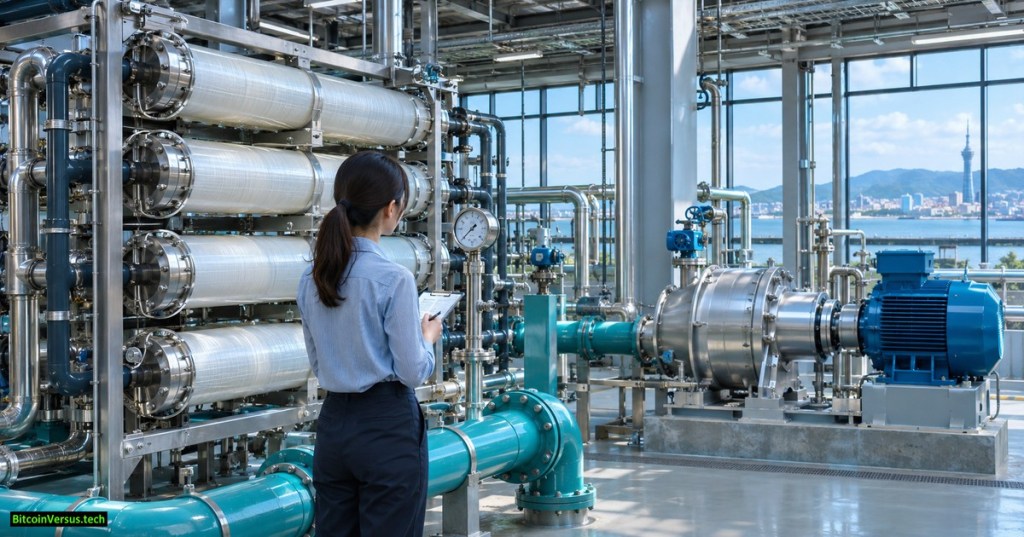
Osmotic power, also called salinity-gradient energy or blue energy, converts the free energy released when waters of different salt concentrations mix into useful work. Unlike tidal turbines, the source is a chemical-potential difference, not moving waves or tidal currents. Japan’s Mamizupia desalination center in Fukuoka offers a working example of an emerging technology with modest but measurable engineering ambitions.
Project status: The installation began operating on August 5, 2025. Fukuoka’s water utility lists about 110 kilowatts of planned net capacity and up to 880,000 kilowatt-hours of planned annual output. Neither number should be presented as an independently verified full-year production result. The operator’s project record describes a five-year verification period.
Video: Fukuoka City’s official channel documents the local osmotic-generation launch ceremony. The project was already operating in 2025.
Definition and operating principle
In ordinary osmosis, water crosses a semipermeable membrane from a solution with lower dissolved-solute concentration toward one with higher concentration. In pressure-retarded osmosis (PRO), the saltier stream is kept under hydraulic pressure. Incoming water raises its pressurized volume; a controlled outlet drives a turbine and generator. The membranes separate water from most dissolved salts while allowing useful water flux.
The energy source is the loss of chemical free energy as water compositions approach equilibrium. Pumps, filtration, membrane resistance, concentration polarization, and turbine losses reduce the electricity available at the output terminals. The commercial question is therefore net power, not merely the gross energy released by mixing.
Three membrane processes are not interchangeable
- Reverse osmosis: electrical energy pushes seawater through a membrane to create drinking water.
- Pressure-retarded osmosis: a salinity gradient draws comparatively fresh water into pressurized brine, enabling hydraulic energy recovery.
- Reverse electrodialysis: selective ion membranes and electrodes convert differences in dissolved-ion concentration into electrical current, following a different mechanism.
Fukuoka: an operating case study
Mamizupia already uses reverse osmosis to produce drinking water. Its desalination process leaves a concentrated brine stream containing roughly 8% salt, compared with about 3.5% for ordinary seawater, according to Japan’s Cabinet Office. Nearby treated sewage water provides the lower-salinity side. Engineers combine two formerly discharged water streams in a PRO system rather than building a new freshwater diversion solely for electricity.
| Property | Fukuoka Mamizupia installation |
|---|---|
| Technology | Pressure-retarded osmosis (PRO) |
| Operations began | August 5, 2025 |
| Planned net electrical output | Approximately 110 kW |
| Planned annual generation | Up to 880,000 kWh |
| Daily feed streams | About 10,000 metric tons of brine; 9,000 metric tons of treated wastewater |
| Evidence status | Operator design figures; five-year performance verification under way |
The utility’s stated 880,000 kWh annual target corresponds to an implied utilization of about 91.3% relative to 110 kW running continuously: 880,000 ÷ (110 × 8,760) ≈ 0.913. The calculation reconciles the plan with the operator’s approximately 90% utilization expectation; it is not a reported capacity-factor measurement.
Video: Japanese-language coverage discussing the Fukuoka osmotic power installation and its planned annual generation.
Benefits, constraints, and environmental accounting
Weather independence can make salinity-gradient generation attractive near water-treatment infrastructure. Concentrated brine improves the gradient, while shared piping and access to wastewater may improve project economics. Still, the plant is far smaller than a utility-scale generator, and the five-year trial must establish reliability, membrane replacement costs, pretreatment needs, and net energy yield.
Fouling, saline corrosion, hydraulic pumping requirements, and any change in discharged-water chemistry must be assessed at the actual site. Calling the process emissions-free would ignore the construction and operational electricity supply. Net climate benefits depend on the electricity displaced and the complete plant lifecycle.
How osmotic power fits the energy system
Osmotic generation differs from the moving-water technologies examined in our tidal and ocean power explainer and the Bay of Fundy tidal-turbine project. The pairing of water and energy infrastructure also echoes data-center waste heat used for desalination and electricity-assisted wastewater resource recovery. All four cases concern energy or valuable material hidden in ordinary industrial flows.
Expansion beyond desalination brine would require membranes and system designs that remain economically productive with the weaker gradient between conventional seawater and treated freshwater. Fukuoka is a demonstration of integration, not evidence that gigawatt-scale osmotic power is commercially available.
Primary references
- Fukuoka District Waterworks Agency: osmotic power facility overview, including planned ratings and verification period.
- Government of Japan: desalination and osmotic generation at Mamizupia, published December 12, 2025.
- Kyowakiden Industry: pressure-retarded osmosis engineering, developer description.
We volunteer daily to ensure the credibility of the information on this platform is Verifiably True. If you would like to support to help further secure the integrity of our research initiative, please scan the QR code below.



Leave a Reply