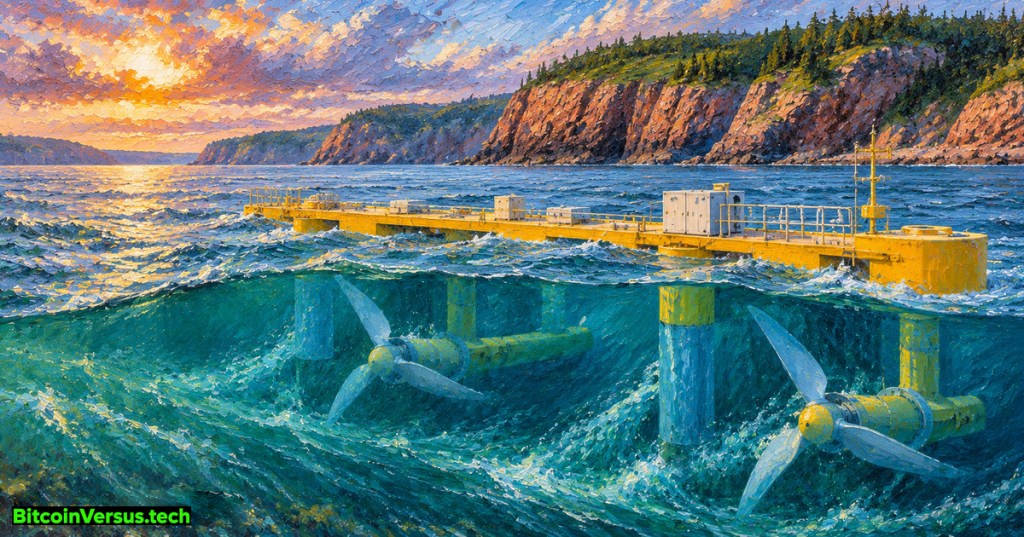
A proposed tidal power station in Canada’s Bay of Fundy has secured federal approvals for all six planned turbines, advancing a 15-megawatt (MW) project toward construction. Developers Eauclaire Tidal and Orbital Marine Power said on November 18, 2026, that Fisheries and Oceans Canada had expanded its authorization from three turbines to six. Transport Canada separately approved all six devices under the Canadian Navigable Waters Act. No Canadian turbines have begun operating as a result.
The Eauclaire FORCE Tidal Array is planned for the Minas Passage in Nova Scotia, where strong tidal currents can drive electricity-generating rotors. The six floating O2-X devices would be installed in phases at the Fundy Ocean Research Centre for Energy (FORCE). Long-term power purchase arrangements with Nova Scotia Power provide a route to market, but financing, final investment approval and construction remain ahead.
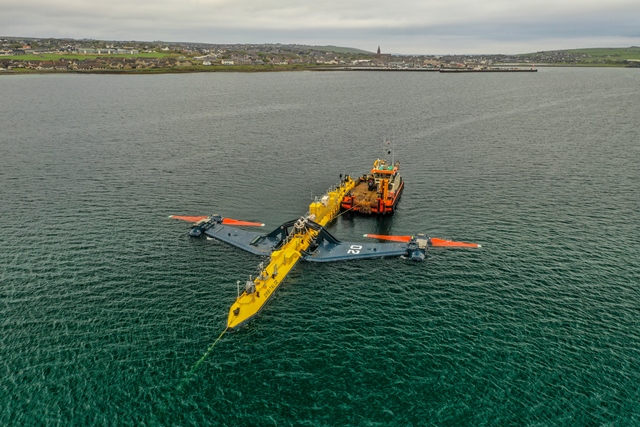
Orbital’s official April 2021 launch video documents its earlier O2 machine in Scotland. It is not footage of Canadian O2-X construction.
What the federal permissions actually cover
The Fisheries Act authorization considers effects on fish and their habitat. The revised permit expands the three-device scope initially authorized in 2025. Transport Canada’s separate decision concerns navigation around floating structures, moorings and related marine infrastructure. Both approvals reduce development uncertainty without establishing that construction funding is secured or that every future operating condition has been satisfied.
Canada’s staged regulatory framework aims to let developers test equipment while monitoring environmental impacts. FORCE sought public comments in July on six turbines, moorings and associated subsea cabling. Natural Resources Canada also supports research into potential fish–turbine collisions. Permission to deploy does not eliminate ongoing monitoring obligations or the need for credible evidence on marine wildlife risks.
How floating tidal machines turn currents into electricity
A tidal-stream turbine captures the kinetic energy of moving seawater. Flowing water rotates submerged blades linked to generators, and subsea cables transport electricity toward shore. Orbital’s design supports turbines on retractable arms attached to a floating hull, allowing equipment to be raised toward the surface for maintenance. Marine access, mooring strength, corrosion and cable reliability still pose demanding engineering challenges.
Orbital’s earlier 2 MW O2 has exported electricity to the Orkney grid since 2021. The proposed Canadian machines are the newer O2-X design, not six identical copies of the older 2 MW unit. Our tidal and ocean power explainer describes why a water-current turbine differs from a wave-energy converter.
Why 15 MW does not mean 15 MW around the clock
The announced 15 MW is approximate project nameplate capacity, not measured continuous output. Actual generation would vary with current speed, turbine availability and operating restrictions. Tides follow predictable cycles, but turbine output rises and falls during those cycles. With the Canadian array unbuilt, no verified annual energy production or project capacity factor is available.
Developers estimate that a completed array could provide the annual electricity equivalent of roughly 6,600 Nova Scotia homes. That is a forward-looking comparison, not a metered result. The design can be contrasted with Ireland’s proposed tidal-kite farm and Hawaiʻi’s wave-flap research device, which harvest ocean energy using different motions.
Orbital’s official April 2021 video shows moving its Scottish O2 unit to the launch site. The footage predates the Canadian approvals by five years.
The next milestone is investment, not another capacity claim
Strong currents deliver predictable energy opportunities but also impose high fatigue loads. Turbine maintenance windows, marine growth, fish interactions and subsea power losses can limit useful output. The economics depend on manufacturing and installation costs, long-term servicing and power contract revenues. Our stories on wave-powered offshore computing and firming intermittent generation explore related trade-offs.
The developers must still reach a final investment decision, install turbines and demonstrate sustained grid-connected operation. Their new regulatory approvals are substantive progress for Canadian marine energy, but reliability, environmental effects and commercial competitiveness remain open questions.
Primary documentation and verified media
- November 18 joint Eauclaire–Orbital announcement via Marine Technology News
- FORCE: July 2026 public notice for six turbines and cabling
- FORCE: initial three-device permit, November 2025
- Fisheries and Oceans Canada: adaptive regulatory framework
- Natural Resources Canada: fish–turbine collision research
- Orbital Marine Power: O2 machine operating background
- Official Orbital launch video and official transport video
Media disclosure: The featured 1200×630 cover is an original conceptual digital illustration, not a photograph of installed Canadian turbines. The credited in-story photograph depicts Orbital’s earlier Scottish O2, while both official videos date to 2021.


Leave a Reply