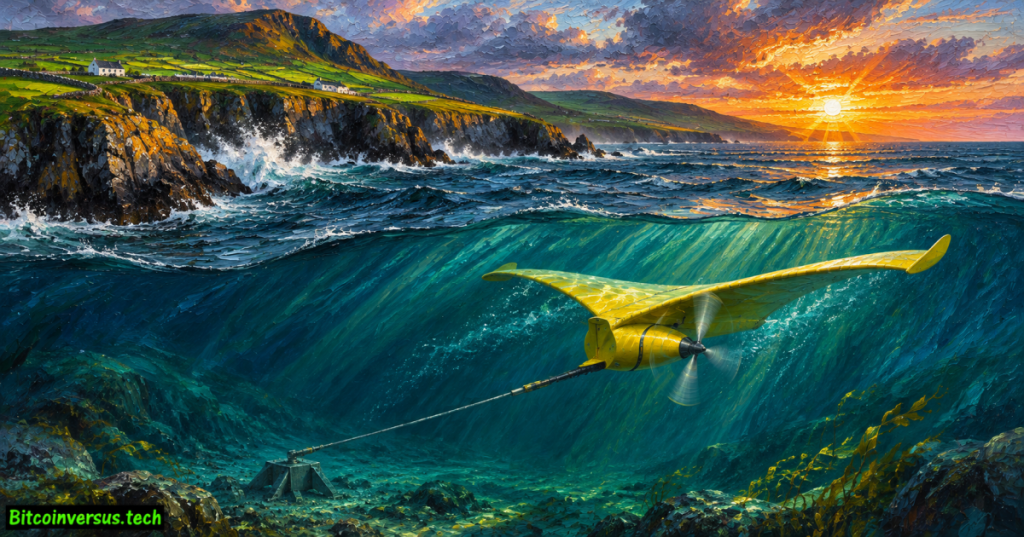
Swedish ocean-energy developer Minesto is negotiating a €20.2 million European Union Innovation Fund grant for its proposed 10 MW Euro Dragon Farm in Irish coastal waters. The European Commission selected the project for grant-agreement preparation on October 19, 2026; on November 5 it received a Strategic Technologies for Europe Platform (STEP) Seal. Neither milestone means the array has been built, connected to the grid, or received all its financing. Minesto’s funding announcement.
Official Minesto webinar recorded October 29, 2026, with CEO Martin Edlund and CFO Alexander Jancke discussing the company’s Q3 developments. Background management briefing, not proof of an operating Irish farm.
How an underwater kite generates electricity
Rather than fixing a large rotor on a stationary tower, Minesto tethers a wing-shaped underwater vehicle to the seabed. Ocean currents drive the wing through a controlled figure-eight path, accelerating the turbine relative to the surrounding current. A generator produces electricity that passes through the tether and subsea electrical infrastructure to shore. The technology targets relatively slow tidal flows where conventional turbines might be less productive.
The company has tested a 100 kW Dragon 4 unit and a 1.2 MW Dragon 12 device in the Faroe Islands. Dragon 12 first delivered power to the Faroese grid in February 2024, establishing a real demonstration distinct from the still-proposed Irish 10 MW project. Original Dragon 12 grid-connection report.

€20.2 million covers a proposed 60% of investment
According to Minesto, the planned grant would represent 60% of the investment required. Dividing €20.2 million by 0.60 implies a roughly €33.7 million project investment, but the calculation is not a fully audited construction budget. The developer expects grant-agreement preparation with European agency CINEA to conclude in the first quarter of 2027; award negotiations and financing can change.
The STEP Seal is a recognition intended to support access to investment, not a separate cash payment. Minesto’s October management statement also discusses a proposed SEK 130 million rights issue to support commercialization, including the Irish and Faroese development paths. The €20.2 million selection should not be added to a confirmed construction financing total before contracts are signed. STEP announcement and company interim statement document the different steps.
Minesto’s official February 9, 2024 footage of the 1.2 MW Dragon 12 commissioning in the Faroe Islands. Demonstrated equipment; not the proposed Irish array.
Predictable currents do not guarantee continuous output
Tides can be forecast far in advance, offering scheduling advantages over variable weather-driven generation. Their speed still changes through each tidal cycle, so a 10 MW nameplate rating does not equal constant 10 MW delivery. Grid integration, marine environmental assessments, anchor reliability, underwater inspections, cable protection, weather windows and maintenance costs remain commercial challenges.
Minesto reported a 48-hour recovery, inspection and redeployment of an upgraded Dragon 4 unit in October 2026. That is a company-reported service milestone for one device—not proven fleet-wide uptime or a measured levelized cost of electricity. The European Commission’s blue-economy review says newer ocean-energy technologies remain commercially challenging, with high support prices relative to mature renewables. Minesto service details; European Commission marine-energy review.
Official Minesto Dragon 4 product/operations video referenced in the company’s October 15, 2026 service release. Equipment demonstration and service context.
Why Ireland matters
An eventual Irish array would offer a test of whether smaller tidal-kite systems can scale into repeatable commercial farms. Our earlier tidal and ocean-energy explainer covers the fundamental physics, while reporting on ocean-powered AI infrastructure, wave-energy control systems and commercial offshore wind illustrates important differences among marine technologies.
The next evidence to watch is a signed grant, confirmed site permits, procurement, installed turbine count and metered Irish electricity deliveries. Until then, 10 MW represents proposed capacity, not operating generation.
Primary sources: Minesto October 19; Minesto November 5; Minesto interim report; European Commission marine renewables.
Editor’s note: Featured cover is original oil-painting-style conceptual artwork, not an image of an existing Irish installation. Authentic Minesto equipment photographs and videos are explicitly dated and credited. Grant selection, technical demonstrations and commercial operation are not interchangeable.


Leave a Reply