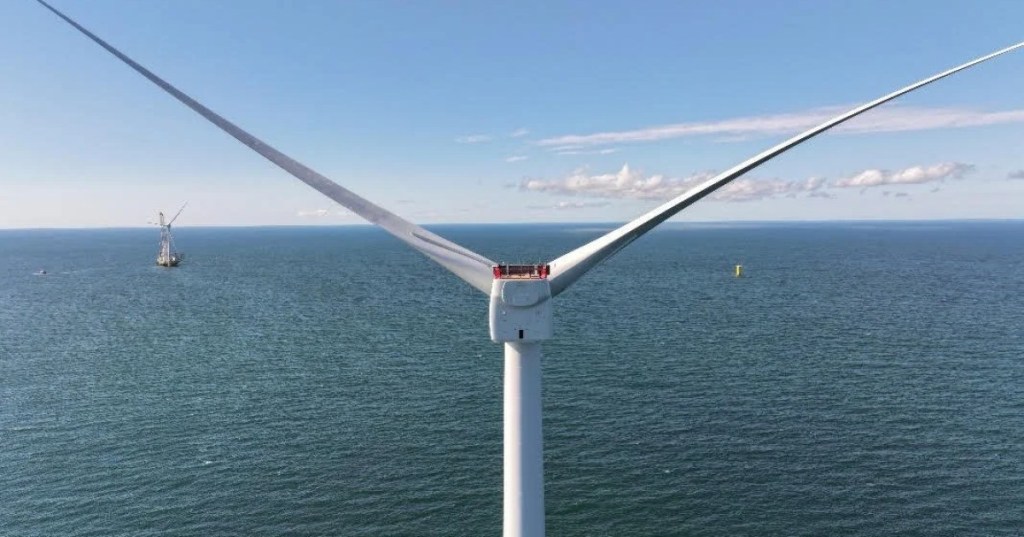
Vineyard Wind 1 reached full commercial operations on October 29, 2026, project spokesperson Craig Gilvarg confirmed to WBUR on November 6. The offshore wind farm, located approximately 15 miles south of Martha’s Vineyard, comprises 62 turbines and is generally described as an 800-megawatt project. Full commercial operation marks the completion of commissioning, not an 800 MW surge of power generated continuously or new construction completed in one day.
Vineyard Wind began delivering electricity to Massachusetts in January 2024, and turbines were added to the operational fleet in stages. Avangrid and Copenhagen Infrastructure Partners own the project. State marine authorities reported construction complete and commissioning under way in their October updates; the operator’s later confirmation establishes the October 29 commercial-operation milestone. Both dates matter when assessing the progress of a previously operating but not fully commissioned facility.
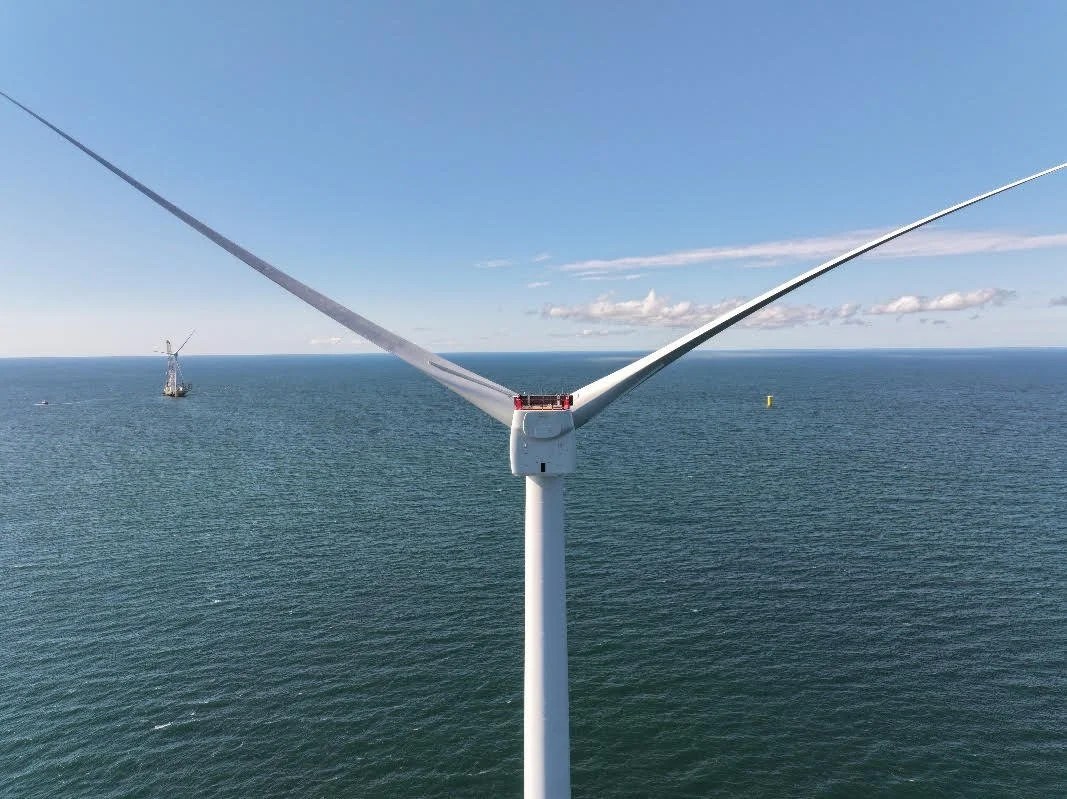
How 62 offshore turbines connect to the grid
Offshore wind turbines extract kinetic energy from moving air. Their rotors drive generators, and subsea cables collect electricity at an offshore substation. Vineyard Wind’s project documentation describes two export cables carrying power to Covell’s Beach in Barnstable and an onshore connection toward Hyannis. The 62 GE Haliade-X turbines have a stated rating of 13 MW apiece. Multiplying their ratings yields 806 MW, while the project and regulators frequently use approximately 800 MW as the overall project rating. Neither figure measures annual generation.
U.S. Department of Energy, “Energy 101: Wind Power” (May 6, 2014), explains turbine technology and includes offshore wind. Historical instruction, not new Vineyard Wind footage.
The difference between capacity and delivered energy is fundamental. A wind farm cannot sustain its nameplate output whenever winds weaken, equipment requires maintenance or grid conditions constrain dispatch. Actual electricity production must be measured in megawatt-hours over a defined reporting period. BitcoinVersus.Tech’s capacity-factor explanation sets out the calculation, while its solar-versus-wind generation analysis illustrates why annual energy rankings can differ from capacity rankings.
Blade failure, project delays and settlement
Completion followed years of costly delays. In July 2024, one GE Vernova turbine blade failed, sending debris toward Nantucket. The Bureau of Ocean Energy Management says the manufacturer’s investigation identified a manufacturing deviation. Federal regulators suspended certain operations; a revised blade-removal plan was approved and the suspension lifted in January 2025. Separate federal action in December 2025 also interrupted project activities before litigation allowed work to resume.
Vineyard Wind, “We Are Offshore Wind” (March 31, 2023), documents the project’s workforce and construction background. Archival developer film, not footage of the October 2026 completion.
In September 2026, Vineyard Wind and GE Vernova announced settlement of their commercial litigation. Their statement said every turbine was capable of producing power. Capability in September and full commercial operations in October describe different milestones, so the September statement must not be retroactively labeled a final commissioning certificate.
Grid benefits and environmental costs
For the New England electricity system, the extra operational offshore capacity may diversify supplies and reduce demand for gas-fired generation during windy periods. Yet the expected effect on customer bills depends on actual output, wholesale-market conditions, transmission and contract terms. The commercial structure is better understood alongside BitcoinVersus.Tech’s power-purchase agreement guide. Developer projections that the project can supply the equivalent of 400,000 homes are planning comparisons, not verified live household deliveries.
The environmental ledger also has competing entries. Operating turbines avoid direct fuel combustion, but construction and maintenance affect fishing activity, vessel traffic, seafloor habitat and marine ecology. Massachusetts oversees fisheries engagement and compensation arrangements; offshore turbine components require regular inspection and repair. Vineyard Wind uses fixed-bottom foundations, unlike the floating-turbine designs under development in Norway. Neither architecture eliminates marine operating risks.
Measured output remains the next test
The milestone is significant for offshore wind deployment, but long-run performance remains to be demonstrated through measured electricity generation, availability, repair costs and environmental monitoring. Full commercial status means the planned array has entered its operating phase; it is not proof of uninterrupted 800 MW output or a guaranteed electricity-price reduction.
BitcoinVersus.Tech
BitcoinVersus.Tech Editor’s Note: The October 29 full-commercial-operation milestone was confirmed by Vineyard Wind’s spokesperson in WBUR’s November 6 first-hand report. State marine notices, the developer’s engineering description, BOEM’s incident record and the September 16 settlement provide independent historical and technical cross-checks. Project ratings of 800 and 806 MW are distinguished from measured generation. Both video clips and the actual project photograph are archival, not evidence of the October 2026 event.
To donate 5,000 sats, display the original QR code on a larger screen and scan it with a compatible Bitcoin wallet. On mobile, use another device to display the QR or a wallet feature that supports scanning an existing image. Verify the destination address before sending.

We volunteer daily to ensure the information on this platform is Verifiably True. If you would like to support the research, please scan QR code.
Bitcoin receiving address: 3C9o19EH5HSiwEPyCTmEKzxhNCbo2X6TTb. Confirm the address and amount in your wallet before sending.
BitcoinVersus.tech is not a financial advisor. Technology and energy reporting is provided for informational purposes.


Leave a Reply