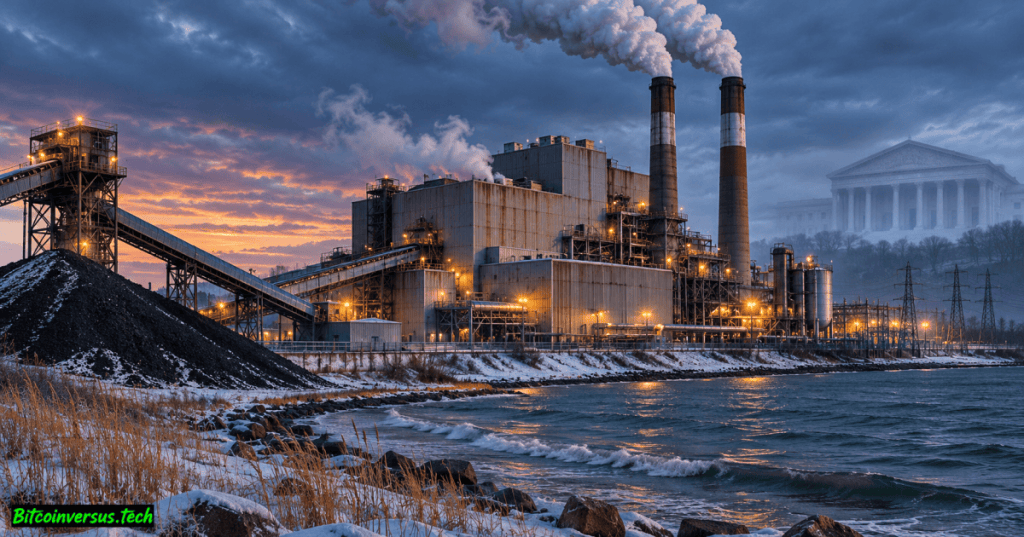
The U.S. Department of Energy issued its seventh emergency directive for Michigan’s J.H. Campbell coal-fired power station on November 13, 2026, keeping the 1,407-megawatt plant available through February 12, 2027. Order 202-26-51 took effect November 15, despite a federal appeals court ruling against the department’s original 2025 intervention. The latest order addresses electricity reliability, but its cost and legal justification remain contested. Read the DOE order record.
WWMT-TV, August 17, 2026: coverage of the previous Campbell extension and Michigan’s challenge. Background footage predates the November order; source: verified WWMT-TV YouTube channel.
What the 90-day order actually requires
The directive instructs regional grid operator MISO and Consumers Energy to maintain the West Olive facility’s availability and dispatch it only when necessary, while seeking to minimize costs. Availability is not equivalent to operating all 1,407 MW around the clock: nameplate capacity measures an upper generating rating, while actual megawatt-hours depend on dispatch, operating conditions and demand.
Section 202(c) of the Federal Power Act allows emergency federal action over electric supply. Energy Secretary Chris Wright says keeping dispatchable coal capacity available protects Midwest customers against potential shortages and severe-weather disruptions. DOE cites winter reliability concerns, but the November order does not establish that Campbell must produce its maximum output every day. DOE’s November 14 explanation describes the agency’s position.
The court ruling does not automatically cancel later orders
Consumers had planned to retire Campbell on May 31, 2025, after Michigan regulators approved a replacement-resource strategy. On September 11, 2026, a three-judge U.S. appeals court vacated the first federal emergency order, finding DOE had not shown the sort of immediate emergency required by the statute. Crucially, the ruling addressed the original May 2025 order; subsequent directives were not automatically invalidated. Additional litigation and a federal rehearing request remain unresolved. Michigan attorney general’s statement sets out the state’s objection.
The disagreement is larger than a single generator. A coal unit can provide controllable output when wind and solar output fluctuate, yet continued coal combustion brings fuel expense, carbon emissions and conventional air pollutants. Our earlier nuclear-versus-coal generation comparison shows why installed capacity and actual electricity generated must be analyzed separately.
$303 million in net costs sought for recovery
Consumers Energy’s September 30, 2026 SEC filing estimates $303 million associated with complying with the emergency orders, after $344 million in MISO electricity-market revenue. That $303 million is the net amount the utility expects to seek through federal cost-recovery proceedings; it is not a finalized bill assigned to individual households. Some filings remain subject to Federal Energy Regulatory Commission approval. Read the company’s SEC filing.
WOOD TV8, May 14, 2025: local reporting ahead of Campbell’s originally planned retirement. Historical context, not footage of the November 2026 order; source: verified WOOD TV8 YouTube channel.
Replacement capacity and the next test
Consumers says it purchased the 1,200 MW Covert gas plant in 2023 and has proposed further gas, renewable energy and storage resources. Capacity figures alone cannot establish equivalent reliability: fuel supply, outage rates, demand peaks, transmission limits and energy storage duration all matter. Related BitcoinVersus.Tech reporting examines a proposed 2.1 GW gas project, commercial offshore wind generation and changing U.S. electricity demand.
The next material milestones are how often MISO actually dispatches Campbell during winter, whether the government substantiates its reliability case, who ultimately pays the verified net costs and how the courts resolve challenges to the later orders. A nominal 1.4 GW of retained capacity is a grid-planning figure—not proof of electricity delivered or savings achieved.
Sources: DOE order, Nov. 13; Consumers/CMS SEC Form 10-Q; Michigan attorney general; AP follow-up, Nov. 16.
Editor’s note: The featured cover is original conceptual artwork, not a photograph of Campbell. Linked videos offer independently sourced historical footage. Capacity, dispatch, and cost-recovery claims reflect distinct measures and periods.


Leave a Reply