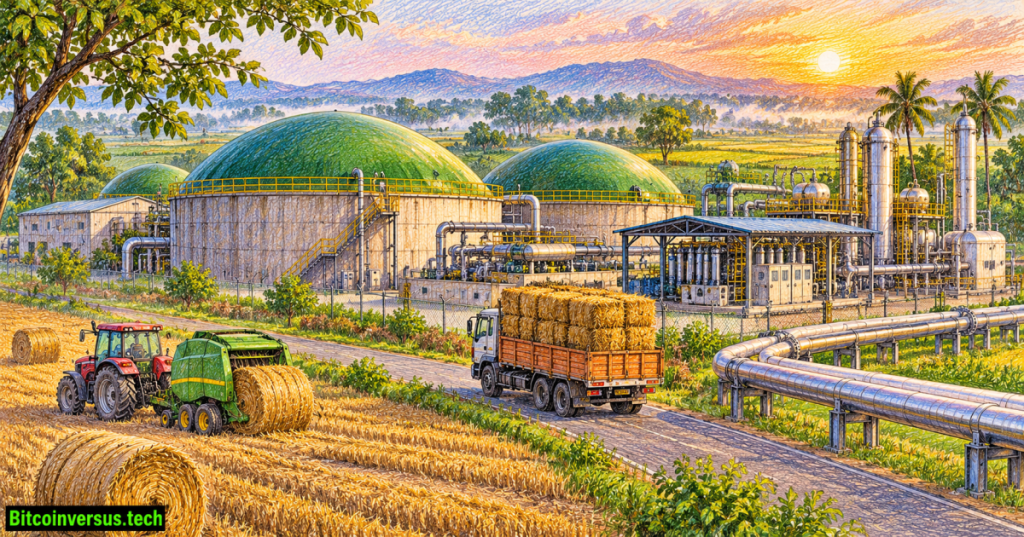
India’s Reliance Industries is planning approximately 100 compressed-biogas plants by 2030 at an estimated cost of ₹150 billion ($1.6 billion), according to comments from Bio Energy Business chief financial officer Vikas Rathi reported by Reuters on November 17, 2026. Rathi also outlined a production ambition of approximately 5 million cubic metres of gas per day from agricultural residues. The financial commitment and output figure are plans, not independently measured production or proof that 100 new facilities are already financed, built or commissioned. Reuters’ original report.
Asianet News English, July 2, 2026: verified news-channel recording of Reliance executive Ashwani Kumar discussing compressed-biogas strategy. Older background footage, not the November 17 announcement.
From crop residue to pipeline-quality gas
Compressed biogas (CBG) starts with organic matter—straw, cattle dung, sugarcane-processing residues or segregated food waste. In an oxygen-free anaerobic digester, microorganisms release methane-rich biogas together with carbon dioxide and trace contaminants. Gas-upgrading equipment removes carbon dioxide, moisture and hydrogen sulphide before compression or distribution. Reliance says its upgraded CBG contains more than 96% methane by volume, suitable for applications similar to compressed natural gas. Reliance’s technology overview describes the process.
Scale is a logistics problem as much as an energy problem. Facilities must secure a steady supply of agricultural residue, control moisture and contamination, keep digesters biologically stable, maintain gas-cleaning systems and arrange dependable fuel buyers. Methane leaks can substantially undermine climate benefits; lifecycle emissions depend on feedstock collection, competing land uses, energy consumed in upgrading and compression, and responsible handling of leftover digestate.
What Reliance has actually built
Reliance’s FY2025–26 annual report listed 35 operating CBG plants with roughly 700 tonnes/day of installed capacity, while observed production exceeded 270 tonnes/day. At the November event, Rathi reportedly cited 45 plants operating at reduced output and said another 10 were planned by March 2027. The differing counts refer to separate reporting dates and commissioning stages; they are not equivalent to all sites operating at their rated capacity. Primary annual-report disclosure.
A plant-level check helps distinguish nameplate ratings from delivered gas. The operator of Reliance’s Barabanki project reported reaching 15 tonnes/day of CBG from around 125 tonnes/day of paddy straw in October 2025, with a later 72-hour operating demonstration. That operating milestone should not be confused with India’s government registry showing the Barabanki facility as a 20-tonne/day commissioned project. Plant operator’s account and government project registry document the distinct figures.
India Science, May 24, 2022: official educational video promoting a Bio-CNG facility in Indore and explaining organic-waste conversion. Historical process context; not footage of a Reliance facility.
100 proposed plants or 500-plus by 2030?
The new 100-plant investment description does not precisely match Reliance’s broader website target of more than 500 CBG plants by 2030. The public disclosures do not establish whether the latest 100 are one funded tranche of a longer expansion, a different project scope or a revised near-term rollout. Treating 100 as a confirmed reduction of the 500-plus ambition would be premature. Read the stated 500-plus target.
Dividing ₹150 billion by 100 gives an illustrative ₹1.5 billion, or ₹150 crore, per planned plant. The arithmetic is not a disclosed unit construction budget: site sizes, land, feedstock handling, pipeline connections and financing can differ considerably. Reuters also printed an implausibly large daily mass-output figure for the current fleet, inconsistent with company filings; the disputed quantity is deliberately excluded from calculations pending clarification.
The opportunities and constraints
A larger CBG fleet could displace some fossil-derived gas and reduce open-field residue burning while creating a market for organic waste. Potential limitations include transport emissions, seasonal feedstock shortages, water needs, methane escape, capital cost and methane-price competitiveness. Renewable CBG is not automatically carbon-neutral, and commissioning dates matter more than aspirational plant counts.
For comparison, our North Carolina biomass power report covers a different conversion pathway: thermal biomass use rather than microbial digestion. Related analyses follow petroleum and refined-fuel supply, natural-gas generation investments and India’s electricity-storage plans.
The next verifiable milestones are the number of commissioned facilities, measured tonnes of CBG sold daily, delivered gas quality, feedstock supply contracts and project-level capital spending. Until the project rollout and 500-plant target are reconciled, investment announcements should remain separate from operating capacity.
Sources: Reuters, November 17, 2026; Reliance FY2025–26 report; Reliance Bioenergy; GPS Renewables operating account; Government of India commissioned-plants registry.
Editor’s note: The 1200 × 630 featured artwork is a colored-pencil concept illustration, not a documentary photograph of any Reliance plant. The linked videos are authentic, independently dated historical context rather than recordings of the November investment statement. Operating capacity, measured production, proposals and long-range targets are identified separately.


Leave a Reply