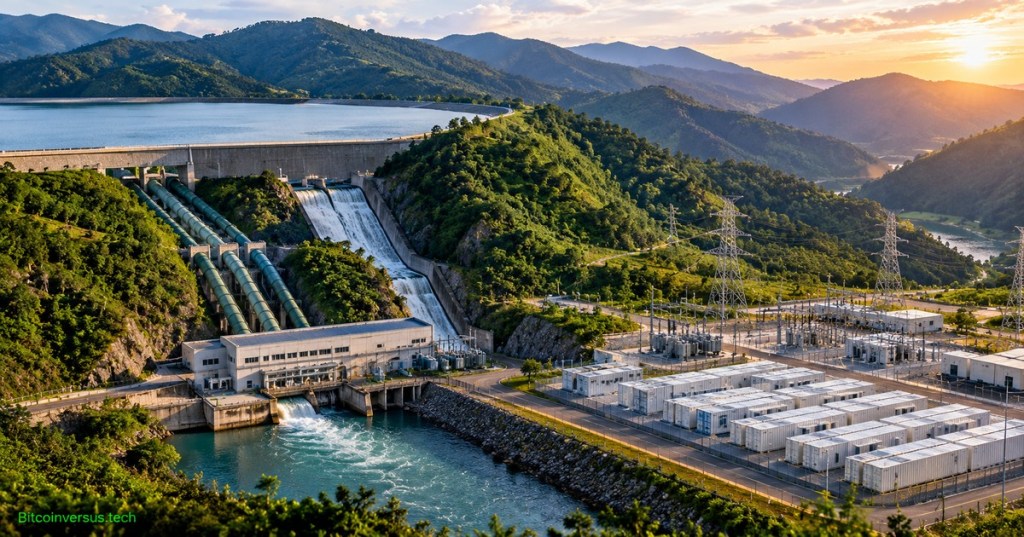
India has approved ₹14,500 crore in public support for 92 gigawatt-hours (GWh) of proposed grid-scale energy storage. The Union Cabinet’s November 4, 2026 decision allocates 60 GWh to pumped hydro, 30 GWh to batteries and 2 GWh to alternative technologies. Funding spans fiscal years 2026–27 through 2030–31. The 92 GWh describes storage capacity targeted for development, not equipment commissioned or electricity already supplied.
Pumped-storage plants use surplus electricity to pump water into an upper reservoir, then recover part of the energy when water flows downhill through turbines. Battery systems store energy chemically and release it through power electronics. Both technologies help shift output from variable solar and wind farms into periods of greater electricity demand. Energy in GWh differs from power in GW: energy capacity indicates how much can be stored, while power ratings determine the rate of discharge.
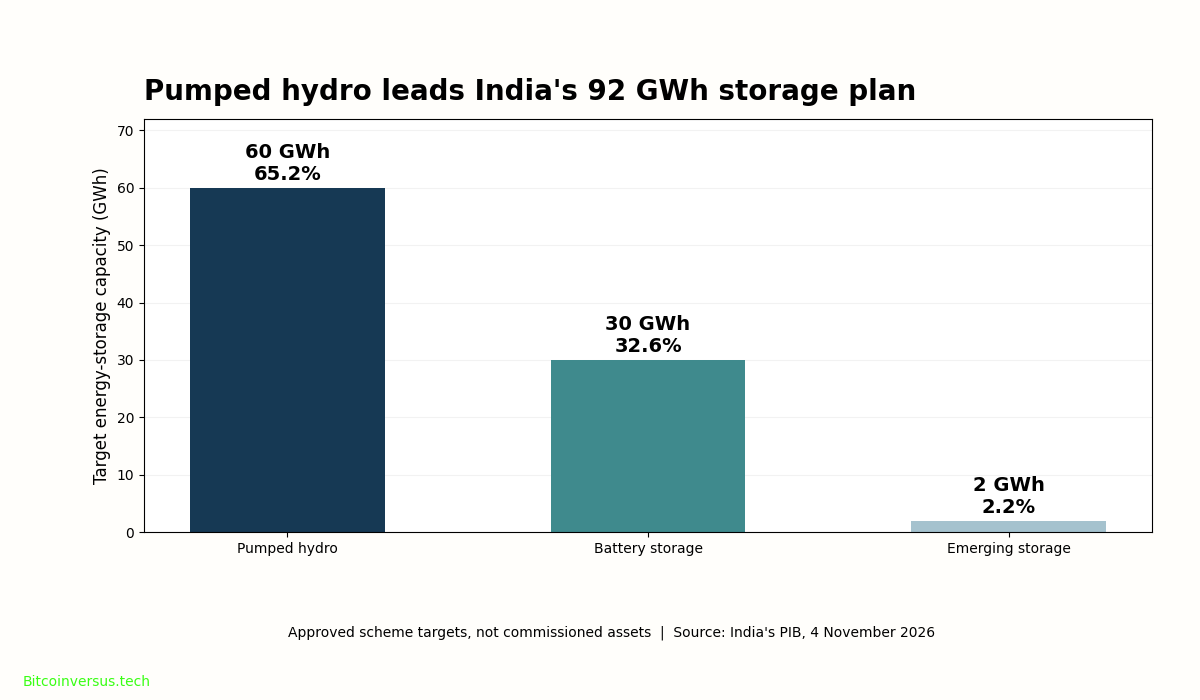
Pumped hydro gets nearly two-thirds
Pumped hydro represents 65.2% of the approved program’s planned energy capacity, batteries 32.6% and emerging storage 2.2%. Those shares use 92 GWh as the common denominator. The government has not specified the precise technologies or sites for the 2 GWh emerging category. India says allocations will proceed through tariff-based competitive bidding, not automatic construction authorizations. Battery projects must meet a 40% minimum domestic-content requirement, adding procurement obligations alongside manufacturing opportunities.
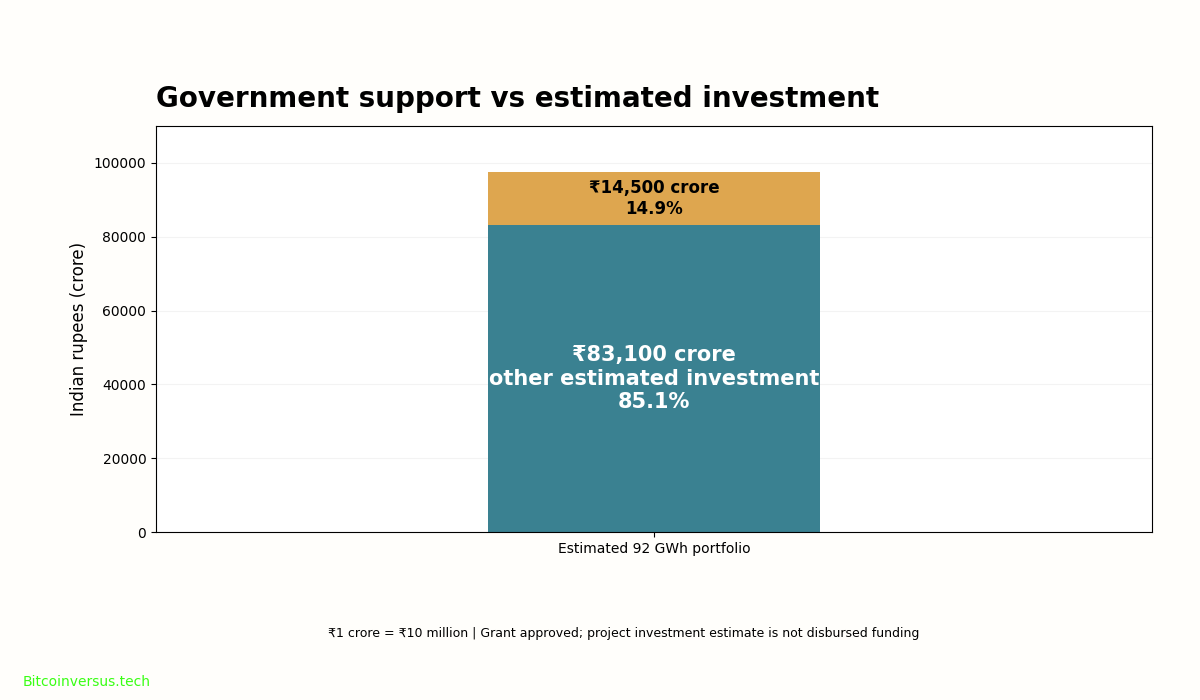
₹14,500 crore support inside a much larger budget
The Cabinet estimates ₹97,600 crore of investment across the 92 GWh program. Approved viability-gap funding equals approximately 14.9% of that estimate; the remaining ₹83,100 crore is an arithmetic remainder, not evidence of financing secured from named investors. Viability-gap grants are intended to make projects commercially feasible where market revenue would otherwise be inadequate. Tender prices, construction costs, financing terms and actual disbursements remain unknown.
The new scheme complements earlier storage policies, including India’s green-energy transmission and storage plans. Its estimated 92 GWh equals about 22.4% of the government’s cited 411 GWh national storage requirement for fiscal 2031–32. The comparison measures scale against a projected requirement; it does not establish how much of the national gap will remain after other projects are delivered.
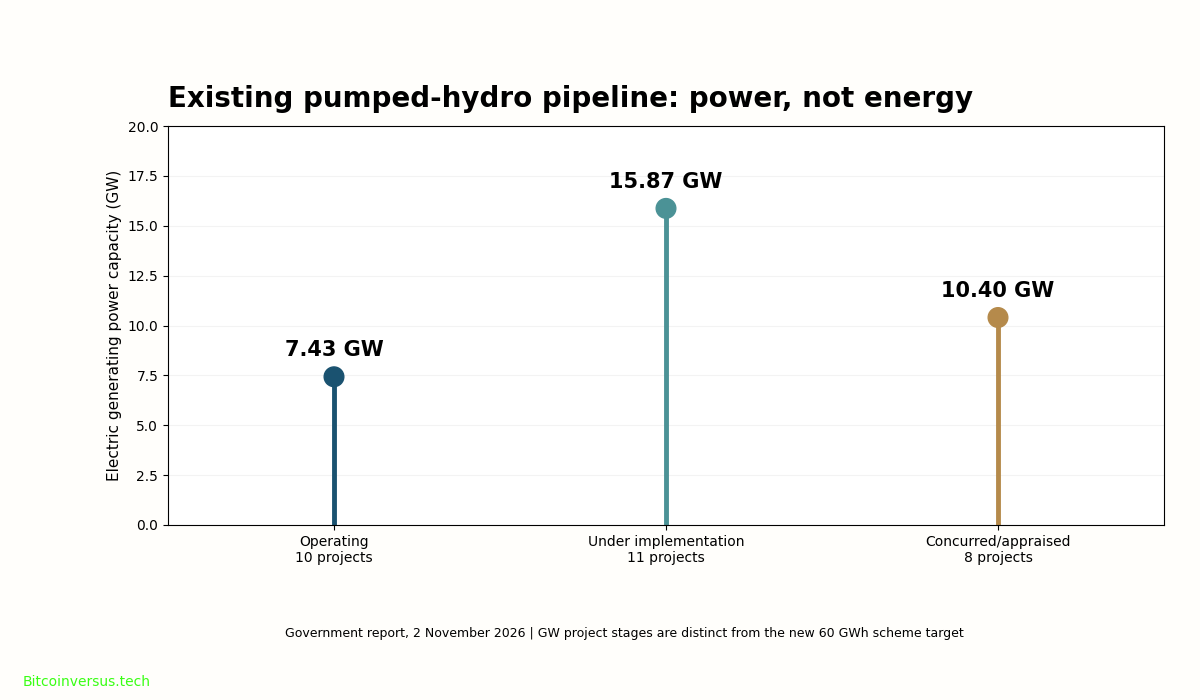
Existing pumped-hydro projects are not the new scheme
A separate November 2 government briefing listed 7.43 GW of pumped-storage generating capacity operating across ten projects as of August 2026, plus 15.87 GW at eleven projects under construction or implementation and 10.40 GW across eight concurred or appraised projects. Those stage figures use GW, not GWh, and must not be added to the new program’s 60 GWh energy target. Project pipeline status is also not a commissioning guarantee.
The delivery test
Pumped hydro requires favorable terrain, reservoirs, transmission connections and lengthy engineering and environmental reviews. Battery projects face procurement, fire-safety, grid-connection and degradation considerations. Domestic-content rules could strengthen manufacturing while complicating sourcing and cost management. Elsewhere, proposed Scottish pumped-hydro development and New York storage grants show different funding approaches without proving equivalent construction economics.
India’s decision could improve renewable-energy utilization if competitive procurement produces financially viable plants. Yet global renewable-capacity growth is creating more demand for flexibility, and grid-connection delays can outlast renewable construction. The measurable result today is an approved financing framework and an explicit technology split. Installed storage, project operating duration, verified efficiency and delivered peak-hour electricity must be assessed after projects enter service.
Editor’s Note
The Cabinet approval was announced on November 4, 2026. The ₹14,500-crore VGF support, ₹97,600-crore total investment estimate, 60/30/2 GWh split, 40% domestic-content rule, and 411 GWh national requirement are government-reported values. Calculated percentages are editorial arithmetic. Pumped-storage operating and development-stage GW figures come from a separate November 2 briefing and use a different unit. All illustrated facilities are conceptual rather than photographs of specific commissioned projects. No verified topical YouTube video was available for insertion at publication.
Support BitcoinVersus.Tech
To support independent technical reporting, scan the original approved QR below for an optional 5,000-satoshi contribution. On a phone, display the code on a second device or use a Bitcoin wallet’s supported image-scanning function. Verify the receiving address and amount before authorizing a payment.

We volunteer daily to ensure the information on this platform is Verifiably True. If you would like to support the research, please scan QR code.


Leave a Reply