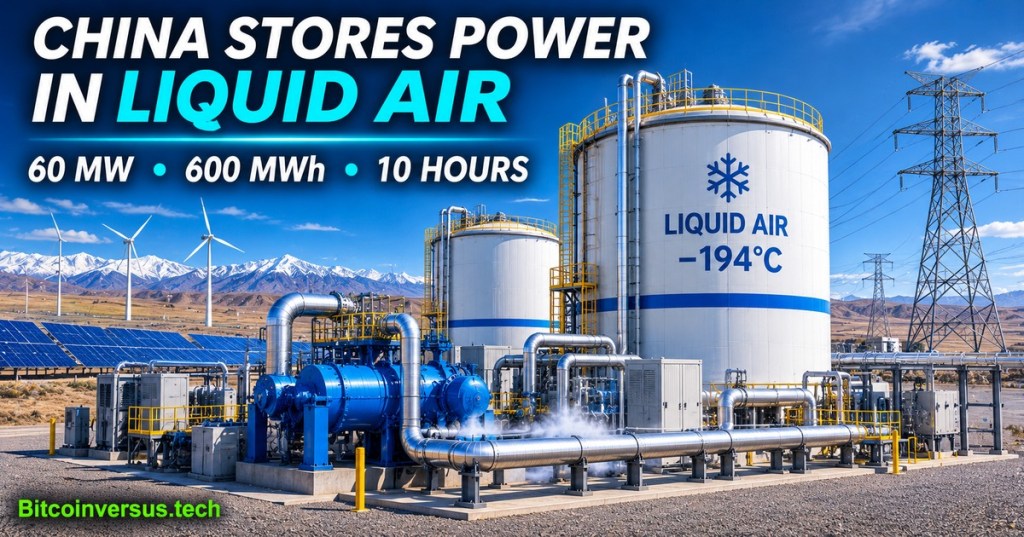
China’s largest reported liquid-air electricity storage plant began delivering power to the grid in Golmud, Qinghai province, on October 30, 2026. The demonstration is rated at 60 megawatts (MW) of output and 600 megawatt-hours (MWh) of energy capacity. Developer China Green Development Investment Group and the Golmud municipal government describe it as the world’s largest grid-connected plant using liquid-air storage, a narrower claim than the world’s largest energy-storage facility of any kind.
Unlike lithium-ion batteries, liquid-air energy storage uses electricity to refrigerate and liquefy ordinary air, then stores the cold fluid until electricity is needed. Grid connection marks an engineering milestone, not proof of years of reliable commercial operation.
Highview Power’s April 2018 animation explains the liquid-air charge and discharge cycle. Historical UK-developed technology background, not footage from the new Golmud plant. Source: Highview / YouTube.
Turning electricity into extremely cold air
Surplus power drives compressors and refrigeration equipment. Air is purified, chilled to approximately −194°C and collected in insulated, near-atmospheric-pressure tanks. When electricity demand rises, pumps pressurize the liquid; reheating causes it to expand through a turbine coupled to a generator. Recovery of compression heat and discharge cold can reduce energy losses.
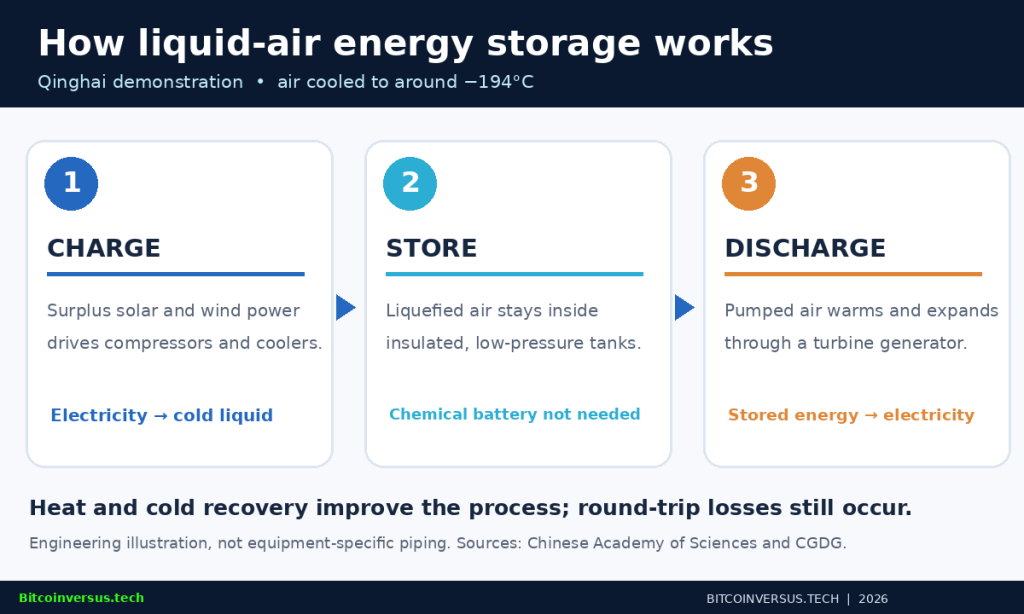
The Chinese Academy of Sciences says researchers progressed from a 100-kilowatt experimental platform to a project hundreds of times larger in rated power. The Qinghai facility combines cryogenic exchangers, compressors and turbine controls without requiring a salt cavern. Equipment supplier Shengu Group confirmed supplying the large centrifugal compressors on November 3.
What 60 MW and 600 MWh actually mean
Power and energy must not be confused. A 60 MW generator can supply electricity at a rate of 60 MWh each hour. Dividing 600 MWh by 60 MW gives ten hours of theoretical full-power discharge, assuming all 600 MWh represents deliverable electricity. Several November reports repeat a ten-hour design duration, but the ratio is not a verified ten-hour operating test.
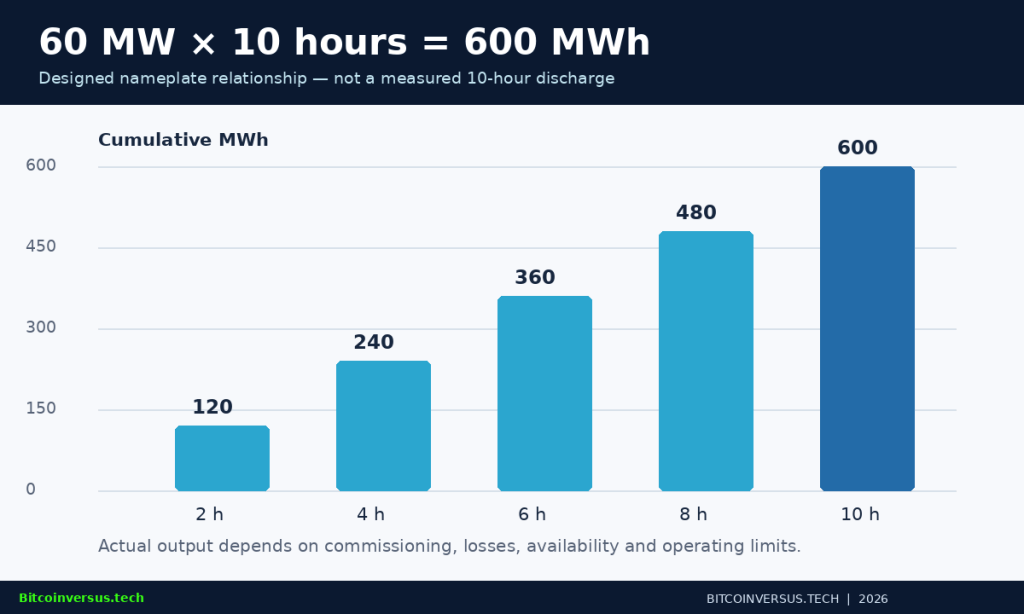
An important discrepancy remains: a 2025 Chinese government project list describes the same 60 MW/600 MWh demonstration with six hours of storage, five hours of generation and a proposed 55% electricity-to-electricity conversion efficiency. The newer reports do not provide an independent as-built efficiency test explaining the difference. The figures should not be merged as though all describe measured performance.
A new option for renewable-heavy grids
China Green Development projects about 180 GWh of electricity delivered annually and says all principal equipment is domestically sourced. Both are company-reported claims, not independently audited annual results. Qinghai’s solar and wind resources make shifting generation from low-demand hours to evening peaks valuable; renewable capacity growth increases the need for flexible power systems.
A February 2014 Highview Power pilot-plant site visit offers historical context on practical liquid-air machinery. The UK pilot is unrelated to the Chinese facility. Source: Highview / Energy Live News / YouTube.
Liquid-air systems compete with battery arrays and pumped hydropower for long-duration services. Related Indian storage investment concerns a much larger energy portfolio, while New York’s advanced-storage grants demonstrate continued interest in multiple technologies. An earlier battery supply proposal demonstrates another storage approach, not a confirmed alternative with equivalent operating duration.
Unlike pumped hydro, insulated tanks need no mountain reservoir, but refrigeration and reheating consume electricity. Long-term cost, uptime and round-trip efficiency still require operating data. Golmud now provides a test at utility scale. The decisive measurements will be sustained discharge duration, electricity consumed during charging, net output, maintenance requirements and cost per MWh returned to the grid. Such records will determine whether the plant’s early achievement becomes a competitive storage business.
Sources and Editor’s Note
Editor’s Note: Primary sources include Golmud municipal reporting dated November 2, 2026; the Chinese Academy of Sciences; Shengu Group; and the 2025 National Development and Reform Commission demonstration-project list. Industry reports dated November 6 support commissioning and capacity claims. “World’s largest” is attributed to the developer for grid-connected liquid-air storage only. The 600 MWh/60 MW calculation is nameplate arithmetic, not observed ten-hour operation; historical planning specifications differ. The feature image is conceptual artwork. Highview videos are older explanatory material and are not footage of Golmud.
Support BitcoinVersus.Tech
For an optional 5,000-satoshi contribution, scan the original BitcoinVersus.Tech QR with a compatible Bitcoin wallet. Mobile readers can show the code on another display or use supported wallet gallery scanning. Verify the destination and amount before sending.

We volunteer daily to ensure the information on this platform is Verifiably True. If you would like to support the research, please scan QR code.


Leave a Reply