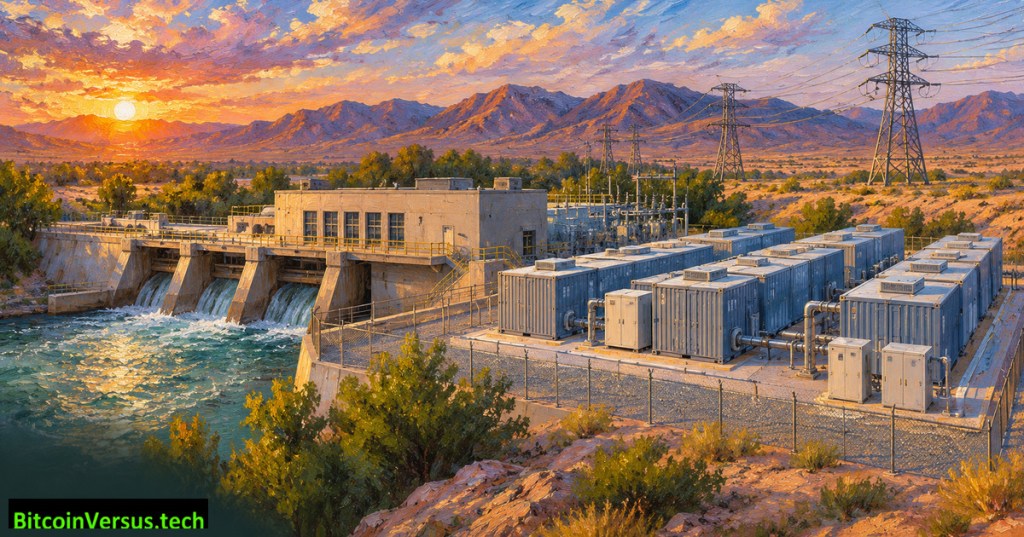
California has approved a $7.11 million grant for the first phase of a non-lithium battery designed to deliver electricity for ten hours. The Echo Sands Community Resilience project, announced by CMBLU Energy and the Imperial Irrigation District (IID) on November 18, 2026, is planned for the Pilot Knob Hydroelectric Power Plant in Winterhaven, near the Colorado River. The project aims to improve grid resilience for the Fort Yuma Quechan Indian Tribe and neighboring communities, especially during extreme heat.
There are two different project sizes to understand. The full proposed installation is 10 megawatts (MW) and 100 megawatt-hours (MWh). The state-supported initial phase is only 1 MW and 10 MWh. The California Energy Commission’s November 18 resolution authorizes precisely $7,111,984 for IID; CMBLU’s announcement describes the award more broadly as $7.2 million. Neither document establishes that the full 100 MWh is already installed or financed.
CMBLU’s official 2023 company film explains its organic SolidFlow technology. It predates Echo Sands and does not show construction at the California site.
What makes a ten-hour battery different?
Power and stored energy are related but distinct. Dividing the proposed 100 MWh of energy by 10 MW of discharge power gives 10 hours at rated output. The first phase has the same nominal ratio: 10 MWh divided by 1 MW. Actual usable discharge duration can vary with conversion losses, reserve settings, temperature and operating restrictions. Nameplate figures are not equivalent to a demonstrated ten-hour grid discharge.
A longer discharge window could help shift electricity into evening peaks and maintain selected services during extended grid disruptions. It does not guarantee uninterrupted electricity for every customer during a widespread outage. The utility would need appropriate controls, interconnection and islanding arrangements. The planned installation would complement existing infrastructure, just as our reporting on rapid growth in U.S. battery capacity shows storage becoming more important to grid operations.
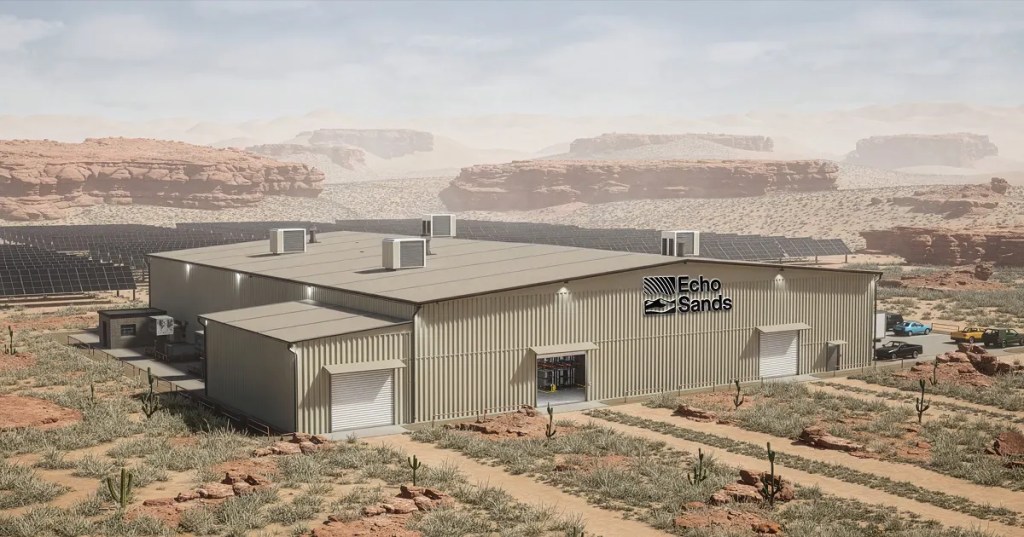
How CMBLU’s SolidFlow chemistry stores energy
CMBLU combines organic solid storage material with a circulating water-based electrolyte. Instead of storing the relevant energy entirely in liquid tanks or lithium-ion electrodes, the design uses a redox-flow architecture to move charge through a system containing solid active materials. The company says the chemistry avoids lithium and vanadium and uses nonflammable components. Those are company design claims, not an independent safety certification of Echo Sands.
On its current product page, CMBLU lists a 10 kW / 100 kWh module, 75% efficiency and a potential service life of up to 20 years. None of those marketing specifications should be presented as measured efficiency, degradation or lifetime at the proposed California facility. The distinction matters when comparing the approach with the 1.6 GWh conventional battery installation in Florida, where scale and operating history are different.
Official CMBLU modularity demonstration from July 2024. Its animated 50 MW / 250 MWh example illustrates scalability; it is not a rendering of the 10 MW / 100 MWh Echo Sands layout.
Why California is supporting the first phase
The California Energy Commission approved the grant under its Community Energy Reliability and Resilience Investment program. IID, a community-owned water and power utility, is working with CMBLU on a two-phase project. The developers identify Pacific Northwest National Laboratory, the Electric Power Research Institute, Campesinos Unidos and other groups as expected partners. Specific commercial operating dates and the financing required for phase two were not established in the announcement.
Storage options address different grid problems. Our report on China’s 600 MWh liquid-air plant examines another ten-hour design; the California vanadium-flow project illustrates a separate non-lithium approach. And growing solar generation gives utilities a reason to investigate storage lasting beyond short demand spikes.
What must happen before Echo Sands proves its case
The next evidence should be procurement, permits, construction, commissioning and measured discharge at the first 1 MW / 10 MWh phase. Verified round-trip efficiency, availability during heat waves, maintenance cost and long-term degradation will matter more than specifications alone. The larger 10 MW / 100 MWh proposal remains a future phase. For now, the consequential development is an approved grant for a real-world demonstration of a different battery architecture—not a completed ten-hour power plant.
Primary sources and reporting
- CMBLU and IID, November 18 project announcement
- California Energy Commission, November 18 adopted resolution 26-1118-03c
- CMBLU, SolidFlow battery technical specifications
- ESS News, November 20 independent coverage
- CMBLU company film and CMBLU modularity demonstration
Editorial image disclosure: The featured cover is an original oil painting illustrating the proposed combination of hydroelectric infrastructure and modular batteries; it does not depict a completed Echo Sands installation. The in-story site photograph is authentic and credited to CMBLU.


Leave a Reply