
Alternate-universe scouting report, not a historical claim. Imagine Michael Jordan at his competitive peak playing a modern EuroLeague career instead of his NBA career. The assignment changes the rules, schedule and opponents—not Jordan’s documented athletic profile. A 40-minute European contest makes raw points per game misleading unless playing time is addressed.
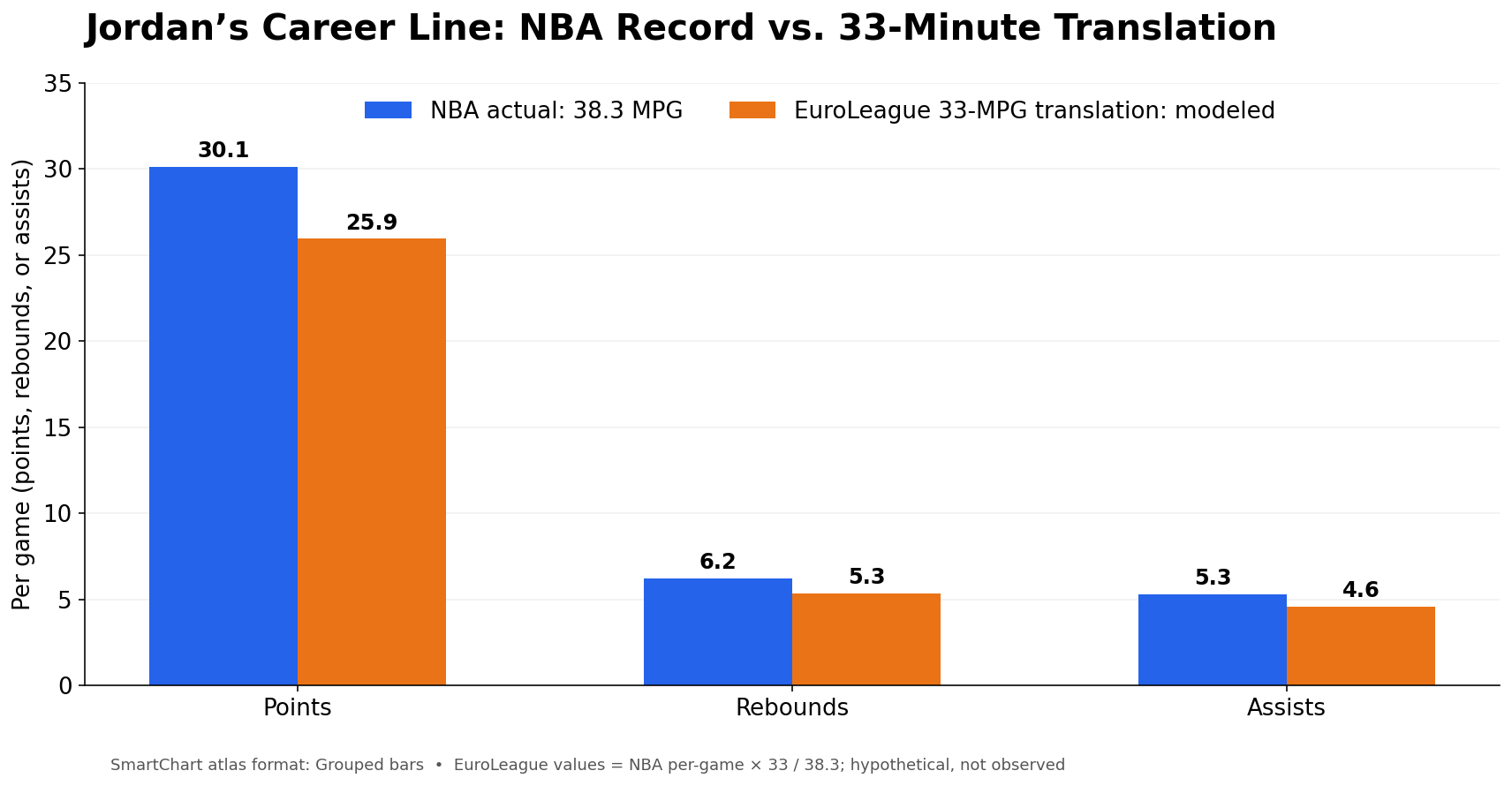
The historical reference is clear: across 1,072 NBA regular-season appearances, Jordan averaged 30.1 points, 6.2 rebounds and 5.3 assists in 38.3 minutes per game, with 49.7% shooting. He won six NBA championships and five regular-season MVP awards. None of the EuroLeague figures below are recorded achievements; each comes from an explicit hypothetical assumption. Source: Basketball-Reference.
Film footage: ESPN channel, non-NBA YouTube upload. Watch directly on YouTube if playback is unavailable.
Scouting profile: Jordan against European defenses
Position: shooting guard and secondary creator; listed height: 6 ft 6 in (1.98 m). Primary strengths: first-step separation, body control, mid-post footwork, fadeaway scoring, transition finishing, perimeter defense and late-clock creation. His ability to attack either elbow would translate especially well when opponents switch pick-and-roll actions or crowd the lane.
EuroLeague opponents can deploy compact help schemes and deliberately load the paint. Jordan’s career 32.7% NBA three-point accuracy would be a genuine analytical concern for modern spacing, although the shorter FIBA arc could alter shot selection. His passing would punish aggressive traps, while physical defensive assignments and a five-person starting unit would influence his workload. EuroLeague games last 40 minutes, compared with 48 in the NBA; the rules and scoring context are not identical. See the peer-reviewed NBA–EuroLeague rules comparison.
Model: translating NBA output to a 33-minute EuroLeague role
Assume Jordan plays 33 minutes per EuroLeague game and initially retains his recorded NBA per-minute production. For any box-score category, the calculation is NBA per-game average × 33 ÷ NBA minutes per game. Applying it to his career yields 25.9 points, 5.3 rebounds and 4.6 assists. The conversion isolates playing time; it does not establish EuroLeague shooting efficiency, opponent strength, pace or the effect of coaching.
Five career checkpoints
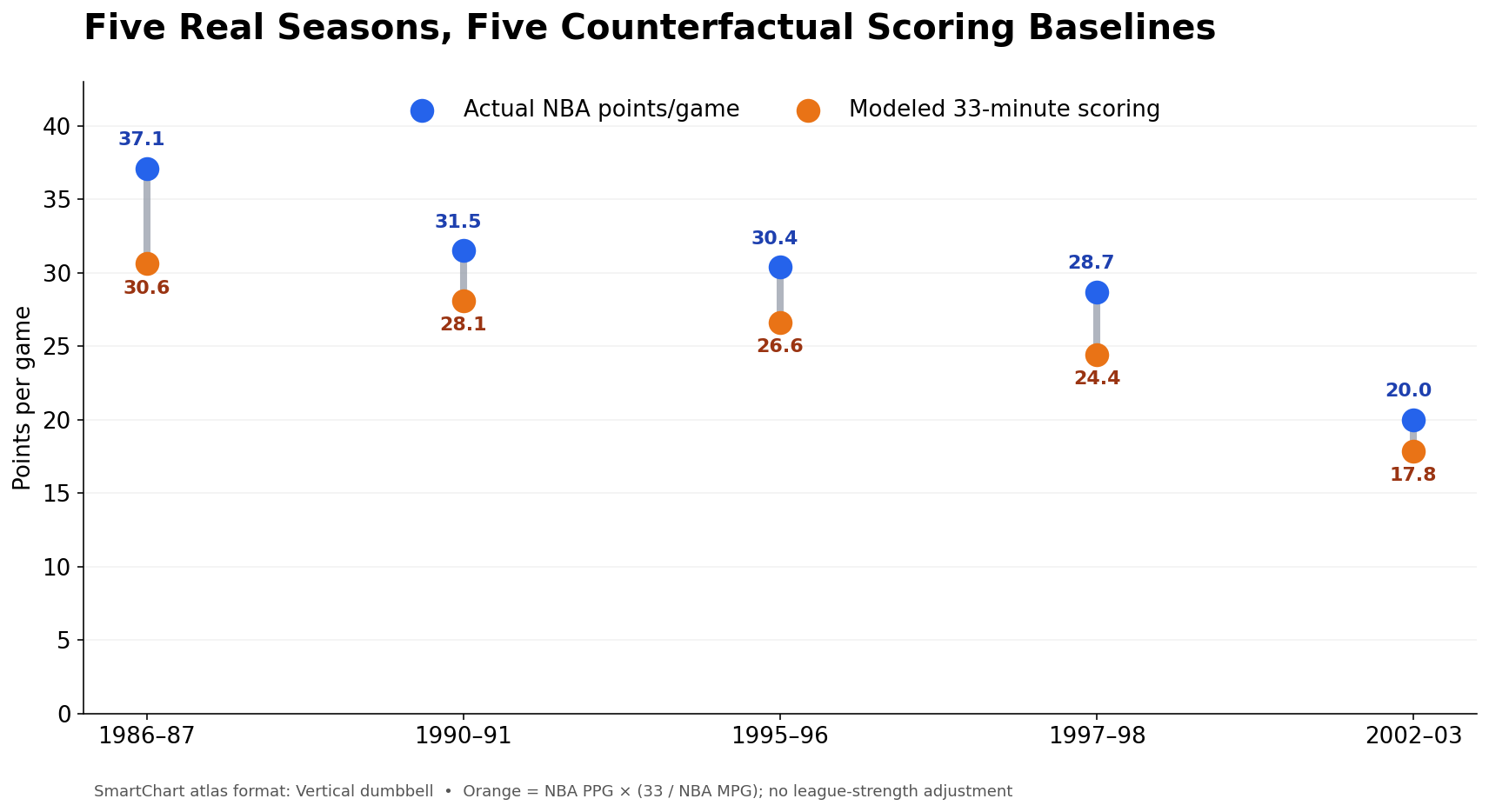
Jordan’s 1986–87 scoring season reached 37.1 NBA points in 40.0 minutes, converting to 30.6 across 33 minutes. The corresponding estimates are 28.1 for 1990–91, 26.6 for 1995–96, 24.4 for 1997–98 and 17.8 for 2002–03. Blue markers show genuine NBA statistics; orange markers represent the same hypothetical minutes-only adjustment. A projected 1990–91 score of 28.1, for example, becomes approximately 25.3–30.9 points with an illustrative ±10% rate sensitivity, not a measured confidence interval.
Film footage: ESPN channel, non-NBA YouTube upload. Watch directly on YouTube if playback is unavailable.
Alternate career trajectory and award outlook
An age-based simulation offers four phases: early adaptation from ages 21–24, peak offensive responsibility from 25–32, a footwork-driven veteran phase from 33–35 and reduced-volume closing seasons around 38–40. Modern EuroLeague competition began after Jordan’s real professional debut, so the imagined timeline deliberately transports his skill set into the modern format rather than pretending the same league existed in 1984.
A prime-season scouting forecast of roughly 26–31 points per game is defensible as a scenario range, with an especially high-usage year potentially exceeding it. Assists could rise under a ball-dominant system or fall within a shared-creation offense. Multiple MVP-caliber seasons are plausible; specific championship counts cannot be responsibly assigned without teammates, coaching, injuries and opponents. Compare the real competition’s contemporary stars in our EuroLeague top-seven report.
Scouting verdict
Projected tier: elite two-way primary scorer and perennial MVP candidate. Best role: lead perimeter option with a stretch frontcourt, creative pick-and-roll partner and aggressive defensive wings. Primary uncertainty: shot distribution, travel, shorter games and changing roster systems. Jordan’s NBA prime is documented; no conversion can determine how he would actually perform overseas. Related scouting and league-politics reporting includes Jordan versus LeBron after 40, proven stars playing outside the NBA and a modern guard scouting comparison.
Method and sources: Basketball-Reference NBA season and career statistics; peer-reviewed comparison of NBA and EuroLeague basketball; BitcoinVersus SmartChart 40-chart atlas. Video commentary is from ESPN’s YouTube channel, not the NBA channel. Original image depicts a fictional scenario.


Leave a Reply