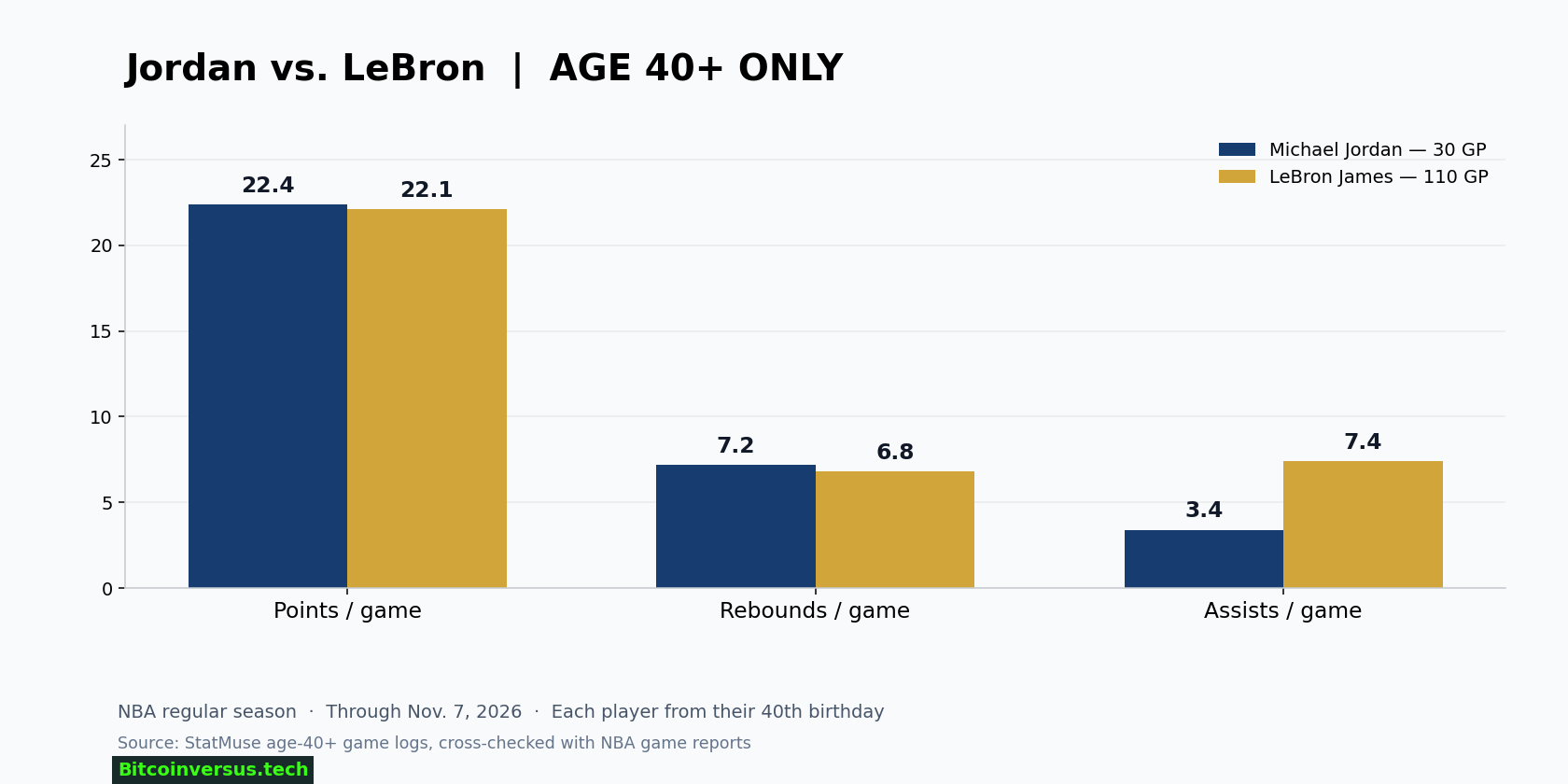
After their 40th birthdays, Michael Jordan and LeBron James remained productive NBA players in different eras. Jordan finished his Washington Wizards career averaging 22.4 points over 30 regular-season games after turning 40. LeBron averaged 22.1 points in 110 such games through November 7, 2026. Their scoring rates are close; their passing, shooting efficiency and length of service are not.
The age cutoff matters. Jordan turned 40 on February 17, 2003, and his qualifying games began February 19. LeBron James turned 40 on December 30, 2024, and his first qualifying game followed December 31. Full 2002–03 or 2024–25 season averages would include games before the respective birthdays and distort the comparison.
Jordan scored 43 at 40; LeBron reached 42
Jordan produced 43 points, 10 rebounds and four steals against the New Jersey Nets on February 21, 2003. Washington won 89–86, and he shot 18-for-30. Four days after his birthday, the 43-point performance remained his highest after age 40. Across his final 30 appearances, he recorded four 30-point games.
Archival Michael Jordan highlights versus New Jersey, February 21, 2003: 43 points at age 40. Credit: MJ23 His Airness Forever/YouTube. NBA game record independently confirms the totals.
LeBron scored 42 points, 17 rebounds and eight assists against Golden State on February 6, 2025, in a 120–112 Lakers win. He added a 40-point outing against Portland on February 20, 2025. Through the stated cutoff, he had 16 games of 30 or more points and two 40-point games after turning 40, versus Jordan’s four and one. The raw totals favor LeBron partly because he played 80 more games.
Official NBA highlights: LeBron James scores 42 points with 17 rebounds and eight assists against Golden State on February 6, 2025, at age 40. Credit: NBA/YouTube.
Points, rebounds and assists per game
The per-game scorecard is tightly contested in two categories: Jordan 22.4 points versus LeBron 22.1, and Jordan 7.2 rebounds versus LeBron 6.8. The passing gap is substantial: LeBron 7.4 assists versus Jordan 3.4. Jordan also averaged 1.3 steals to LeBron’s 1.2; LeBron averaged 0.6 blocks to Jordan’s 0.5.
Minutes change the interpretation. Jordan averaged 39.9 minutes against LeBron’s 33.8. Normalizing their rounded scoring rates to 36 minutes gives approximately 20.2 points for Jordan and 23.5 for LeBron; their assists normalize to about 3.1 versus 7.9. The per-36 view describes rate production, not hypothetical guaranteed output in extra playing time.
LeBron’s shooting efficiency leads; Jordan wins at the foul line
From the field, Jordan converted 46.2% to LeBron’s 51.4%. From three-point range, the marks were 22.2% and 34.6%, respectively; Jordan took only 18 three-point attempts in his age-40 sample, limiting the stability of his percentage. True shooting percentage—which combines two-pointers, threes and free throws—was 50.3% for Jordan against 59.8% for LeBron, a 9.5-percentage-point difference. Jordan led at the line, 83.9% versus 75.3%.
The difference between conversion rate and volume parallels the site’s three-point percentage leaderboard: made attempts and total attempts matter as much as the percentage. Likewise, an earlier Maxey–Curry statistical comparison separates scoring rate from shot selection.
Age-40+ totals reflect very different sample sizes
Jordan finished with 671 points, 215 rebounds, 103 assists, 39 steals and 14 blocks after his 40th birthday. LeBron’s through-cutoff totals were 2,427 points, 749 rebounds, 810 assists, 131 steals and 64 blocks. The same caution applied in the site’s sports-science examination of extreme dunk distances applies here: measured accomplishments must be distinguished from extrapolations.
Jordan’s post-40 window lasted 30 games before retirement. LeBron’s spans multiple seasons, and the 2026–27 entries belong to a player still aged 41 on November 7, 2026, regardless of season-age labels elsewhere. The comparison supports precise conclusions about production after age 40, not a verdict on entire careers.
Sources and calculation notes
Statistics: Jordan age-40+ game-by-game totals; age-40+ leaderboard including LeBron through November 7, 2026; LeBron season segments after turning 40; NBA February 7, 2025 game report; NBA February 21, 2003 game record. Totals cover regular-season games only and include no pre-birthday appearances or playoffs. Rates are rounded to one decimal; ratios and percentage-point differences are not adjusted for pace or opponent strength.
Editor’s Note: Statistical snapshot through completed games November 7, 2026. The featured cover is an original jersey-only illustration, not a photograph of either player; the image is used exclusively as the featured cover. Historic video footage is contextual, not proof of any season-spanning statistic. Playing-time, era and unequal-sample limitations are disclosed to prevent false equivalence.
Support BitcoinVersus.Tech
For an optional 5,000-satoshi contribution, scan the original BitcoinVersus.Tech QR code with a compatible Bitcoin wallet. Verify the destination and amount before approving any payment.

We volunteer daily to ensure the information on this platform is Verifiably True. If you would like to support the research, please scan QR code.
Sports statistics and comparisons are for informational purposes, not gambling advice.


Leave a Reply