
Ronald Reagan offered Americans a simple response when they disliked how a state was run: “You can vote with your feet in this country.” Nearly fifty years later, a pandemic-era migration wave gave the expression new relevance. Families left parts of the North and West for the South; many settled around growing cities in Texas and Georgia, where major new data-center investment proposals now reflect continuing Sun Belt economic growth. In the November 3, 2026 midterms, Democrats captured the governorships of both states. The irony: moving changes an electorate before ballots are cast.
What Reagan actually meant by “vote with your feet”
Reagan made the remark during a January 1976 presidential campaign appearance in New Hampshire. As reported by The Washington Post’s account of contemporary reporting, he argued that residents could relocate if states failed to maintain adequate public assistance after federal welfare responsibilities were reduced. He was discussing welfare policy, not predicting liberal migration to Republican states. Yet mobility still lets Americans respond to differing state conditions.
Reagan Library archival video of the August 1981 tax and budget signing. The footage documents his economic agenda, not the separate 1976 “vote with your feet” remark. Source: Reagan Library / National Archives.
The pandemic made voting with your feet a mass movement
Remote work, household reassessment, rising housing costs and job relocation encouraged Americans to leave expensive metropolitan areas during COVID-19. According to the U.S. Census Bureau, the South alone recorded net domestic migration of 657,682 people from July 2020 to July 2021. For 2023–24, it was again the only region with positive net domestic migration, adding 411,004 residents from moves within the country. Those figures measure regional flows, not the ideology of movers.
Texas was a major destination: its net domestic migration reached 230,961 in the year ending July 2022, according to Census state estimates. A March 2026 Census migration study identified Texas counties east of Dallas as national growth leaders in 2021–23 and Georgia counties north of Atlanta as leaders in 2024. The pattern spans growing suburbs where new residents can register to vote. An earlier BitcoinVersus.Tech account of Georgia-to-Detroit migration illustrates how American relocation patterns have also moved in the opposite direction.
Families moved for housing, work or relatives without necessarily abandoning their politics. Some remained progressive; others were conservative or independent. Growing demand also pushed prices upward in some destinations.
From moving trucks to the 2026 ballot box
The November 2026 results made the long migration story politically tangible. In Texas, Democrat Gina Hinojosa defeated Republican Governor Greg Abbott and James Talarico won a U.S. Senate seat against Ken Paxton. In Georgia, Keisha Lance Bottoms won the governorship and Senator Jon Ossoff won reelection, according to CBS News election reporting. The victories followed years of shifting suburban populations and voter coalitions; they also coincided with a national backlash against Republican incumbents.
CBS News coverage of Texas’s projected Democratic victories after the November 3, 2026 midterms. Source: CBS News / Paramount Press Express.
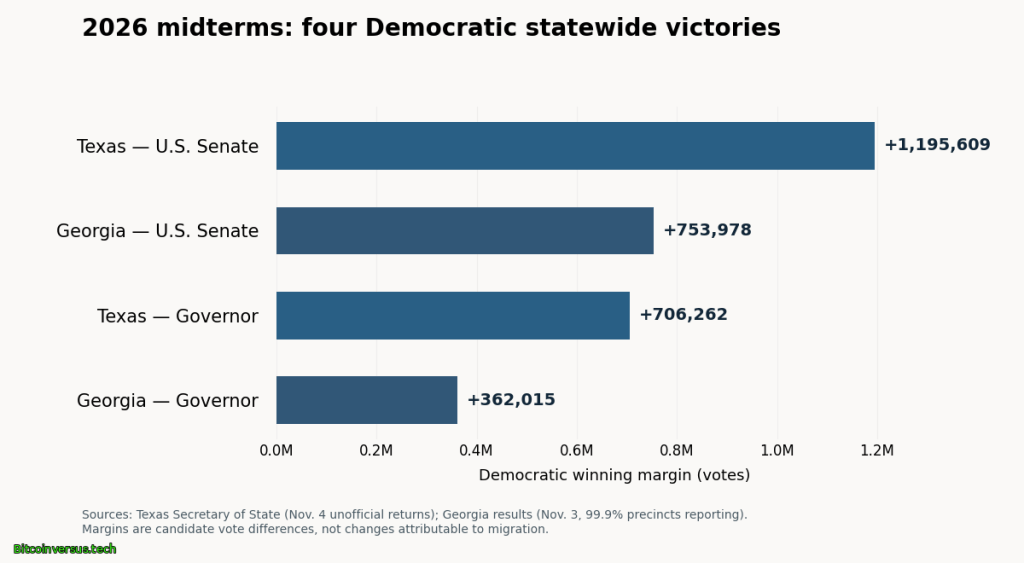
Reagan’s phrase permits a paradox: households may move to Texas for jobs or housing, yet oppose Republican candidates there. Longtime residents can also change their votes. BitcoinVersus.Tech’s midterm charts place the two states within the wider 2026 Democratic gains.
Did migrants actually turn the states blue?
The mechanism remains unquantified. Research published by the Texas Tribune found that California was a major origin for new Dallas–Fort Worth suburban residents. Yet exit polls in 2018 and 2024 showed Texas transplants voting more Republican than Texans born in the state. Census migration counts cannot distinguish 2026 voters from nonvoters or identify partisan registration, candidate preference or length of residence.
Donald Trump’s standing and turnout patterns offer separate explanations. A mid-October Marquette Law School survey of Wisconsin registered voters measured 37% approval and 61% disapproval, a net minus 24 points in that state—not a national figure. Texas election coverage highlighted urban and border-county turnout and changing Republican margins. Candidate choice, local conditions and voter participation may have mattered as much as newer residents. The wider debate over policy backlash in the 2026 midterms demonstrates the competing explanations.
Reagan’s advice acquired a new political meaning when pandemic movers settled in Southern states that later elected Democrats. The chronology is clear; proof that the moves determined election outcomes would require voter-level migration and turnout data.
Editor’s Note
BitcoinVersus.Tech distinguishes Reagan’s documented 1976 remark about state welfare policy from later arguments about taxation, housing and migration. Census counts show relocation, not political affiliation. Election results reflect November 2026 calls and preliminary tallies, subject to certification; the chart shows vote margins and cannot isolate migrant votes. Reagan footage depicts a different event from the quoted statement. Videos use rendered WordPress YouTube embeds; playback on all devices has not been independently established. The featured illustration is conceptual.
Support BitcoinVersus.Tech
For an optional 5,000-satoshi contribution, scan the original QR with a compatible Bitcoin wallet. When reading on a phone, open the code on a second device or use your wallet’s supported saved-image scanner. Confirm the address and amount before sending.

We volunteer daily to ensure the information on this platform is Verifiably True. If you would like to support the research, please scan QR code.


Leave a Reply