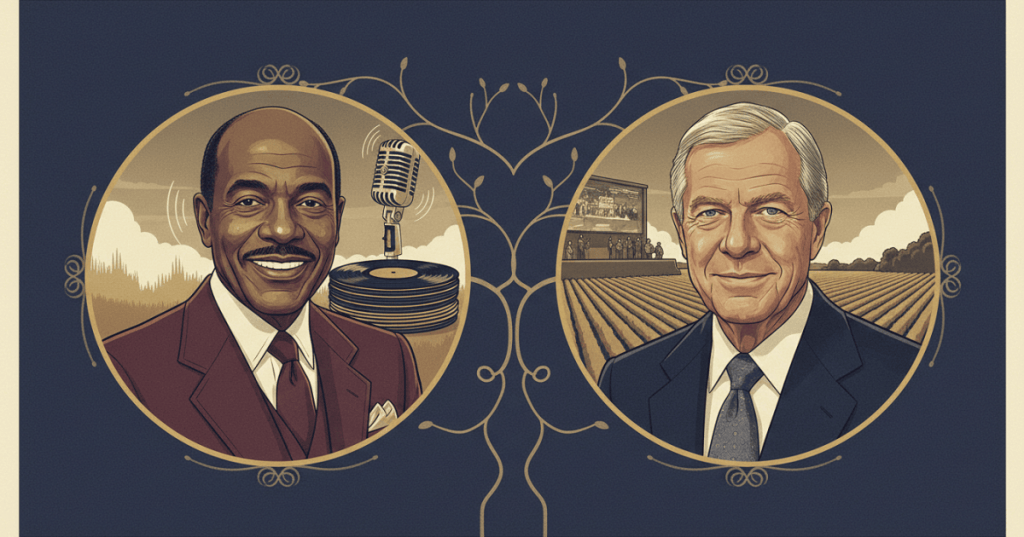
November 5, 2026 — As American voters absorb the results of the November 3 midterm elections, the political transition of the early 1990s offers a revealing comparison. In 1992, economic dissatisfaction, generational changes and emerging forms of entertainment-driven political communication coincided with a change in the White House. The 2026 midterms have produced another transfer of power, with the Associated Press reporting that Democrats won control of both chambers of Congress. Yet a presidential election and a midterm election operate differently, and their outcomes should not be treated as interchangeable.
A less familiar historical connection illustrates another enduring American reality. Motown founder Berry Gordy and 39th U.S. President Jimmy Carter were cousins. The two men shared a great-grandfather in 19th-century Georgia, a connection that runs through an enslaved woman, a plantation owner’s family, the Great Migration, a Detroit music empire and the White House. Their ancestry does not erase America’s history of racial division. Rather, it exposes how intimately linked families and institutions can be even when society treats their communities as separate.
An election that closed the Reagan-Bush era
The Cold War had ended, the United States was emerging from the 1990–1991 recession, and incumbent Republican president George H. W. Bush was seeking reelection. Arkansas governor Bill Clinton offered a new Democratic leadership style, while businessman Ross Perot appealed to people dissatisfied with both major parties. The Federal Election Commission’s certified 1992 compilation records 42.95% of the popular vote for Clinton, 37.40% for Bush and 18.86% for Perot. The National Archives records 370 electoral votes for Clinton and 168 for Bush; Perot won none.
Almost 19% of ballots cast for an independent candidate demonstrated the limits of simply labeling the contest a two-party landslide. The Federal Election Commission reported 104,552,736 voters, amounting to 55.9% of the estimated voting-age population—the highest presidential turnout percentage since 1968 by that measure. Higher engagement did not mean unanimous agreement about the country’s direction. Many Americans expressed economic unease, disagreement with established parties or competing views of social change.
PBS NewsHour, archival video of the first Bush–Clinton–Perot presidential debate, October 11, 1992, in St. Louis. The recording documents the candidates’ competing arguments at the turning point, rather than a reconstructed portrayal.
Economic records explain some of the pressure. Bureau of Labor Statistics historical data place average unemployment at 5.3% in 1989, 6.8% in 1991 and 7.5% in 1992. The Census Bureau’s 1990–1992 income and labor analysis documented job-market damage from the recession, especially in goods-producing industries. The recession had technically ended in 1991, but an official recovery date did not necessarily mean households felt secure in 1992.
The politics of 1992 entered America’s living rooms differently
Political communication was also changing. MTV’s Choose or Lose effort attempted to connect with young voters who had grown distant from traditional civic institutions. In June 1992, Clinton appeared on The Arsenio Hall Show with a saxophone, demonstrating how a candidate could communicate beyond conventional interviews, rallies and formal television advertisements. During the same month, he answered young voters’ questions on MTV. Such programs did not invent entertainment politics, but they exposed how cultural media and political identity were becoming increasingly intertwined.
The National Archives Foundation identifies the Arsenio appearance as a landmark in campaign presentation. Meanwhile, the Commission on Presidential Debates organized an October 15 town hall in Richmond, Virginia, where 209 uncommitted voters were invited to question the candidates. The format placed ordinary citizens on television beside national political figures, altering the visible relationship between voters and candidates.
WFAA, verified archival broadcast of the October 15, 1992, Richmond presidential town hall featuring George H. W. Bush, Bill Clinton and Ross Perot. The participant-driven debate provides a contrast with the more formal October 11 discussion.
The media transition was not politically neutral in effect, nor was it simply beneficial. Candidates gained access to unfamiliar audiences, but image-making, selective editing and cultural controversy became more prominent parts of the electoral contest. A 1992 voter could encounter a candidate in a televised debate, a talk show, a music network or a newspaper without receiving the same version of events. BitcoinVersus.Tech has previously explored the role of newer social platforms after elections and the technological rules surrounding AI political robocalls. The platforms have changed, but questions about access, manipulation and political authenticity have not disappeared.
The actual family connection between Carter and Gordy
Long before the 1992 election, Berry Gordy’s relatives had investigated a connection to Jimmy Carter. A family history compiled by Carter’s son Jeff Carter, later reported by The New York Times in December 2024, traces the lines to James Thomas Gordy, a white Georgia plantation owner in the 1800s. He fathered a son named Berry Gordy around 1854 with Esther Johnson, a woman he enslaved. The same man had a separate family with his wife, Harriet Emily Helms.
The genealogy places the founder of Motown on one branch and the former president on the other. Through Esther Johnson, James Thomas Gordy’s son Berry Gordy became the grandfather of Berry Gordy Jr. Through James Jackson Gordy, a son born to James Thomas Gordy and Harriet Emily Helms, he became the great-grandfather of Jimmy Carter. James Jackson’s daughter Lillian Gordy Carter was the president’s mother. The New Georgia Encyclopedia independently documents Lillian Gordy Carter’s family background.
The relationship began within slavery’s coercive structure. A plantation owner and an enslaved woman did not occupy equal positions of power. Their descendants’ later prominence must not be used to romanticize the circumstances of the earlier generation. The family line also reveals an incomplete public understanding of American ancestry: branches later classified by race, place and opportunity may share quite recent ancestors. Such genealogical connections do not imply that historical inequalities or personal experiences were the same.
Second cousins, third cousins—or second half-cousins?
Gordy himself told The New York Times that his sister Esther commissioned genealogical research in 1978, that he learned of a relationship with Carter and that the two discussed their connection at a 1980 Democratic fundraiser in Los Angeles. Gordy called Carter his third cousin and recalled the men addressing each other as “cuz.” The first-person account is evidence that the family relationship was known and personally acknowledged, not a guarantee that every cousin-degree label was genealogically precise.
The FamousKin relationship chart labels the pair second cousins. Its stated shared great-grandfather makes a second half-cousin description more exact under conventional genealogical terminology because the two lines do not share the same great-grandmother. The contradictory public labels should be explained rather than concealed. Both accounts agree on the consequential fact: the two men were cousins through the family of James Thomas Gordy.
Genealogy can produce disagreements over names, missing records, generation counts and family conventions. Enslaved people were often documented inadequately by the institutions controlling their lives. The reported family tree is substantial evidence of a connection, but writers should not promote one cousin designation as a perfect genetic measurement. “Cousin” itself is an accurate and sufficient description for the historical story.
From Georgia to Detroit, one family helped shape American music
The Gordy family’s migration north helps explain how American families transformed across the twentieth century. The Motown Museum’s official family history describes Berry Gordy Sr. and Bertha Fuller Gordy leaving Georgia for Detroit and raising eight children within a household focused on enterprise and cooperation. Berry Gordy Jr. obtained an $800 family loan through their Ber-Berry cooperative to begin his first label, Tamla. The original family business grew into a company that helped shape popular music across racial and national boundaries.
The Detroit Historical Society recounts Gordy’s experience in the automobile industry, his subsequent songwriting career and the founding of Motown in 1959. The music enterprise and the Carter political family followed separate paths, but their shared lineage connected the worlds of Southern agriculture, industrial migration, commercial entertainment and national political leadership.
Detroit Historical Society archive, footage recorded in October 1988 at the Motown Museum showing Berry Gordy, Esther Gordy Edwards, Michael Jackson and Detroit civic leaders. The film documents Gordy’s public cultural role; it does not depict a meeting between Gordy and Jimmy Carter.
The story is also part of the longer history of American popular culture, in which Black artists and entrepreneurs contributed to the mainstream while confronting unequal access to wealth, recognition and ownership. BitcoinVersus.Tech’s coverage of classic rhythm and blues and modern music technology provides a contemporary connection. Its earlier discussion of slavery’s continuing economic consequences illustrates one important part of the broader debate, separate from the verifiable genealogy.
How closely related are Americans, really?
The Gordy–Carter case offers a concrete answer for two prominent Americans, not a national statistic. Shared ancestry is possible across lines of race, class, region and party, and genealogical branches multiply across generations. But neither an anecdote nor a mathematical family-tree model establishes that all Americans are cousins of the same degree. Reliable claims about population-wide relatedness would require explicitly defined genetic or documentary methods and representative evidence.
Personal closeness is different again. Family connection does not establish friendship, agreement, shared political views or a lifetime of contact. Gordy’s memory of an amicable 1980 conversation supports a specific interaction. It does not authorize a romantic portrait of two families living without segregation or conflict. The strength of the history lies in holding ancestral kinship and real historical inequality together.
What November 2026 resembles—and what it does not
The Associated Press, reporting after the November 3, 2026 midterms, said Democrats had captured both chambers of Congress. The AP Voter Poll identified economic pressures, the cost of living, institutional trust and concerns about political leadership among major voter motivations. Such findings invite comparison with the economic unease and calls for change in 1992. They do not establish identical causes, demographics or durable political realignment.
The differences are substantial. Clinton’s 1992 victory changed the presidency and came after twelve years of Republican control of the White House. The 2026 midterms, according to contemporary reporting, transferred congressional control while a Republican president remained in office. A midterm result also says little by itself about the final 2028 presidential electorate or the permanence of any party’s coalition. BitcoinVersus.Tech’s recent discussion of bipartisan political rhetoric after the elections provides an example of how current public figures are interpreting the results; interpretation is not the same as a certified election statistic.
A cultural parallel may be more durable than a partisan one: the channels through which Americans encounter public life are repeatedly reorganized. Motown helped carry Black musical creativity into mass-market culture; MTV, talk television and televised town halls broadened campaign presentation in 1992; digital platforms and AI-mediated communications create another set of opportunities and risks in 2026. Each era has distinct technology, law, economics and social movements. Historical comparison works best when their differences remain visible.
A family tree does not erase a political divide
The relationship between Berry Gordy and Jimmy Carter makes a larger historical point without requiring a claim that Americans secretly agree. Social boundaries have often been sharper than biological ancestry. An enslaved woman’s descendants built a major music institution; another branch of the same family included a president. Generations later, the two men discovered, acknowledged and discussed the connection.
As voters look for meaning in the 2026 election, the strongest lesson from the early 1990s is not that history repeats on command. It is that political eras change while American families, economic institutions, media and culture remain deeply entangled. Understanding those links can illuminate the past without making predictions about the next election or overlooking the inequalities that helped shape the country.
Historical records and references
Federal Election Commission, 1992 certified returns, January 1993; National Archives, 1992 Electoral College; Bureau of Labor Statistics, historical unemployment; Motown Museum, Gordy family history; New York Times, December 30, 2024 family history; FamousKin genealogical chart; New Georgia Encyclopedia, Carter family; Commission on Presidential Debates, 1992; AP Voter Poll, November 2026.
Editor’s Note: The central family relationship is documented, but accounts differ on the precise cousin degree: Berry Gordy used “third cousins,” while the identified shared great-grandfather supports a second half-cousin classification. The 1992 presidential results are certified historical totals; November 2026 congressional results were reported by news organizations before all state certification processes were complete. The featured cover is a modern editorial illustration rather than archival photography.

We volunteer daily to improve the credibility of the information on this platform. If you would like to support the research, please donate here: 3C9o19EH5HSiwEPyCTmEKzxhNCbo2X6TTb
BitcoinVersus.tech is not a financial advisor. This media platform reports on financial subjects purely for informational purposes.


Leave a Reply