On November 4, 2026, Strategy Executive Chairman Michael Saylor pointed to the U.S. midterm elections as evidence that the case for holding Bitcoin reaches across party lines. In a post on X, he highlighted a newly elected Republican governor in Florida who had backed a federal Bitcoin reserve and a newly elected Democratic senator in Texas who had voted for a state reserve. Both examples can be matched to named winners and legislative records, although bipartisan support for Bitcoin-related policies does not establish universal agreement on investing public money.
Florida voters elected Republican Byron Donalds governor on November 3, defeating Democrat David Jolly, according to Associated Press election reporting. As a member of Congress, Donalds announced the Reserve and Stockpile Act on March 14, 2025, seeking to put the federal strategic Bitcoin reserve established by executive order into law. The proposed reserve centered on government-owned forfeited coins and permitted budget-neutral acquisition strategies; proposing legislation does not mean it became law.
Texas voters elected Democrat James Talarico to the U.S. Senate, defeating Republican Ken Paxton, Reuters reported. During his time as a Texas state representative, Talarico voted to pass Senate Bill 21, establishing the state’s strategic Bitcoin reserve. The official House journal lists him among the 110 votes supporting the final conference committee report on May 29, 2025. Texas signed SB 21 into law the following June.
Bipartisan work is documented, even without consensus
The clearest legislative example is the 2022 Lummis–Gillibrand Responsible Financial Innovation Act, introduced by Republican Cynthia Lummis of Wyoming and Democrat Kirsten Gillibrand of New York. It pursued digital-asset regulation, not a government requirement for Americans to hold Bitcoin. The partnership continued into 2026; a separate Lummis–Wyden bill paired the Wyoming Republican with Oregon Democrat Ron Wyden on rules for noncustodial blockchain developers.

Saylor’s August 2026 essay argued that Bitcoin users need not adopt a single political philosophy or custody preference. Strategy has a financial interest in broader adoption: its six-year Bitcoin treasury transformation also involves equity dilution, debt and valuation exposure. A company’s advocacy is relevant evidence of its position, not independent proof of future asset performance.
The Senate vote exposed the policy divide
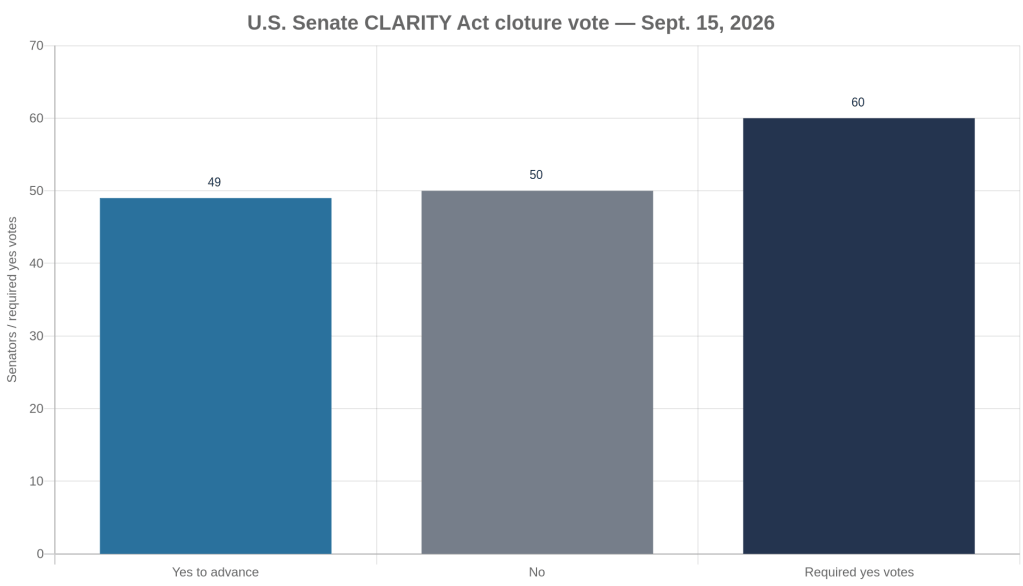
On September 15, 2026, the Senate rejected a motion to advance the CLARITY Act by 49 votes to 50, short of the required 60 votes. The official roll call records the procedural defeat, not a vote banning Bitcoin ownership. Republican supporters promoted regulatory certainty while Democratic opponents raised concerns about ethics and safeguards; four Republicans also opposed the motion. BitcoinVersus.Tech had examined the bill’s uncertain prospects earlier in the year.
The reserve debate is another separate question. A House committee advanced legislation in September to formalize a federal Bitcoin reserve, but Democratic Representative Bill Foster objected to Bitcoin’s investment risks. Earlier BitcoinVersus.Tech coverage followed Lummis’s proposed national reserve. Neither a committee vote nor advocacy by individual lawmakers establishes bipartisan agreement to purchase Bitcoin with public funds.
Owning an asset is different from endorsing a party
A person may view Bitcoin’s predictable issuance and transferable ownership as desirable without supporting every policy proposal backed by an industry group. An investor may also oppose government purchases while retaining personally owned coins. These positions are logically compatible. Separately, holding Bitcoin exposes owners to price volatility, custody losses, scams and potentially long periods below their acquisition cost. The recent spot Bitcoin ETF outflows illustrate market risk rather than a change in protocol supply.
The midterms reinforced the gap between industry expectations and voters’ decisions. Reuters reported November 4 that crypto-backed campaigns lost prominent races despite extensive spending. Bitcoin ownership can cross party lines, but verified votes, disclosure rules and legislative text remain better tests of political agreement than slogans or social-media engagement.
Editor’s Note. Saylor’s original November 4 X text was retrieved through WordPress’s native Twitter/X embed after replacing the x.com embed URL with its canonical twitter.com equivalent. Both named election examples were independently checked against election coverage and primary legislative records. The Senate tally is a separate procedural vote, not a measure of partisan Bitcoin ownership. The cover is an editorial illustration and the Saylor image is archival.

Scan the donation code from another device if your phone cannot scan its own screen.
We volunteer daily to improve the credibility of the information on this platform. If you would like to support the research, please donate here: 3C9o19EH5HSiwEPyCTmEKzxhNCbo2X6TTb
BitcoinVersus.tech is not a financial advisor. This media platform reports on technical and financial subjects purely for informational purposes.


Leave a Reply