Full company review | November 3, 2026. Six complete fiscal years, 2020–2025, plus the latest available 2026 filings. Strategy Inc., formerly MicroStrategy, grew from an enterprise analytics company with a new Bitcoin reserve policy into a multi-security Bitcoin treasury issuer. The achievement is measurable: Bitcoin holdings increased from 70,469 at year-end 2020 to 849,327 on November 1, 2026. But a rising coin count is not the same as rising value per common share. This report weighs operating revenue, shareholder returns, securities issuance, debt, preferred dividends, liquidity and management risks using company statements and SEC filings—not Bitcoin price predictions.

Executive finding: A successful treasury expansion, with material common-stock trade-offs
The positive case is a large, liquid public-market Bitcoin position, capital-market access across common stock and several preferred issues, a real software operation and a multi-billion-dollar dollar reserve. The negative case is dilution, an expensive and complex preferred-stock layer, substantial Bitcoin price concentration and dependence on financing markets. In its third-quarter 2026 release, Strategy itself reported negative 3.7% year-to-date BTC Yield—its gross Bitcoin-per-assumed-diluted-share growth metric—even though holdings had risen approximately 26% during 2026 through October 25. That is precisely why coin totals alone do not establish shareholder accretion.
Our assessment is conditional, neither a buy nor a sell rating: the structure can outperform direct Bitcoin exposure when financing is attractively priced and net Bitcoin attributable to common owners rises faster than share count and senior claims. It can disappoint when dilution, dividend costs, falling Bitcoin prices or a lower equity premium reverse the advantage. The latest November 2 capital-allocation filing and our short report on the $208.2 million STRC repurchase demonstrate both the flexibility and the cost of this model.
1. The six-year timeline: how the business changed
- 2020 — Treasury pivot: under Michael Saylor, MicroStrategy moved excess corporate cash into Bitcoin, then used financing to expand the position. It ended the year with 70,469 BTC, according to the 2020 Form 10-K.
- 2021 — Debt-backed accumulation: holdings rose to 124,391 BTC. Convertible financing made the corporation a leveraged route into Bitcoin; the software operation continued to sell analytics products and support contracts, as the 2021 Form 10-K shows.
- 2022 — Stress test: the crypto downturn reduced the market value of Bitcoin holdings dramatically, while the company ended the year with 132,500 BTC. Price volatility and financing commitments were no longer theoretical.
- 2023 — Recovery: the treasury reached 189,150 BTC. Bitcoin recovered from 2022 lows and the company’s common shares gained, but the total software business remained around $496 million of annual revenue.
- 2024 — Scale-up: holdings reached 447,470 BTC; large equity and convertible-debt transactions accelerated accumulation. The common stock’s split-adjusted return surged before reversing in 2025.
- 2025 — New corporate form: rebranded Strategy Inc. in August, introduced/expanded preferred-share financing and finished with 672,500 BTC. Fair-value accounting created large reported profit-and-loss swings, while senior capital claims became central to the investment case.
- 2026 through November 1 — Financing and defense: the latest position was 849,327 BTC at $64.08 billion aggregate cost. The company raised over $21 billion through stock programs in the first nine months, repurchased STRC, sold some Bitcoin, and expanded cash reserves.
2. Treasury evidence: size and purchase-cost history
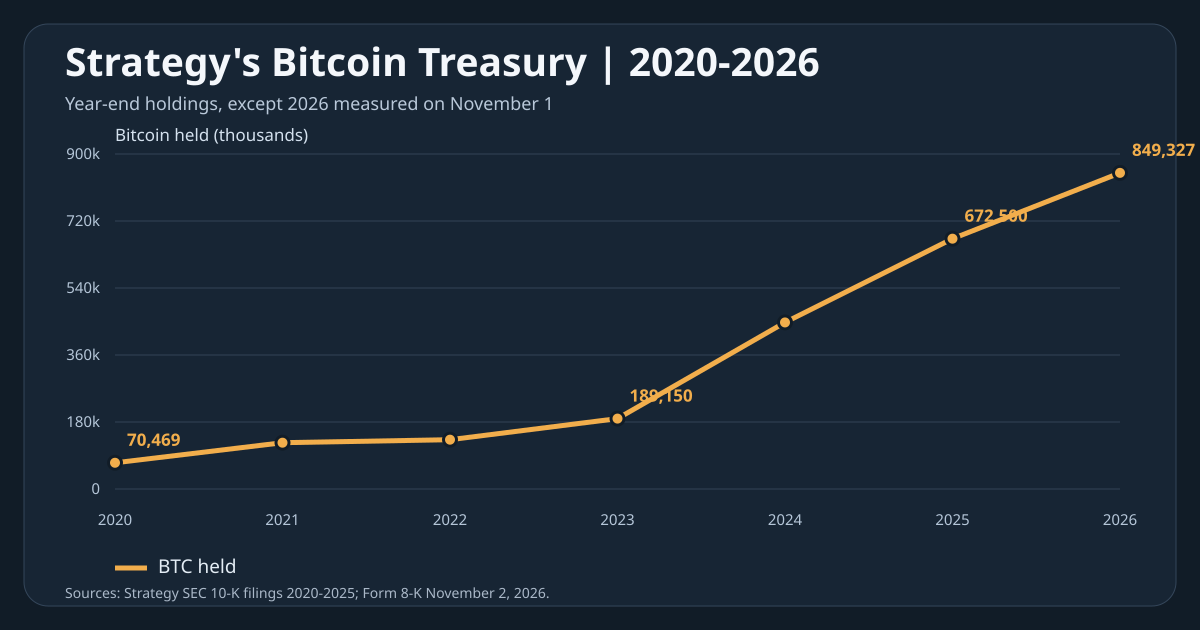
| Report date | Bitcoin held | Aggregate purchase cost |
|---|---|---|
| 2020 year-end | 70,469 | $1.125 billion |
| 2021 year-end | 124,391 | $3.752 billion |
| 2022 year-end | 132,500 | $3.993 billion |
| 2023 year-end | 189,150 | $5.895 billion |
| 2024 year-end | 447,470 | $27.968 billion |
| 2025 year-end | 672,500 | $50.435 billion |
| November 1, 2026 | 849,327 | $64.080 billion |
From 2020 year-end to November 1, 2026, the gross Bitcoin count grew about 12.1-fold (an increase of 778,858 coins). Aggregate purchase cost grew much faster, and the reported average acquisition cost climbed from about $15,964 to $75,451 per coin. These numbers are cost records, not a profit statement or the amount that belongs free and clear to common stockholders. History is sourced to annual SEC Form 10-K filings and the November 2, 2026 Form 8-K; the latest Bitcoin count represents approximately 4.04% of Bitcoin’s eventual 21-million-coin issuance cap, not 4.04% of currently circulating supply.
3. The software company: real customers, limited aggregate growth
The original analytics business has not disappeared. It supplies enterprise software licenses, subscriptions, product support and services, and it can contribute operating cash independent of Bitcoin market prices. But its total revenue has not followed the exponential trajectory of the treasury. From $480.7 million in 2020 to $477.2 million in 2025, nominal annual revenue was essentially flat, with a high of $510.8 million in 2021 among these six years. The figures below use audited annual financial statements, not an annualization of a single quarter.
| Fiscal year | Software / total revenue | Source period |
|---|---|---|
| 2020 | $480.735 million | Full year |
| 2021 | $510.762 million | Full year |
| 2022 | $499.264 million | Full year |
| 2023 | $496.261 million | Full year |
| 2024 | $463.456 million | Full year |
| 2025 | $477.233 million | Full year |
| 2026 | $372.095 million | Nine months only |
The 2022 10-K supplies 2020–2022 revenue, the 2025 10-K supplies 2023–2025, and the September 2026 10-Q provides current partial-year data. For the first nine months of 2026, revenue rose 5.0% from $354.245 million a year earlier; subscription-services revenue grew to $190.3 million from $123.9 million. Conversely, third-quarter revenue fell to $125.4 million from $128.7 million, product-license revenue fell sharply and traditional product-support revenue weakened. A software renewal base and growing subscriptions are positives; muted total growth, product-transition risk and an operating business dwarfed by financial obligations are negatives.
4. Shareholders did make money historically—but timing and dilution matter
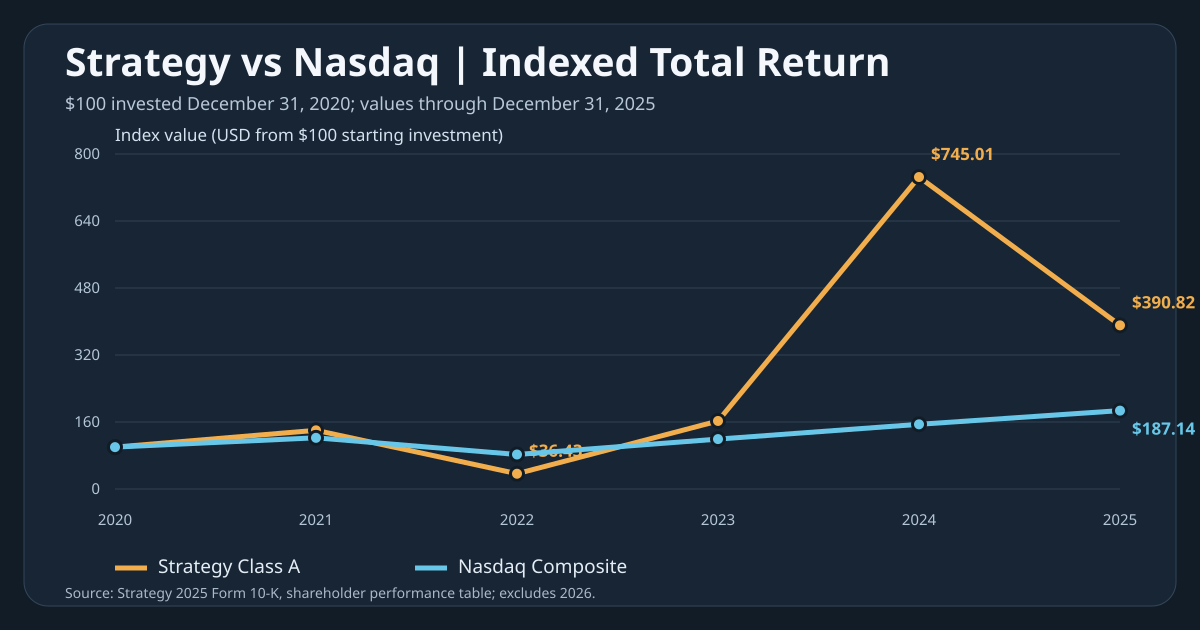
On that five-year measurement from the 2020 baseline to year-end 2025, Strategy’s SEC-reported stockholder-return index grew from $100 to $390.82, compared with $187.14 for the Nasdaq Composite. That is an important shareholder success. But Strategy also went from $140.12 at the end of 2021 to $36.43 at the end of 2022, then from $745.01 at the end of 2024 to $390.82 at the end of 2025. The same filing shows both substantial long-horizon outperformance and exceptionally punishing entry-point risk. These are selected year-end points and must not be presented as current market prices.
For prospective owners, dilution is a distinct issue from stock performance. Class A common shares outstanding rose from 292.422 million at December 31, 2025 to 402.338 million at September 30, 2026, a 37.6% increase in nine months, according to the 10-Q. The company sold 108.753 million common shares through at-the-market offerings over that period for about $13.64 billion net proceeds. Issuing shares raises assets, so it is not automatically value destructive; whether it creates value depends on the prices raised, assets acquired, financing terms and resulting value per diluted share. Strategy reported 2026 year-to-date BTC Yield of minus 3.7% through October 25. That metric is not an economic-profit measure, but it warns against confusing a larger treasury with improved gross BTC per assumed diluted common share.
5. Debt, senior claims and the cost of digital credit
As of September 30, 2026, the balance sheet showed approximately $6.75 billion in debt principal, including around $1.05 billion classified as current, and $14.11 billion in preferred-share redemption value/liquidation preference. These are separate categories: preferred capital is not the same as a conventional bond, and its terms vary by series, but it ranks ahead of common equity for specified claims. At that date Strategy reported STRF with a 10% dividend rate; STRC at 12%; STRK at 8% and convertible; STRD at 10%; and euro-denominated STRE at 10%. Exact terms, redemption mechanics and dividend discretion matter more than headline yields alone.
The financing architecture has real advantages: Strategy accessed more forms of capital than a single ordinary-stock issuer; its reserve addresses near-term payments; and repurchasing preferred shares below their notional value can reduce future dividends. The drawbacks are equally material: high dividend rates impose recurring demands on liquid resources, senior claims absorb value ahead of common owners, and changes in market confidence may make new issues expensive or inaccessible. The October 2026 discussion of Strategy’s credit rating and our report on preferred-share daily dividend approval provide more context.
The financing cash-flow disclosure is particularly revealing. During the first nine months of 2026, Strategy reported $13.64 billion net common-ATM proceeds and $7.52 billion net STRC-ATM proceeds. It paid $1.048 billion in preferred dividends, repurchased $1.342 billion of preferred shares, and repaid $1.379 billion of convertible debt. By comparison, operating activities supplied only $14.3 million in net cash. These cash-flow line items are not directly comparable profit measures, but they demonstrate that the financial strategy is funded primarily through financing transactions and balance-sheet liquidity—not recurring operating cash alone.
A critical counterpoint to a pure buy-and-hold narrative: Strategy disclosed $431.8 million of Bitcoin sales during the first nine months of 2026. Its October 29 results release says those sales funded part of its preferred-stock dividends and STRC repurchases; the September Form 10-Q cash-flow statement records $431.763 million in proceeds. Selling a portion of a large treasury to manage capital is not inherently evidence of failure, but it disproves any claim that every Bitcoin position has been held without sale. It also shows that the financing structure sometimes converts BTC into dollars to service security holders.
6. Liquidity: meaningful reserve, not an unlimited backstop
Strategy’s September 30 balance sheet contained $2.50 billion cash and equivalents plus $3.40 billion short-term investments. Its later November 2 disclosure reported a designated $4.79 billion USD Reserve and $132.7 million USD Cash as of November 1, after $43.4 million in preferred-dividend payments and $208.2 million in STRC buybacks during the preceding week. These dated balances are not additional money to add mechanically to September’s assets: reserve labels, asset classifications and measurement dates differ.
On October 29, management said USD Assets of approximately $5.07 billion offered about 3.4 years of dividend-and-interest coverage under its stated assumptions. That is a substantial mitigating factor. It is not a guarantee: a longer weak market, faster cash use, changes in dividend rates, refinancing stress or another Bitcoin downturn would change the runway. The November 2 week illustrates that liquidity is actively used, not merely displayed on a dashboard.
7. Accounting: a $19.5 billion quarter did not mean $19.5 billion cash earned
In the third quarter of 2026, Strategy reported $19.533 billion net income and $20.912 billion in digital-asset fair-value gains. For the full nine months through September, however, it reported a $1.229 billion net loss and $1.858 billion net digital-asset loss. For 2025, the company reported a roughly $5.40 billion unrealized loss on digital assets and a $3.85 billion consolidated net loss. The contrast reflects Bitcoin valuation movement and tax accounting, not a stable $20 billion earnings engine. Its shift to fair-value accounting beginning in 2025 also limits direct apples-to-apples comparisons with earlier impairment-accounting years. Our prior Q3 earnings breakdown discusses the accounting impact in detail.
Investors should track the software operation, corporate operating cash flow, cash financing raised or spent, preferred cash requirements, Bitcoin market exposure and diluted-share count separately. Blending them into a single price-to-earnings ratio would be a poor model of a company where Bitcoin gains can swamp the software income statement.
8. Original risk scenario: Bitcoin price sensitivity is large
| Illustrative BTC price | Illustrative treasury value | Change from reference |
|---|---|---|
| $81,200 (reference) | $68.97B | — |
| $56,840 (30% lower) | $48.28B | $-20.69B |
| $40,600 (50% lower) | $34.48B | $-34.48B |
| $24,360 (70% lower) | $20.69B | $-48.28B |
This sensitivity is a scenario, not a market-value quote: it multiplies November 1 holdings (849,327 BTC) by the separately dated October 23 reference price of $81,200 reported in Strategy’s Q3 release. The dates intentionally differ, and no later spot price is implied. A 50% fall in that assumed Bitcoin price would reduce the implied gross treasury value by about $34.48 billion before liabilities, taxes, financing effects or any management response. It does not establish that bankruptcy or a margin call would occur at that price: maturity terms, collateral, cash, preferred claims and optional financing outcomes must be analyzed separately.
9. The strongest bull case
- Large accumulated position: 849,327 BTC creates large direct participation in Bitcoin’s price upside; regulated equity and credit securities make this exposure accessible to investors with different mandates.
- Financial-engineering flexibility: common-stock, convertible-debt and multiple preferred programs allow a mixture of financing costs, maturities and shareholder claims. When issued on favorable terms and used accretively, capital issuance can improve the underlying asset base per unit of common stock.
- Cash management: the multi-billion-dollar dollar reserve and preferred-share repurchases show active efforts to manage liabilities, interest and dividends through weak periods.
- Operating foothold: a real enterprise analytics franchise remains active; 2026 subscription-services revenue increased meaningfully even while other product categories weakened.
- Demonstrated past equity upside: Strategy’s 2020–2025 indexed shareholder return beat the Nasdaq Composite by a substantial margin, though it involved severe interim losses.
10. The strongest bear case
- Concentration: Bitcoin was about 92% of $77.15 billion total reported assets at September 30, 2026. This is effectively a concentrated Bitcoin capital-structure investment, not a balanced enterprise-software holding company.
- Common-share dilution: large ATM issuance expands financing capacity but reduces each existing holder’s ownership fraction. Negative year-to-date BTC Yield in October 2026 demonstrates how gross holdings can grow without equal per-share progress.
- Senior capital and dividends: $6.75 billion of debt principal and preferred liquidation rights ahead of common stock create claims that are material even before accounting for other liabilities.
- Financing dependency: negligible nine-month operating cash flow relative to capital-market financing, preferred payouts and repurchases means the thesis depends on repeat access to the capital markets or finite liquid balances.
- Price, valuation and premium risk: the stock can fall with Bitcoin and also suffer a falling equity premium to net underlying assets, magnifying downside. The existence of spot Bitcoin ETPs gives investors alternatives that lack Strategy’s specific financing structure.
- Counterparty, custody and regulation: the 2025 10-K identifies custody, cybercrime, key-loss, regulatory and counterparty risks; insurance is far below total Bitcoin holdings. Holding multiple custodians mitigates some concentration, not all loss scenarios.
- Governance and continuity: reliance on Michael Saylor’s vision, complex security terms and the pending CFO transition deserve independent board, audit and succession scrutiny.
11. What to monitor before making a valuation judgment
A diligence model must be continuously updated. At each filing, record (1) Bitcoin held and its fair value at the same timestamp; (2) common basic and fully diluted share counts; (3) debt principal and maturity/put dates; (4) preferred liquidation preferences and declared cash dividends by class; (5) dollar-reserve balances and real cash-flow coverage; (6) financing proceeds and use of funds; (7) stock-market capitalization and premium or discount to an explicitly defined net-asset measure; and (8) software operating results. Without a verified contemporaneous stock price, calculating an exact current premium to net asset value would create false precision. A gross Bitcoin-to-market-cap ratio is not the same as net equity value because it omits senior claims and other assets/liabilities.
The next important disclosures are the post-November STRC dividend and repurchase trajectory, November/December cash-reserve changes, debt maturity/refinancing decisions, recurring software subscription economics, and 2026 year-end Bitcoin per assumed diluted share. An investor bullish on Bitcoin could still choose a direct vehicle; an investor who values the capital-markets strategy must demonstrate its advantage after dilution, preferred economics and price paid for MSTR. These are separate propositions, not ideological judgments.
Sources, data and methodology
Primary sources reviewed: 2020 annual report, 2021 annual report, 2022 annual report, 2023 annual report, 2025 annual report, September 30, 2026 quarterly report (filed November 2), October 29 Q3 results, and November 2 current report. Treasury and return series are preserved in the SmartChart source-data folder, with CSV files, accessible SVGs and chart-type selection evidence from the 40-chart selection protocol. Historical audited periods and 2026 unaudited/interim figures are labeled separately. The article is original analytical synthesis; all upside and downside scenarios are conditional.
Company source: Q3 2026 results call
Strategy’s official third-quarter 2026 earnings-call recording, linked from its October 29 results announcement.
The company’s November 2 filing supplies the updated weekly purchase and repurchase figures after the quarterly call.
Strategy’s official November 2 announcement of its Bitcoin purchase, STRC repurchases and updated Bitcoin treasury.
Editor’s Note
BitcoinVersus.Tech evaluates Strategy using both favorable and unfavorable evidence. Comparisons use explicit dates and consistent units; the SmartChart visualizations are generated from source tables, not hypothetical chart art. No company representative or shareholder reviewed or approved this analysis. Relevant earlier coverage includes Michael Saylor’s Bitcoin and digital-credit interview.
Support independent research: If this analysis helped, consider donating 5,000 sats in Bitcoin to 3C9o19EH5HSiwEPyCTmEKzxhNCbo2X6TTb.

Disclaimer
This report is independent editorial research and general educational information; it is not financial, tax, accounting, or investment advice and makes no claim about future securities or Bitcoin prices. Strategy’s capital structure, financing terms, the market value of its Bitcoin and its common-share count can change materially after the cited dates. Readers should examine the SEC filings and seek qualified professional advice before investing.


Leave a Reply