
Peter Schiff has called Strategy Inc.’s STRC preferred stock a Ponzi scheme. Michael Saylor argues that the issuer’s Bitcoin treasury can support a new form of dollar-denominated digital credit. Between those positions lies a testable question: how does STRC pay its high variable dividend and support trading near $100, and how accurately are those risks described to investors? Securities filings document reliance on capital raising, reserves, buybacks and Bitcoin sales. They do not establish criminal fraud. The distinction matters because a speculative investment can create meaningful losses without necessarily violating securities law.
Reporting cutoff: November 22, 2026. Earlier BitcoinVersus.Tech reporting covered Strategy’s five preferred-stock products and its longer-term Bitcoin financing and dilution. The investigation below focuses on STRC criticism, documented funding and legal exposure rather than duplicating routine purchase announcements.
What an STRC share actually represents
STRC is Strategy’s Nasdaq-listed Variable Rate Series A Perpetual Stretch Preferred Stock, first issued July 29, 2025. A share has a $100 stated amount, not a $100 guaranteed resale price. The annualized regular dividend rate is currently 12% on stated amount, meaning $12 per year per share only while the rate remains in force and declared dividends are paid. The issuer confirmed the 12% rate for December 2026 in its November 16 SEC filing. The rate can change, STRC has no ordinary maturity, and cumulative unpaid dividends do not have to be immediately paid in cash. Its SEC-filed governing terms detail those limitations.
STRC stands ahead of common stock and several junior preferred issues, but behind creditors, subsidiary liabilities and Strategy’s more senior STRF preferred shares. It is not directly collateralized by specific Bitcoin holdings. Strategy’s official STRC information page expressly says the security is neither a bank deposit nor an insured or regulated money-market fund. A change adopted in October moved dividend record dates to every calendar day beginning November 1, with payment on the next business day after each declared record date. Daily scheduling improves frequency, not principal security.
The $100 objective and the first visible failure
Strategy has pursued a corporate objective for STRC to trade around $99–$100. Its June 29 capital framework describes monthly dividend adjustments, managed dollar reserves, optional repurchases and possible Bitcoin monetization. The announcement also explicitly warns that STRC can trade substantially below its target and that management might not raise the dividend just because prices fall. A management objective is not a market floor.
An actual transaction demonstrates the difference. During July 20–26, Strategy retired 288,930 STRC shares for approximately $25 million at an average repurchase price of $86.53, a discount of 13.47% to stated amount. That is a company-reported transaction average, not a reported low closing price. An investor who paid $100 and exited at $86.53 would lose $13.47 of principal before considering dividends, commissions and taxes. The July 30 earnings disclosure documents the calculation. Repurchasing shares cheaply can reduce Strategy’s future dividend obligations, while the selling shareholder still bears the discount.
The critical funding question: who pays for the yield?
The October 30 STRC prospectus amendment discloses that Strategy expects to finance cash STRC dividends primarily through new MSTR common-share sales, while permitting reserve draws and other financing routes. Such financing is commonplace for companies with significant investment assets, but recurring distributions that rely on new capital are vulnerable when equity markets weaken. Issuing common equity can also dilute existing owners. For a fuller explanation of the capital instruments, see our preferred-equity guide.
The week of November 9–15 is especially revealing. Strategy repurchased $228.1 million of STRC, using $206.3 million in net proceeds from MSTR share issuance and $21.8 million in interest on liquid financial assets. It also drew $18.9 million from its USD Reserve to pay dividends on preferred stock generally, not STRC alone. During the same week the company bought 485 Bitcoin for $33.4 million, funded by common-share sales. The breakdown appears in the November 16 Form 8-K and our transaction report.
The scale of payouts relative to the software business matters. In Q3 2026 Strategy reported $125.4 million in total company revenue alongside $419.6 million of preferred-stock dividends, covering all preferred series. Revenue is not free cash flow, and the comparison is not an STRC-only expense calculation. It nonetheless demonstrates why access to capital and Bitcoin-linked resources is financially central. Strategy’s reported accounting gains on digital assets must not be mistaken for a recurring pool of operating cash. Source: third-quarter results.
What Peter Schiff gets right, and where the Ponzi label overreaches
Schiff contends that new equity capital, asset sales and discretionary price support form a circular structure. If Bitcoin falls, demand for new MSTR or STRC securities could weaken; weaker preferred trading may prompt more buybacks; buybacks consume cash or raise dilution; selling Bitcoin during a downturn could further limit financial flexibility. His June 26 video discussion lays out the allegation. The dependence on capital markets is real and explicitly disclosed. The collapse forecast is an argument, not an established outcome.
A true fraudulent Ponzi scheme normally involves deceptive promises and purported investment returns funded by incoming participants while the underlying economics are concealed or fictitious. Strategy publishes reports, identifies its Bitcoin holdings, and discloses financing channels, liabilities, repurchase activity and dividends. Financing distributions with issuance proceeds does not independently prove fraud. A company may be financially fragile or aggressively marketed without meeting the legal definition of a Ponzi scheme. Investors should assess the evidence rather than assume that an emotive label settles the case.

The reserve and Bitcoin inventory are genuine counterarguments
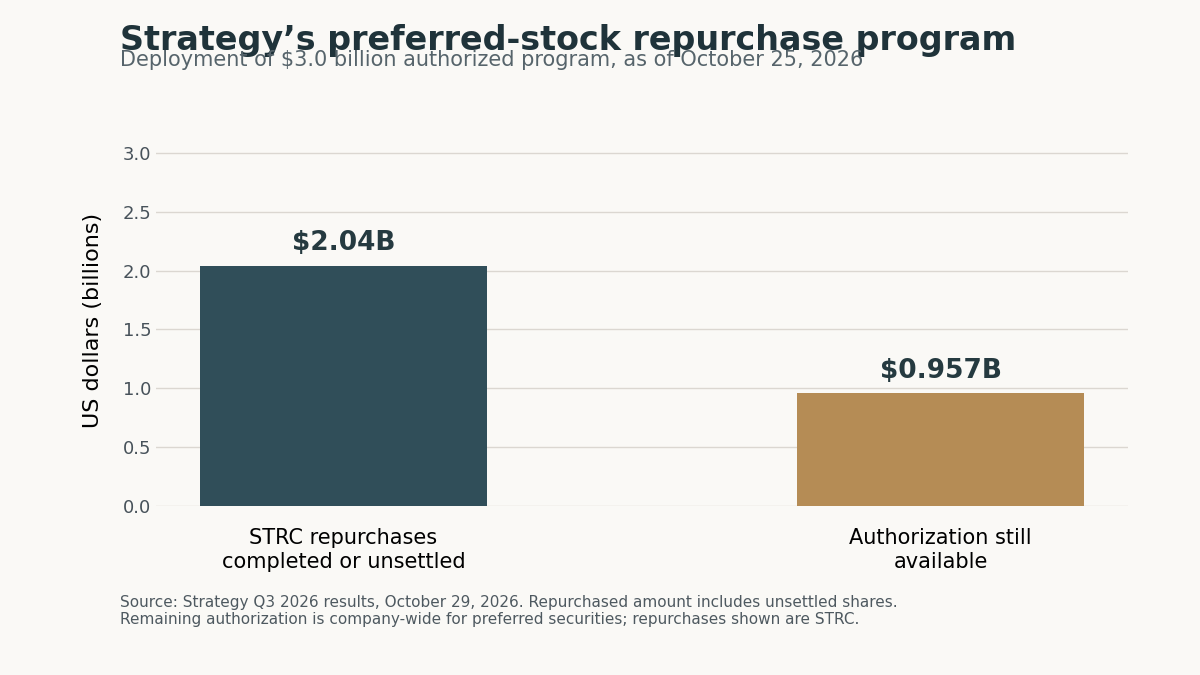
The company reported around $2.04 billion of STRC buybacks through October 25, retiring approximately $2.10 billion of stated amount. The then-remaining $956.7 million repurchase authorization was optional, not a commitment. At October 25, Strategy reported a $4.83 billion USD Reserve and $242.4 million USD Cash, which management estimated covered about 3.4 years of preferred dividends and debt interest under current assumptions. Those amounts were described in the October 29 release; reserve coverage can change with financing, spending and dividend rates.
As of November 15, the next SEC update showed $4.75 billion in USD Reserve, $151.2 million in USD Cash and 850,849 Bitcoin in corporate holdings. The reserve helps absorb near-term obligations but does not form a separately secured trust for STRC holders. The company also disclosed selling about $431.8 million of Bitcoin during 2026 through October 25 toward preferred dividends and buybacks. Selling treasury assets is permitted corporate finance; sustained reliance on asset sales at adverse prices would still increase long-term financing pressure. Related BitcoinVersus.Tech coverage includes the reserve’s growth and the issuer’s credit risk.
Marketing, securities law and actual lawsuits
Saylor has emphasized STRC’s potential for low-volatility dollar yield. The Financial Times reported his description of “money market-like stability”; his own September 29 digital-credit essay discusses volatility reduction and dollar yield. By contrast, Strategy’s official product disclosures emphasize no guaranteed liquidity, principal or dividend, and no protections equivalent to money-market funds. Broad marketing goals need not be fraudulent, yet language capable of suggesting savings-account-like safety deserves scrutiny when share prices can fall materially below par.
A material misstatement or omission might support civil securities claims depending on the exact representation, surrounding disclosures, knowledge, investor reliance and loss causation. The U.S. Supreme Court’s Halliburton decision describes the familiar elements of a private Rule 10b-5 damages case. A falling share price alone cannot establish securities fraud. Likewise, publishing a detailed prospectus does not automatically resolve every potential allegation regarding separate communications; context and the total information available to investors matter.
On June 29, 2026, Rosen Law Firm announced an investigation into potential securities claims involving STRC and Strategy, soliciting prospective clients and saying it was preparing a possible class action. An announced investigation is not a filed complaint or a court judgment. The sources examined for the report did not establish a STRC-specific criminal Ponzi finding or a final judicial ruling that Saylor committed securities fraud in marketing STRC. An investor lawsuit remains a possibility; no verified liability finding should be invented.
Final assessment: legitimate preferred equity, substantial market risk
STRC is a disclosed, publicly traded preferred-equity security whose dividend and price-support model depends heavily on active treasury management. Its cumulative distributions, liquidity reserves and large Bitcoin inventory provide real economic substance. Its lack of maturity, variable dividends, unsecured position, discretionary buybacks and dependence on equity markets expose holders to losses that cash-equivalent marketing can understate. The most important questions are whether future dividends can be funded without destructive dilution, how Bitcoin declines affect liquidity, and whether promotional statements match the risks reasonable buyers actually understood.
Investor checklist: Check the market price rather than the $100 stated amount; read the current monthly dividend declaration; monitor the USD Reserve separately from flexible USD Cash; track MSTR issuance, STRC repurchases and actual Bitcoin sales; and distinguish complaints filed in court from law-firm solicitations. No prospective investor should treat the 12% indicated rate as a guaranteed return or the issuer’s price objective as principal protection.
Primary documents and corroborating sources
- SEC STRC prospectus amendment, October 30, 2026
- SEC 2026 third-quarter Form 10-Q
- SEC November 16 capital-management Form 8-K
- Strategy third-quarter 2026 financial results, October 29
- Strategy second-quarter 2026 results, July 30
- Strategy June 29 digital-credit capital framework
- Strategy STRC product terms and current disclaimers
- Rosen Law Firm securities investigation announcement, June 29
- Financial Times examination of Strategy’s preferred-stock marketing, November 2026
- Peter Schiff’s critique, June 26, 2026; video linked but playback untested
- Supreme Court: Halliburton and private Rule 10b-5 requirements
Methods and visual disclosure: The 1200 × 630 colored-pencil cover is a conceptual editorial drawing and not an official share certificate or live STRC price chart. The first in-story chart reproduces Strategy’s disclosed October 25 authorization data with labeled dates and units. The additional archival illustration is conceptual. No social or video embed has been claimed to pass live playback testing. Reporting and legal analysis are not individualized investment or legal advice.
We volunteer daily to ensure the credibility of the information on this platform is Verifiably True. If you would like to support to help further secure the integrity of our research initiative, please scan the QR code below.



Leave a Reply