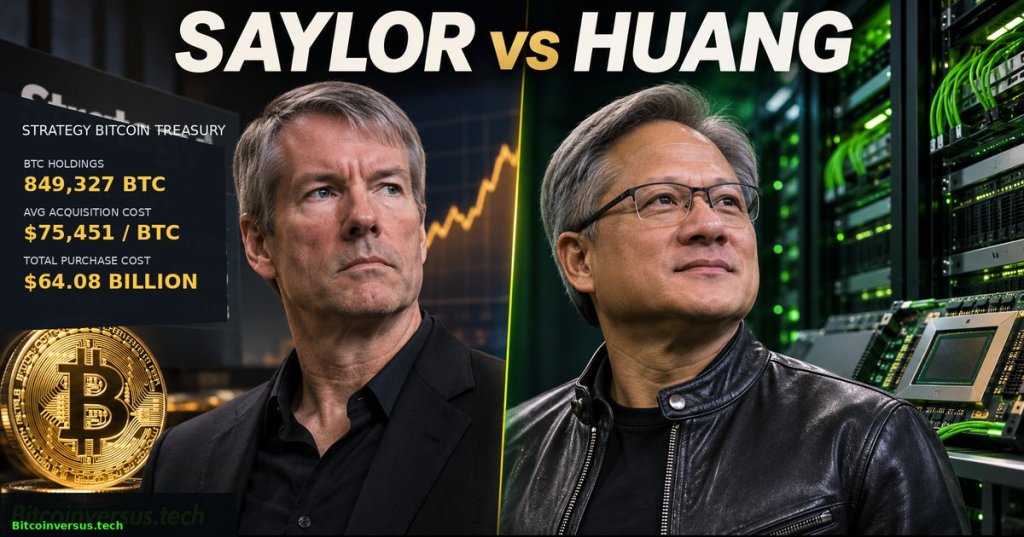
A November 8 social-media discussion contrasts Strategy executive chairman Michael Saylor’s single-minded Bitcoin advocacy with NVIDIA chief executive Jensen Huang’s professional and family responsibilities. But family circumstances cannot establish why executives make financial decisions. Their corporate records offer a more defensible comparison: one company uses capital markets to build a Bitcoin treasury, while the other sells the infrastructure powering artificial intelligence.
Reader-supplied commentary by @zaidlikesmstr comparing Saylor and Huang. The writer’s personal-life interpretations are opinion, not verified evidence of executive decision-making. Credit: @zaidlikesmstr / X.
The titles also matter. Phong Le has served as Strategy’s chief executive since 2022; Saylor is its founder and executive chairman. Huang remains NVIDIA’s founder and CEO. Both influence corporate direction, but their formal operational roles differ.
Saylor’s capital markets engine
Strategy’s November 2 SEC filing reported 849,327 BTC held as of November 1, acquired for an aggregate $64.08 billion at an average cost of $75,451 per bitcoin, including fees. The holding is a concentrated exposure to an externally traded asset, not a warehouse of products Strategy manufactures.
Its October 29 earnings release reported $20.91 billion in third-quarter gains on digital assets and $125.4 million in quarterly software revenue. The former is an accounting gain tied to Bitcoin valuation, not customer sales or cash generated by the software business. An earlier six-year Strategy analysis examined why digital-asset gains, financing costs and shareholder dilution require separate treatment.
The same SEC filing shows how the accumulation program works. During October 26–November 1, Strategy raised approximately $164.0 million through common-stock sales, used $65.5 million of the proceeds to buy 811 BTC and allocated $98.5 million to USD Cash. Separately, it spent $208.2 million from existing USD Cash on STRC preferred-stock repurchases. Its preferred-dividend framework creates further capital-allocation decisions.
Strategy’s official third-quarter 2026 earnings call discusses its Bitcoin treasury, digital credit and financing program. Credit: Strategy / YouTube; linked from the company’s October 29 earnings release.
Huang’s AI production engine
NVIDIA’s model starts with selling computing capacity and software platforms to customers. In the fiscal second quarter ended July 26, 2026, it recorded $96.2 billion in revenue, including $89.0 billion from Data Center—approximately 92.5% of company sales. The figures come from NVIDIA’s August 26 results. Its fiscal calendar differs from Strategy’s, making the periods unsuitable for a direct growth-rate comparison.
Huang’s strategy combines accelerators, networking equipment, rack-scale systems and the CUDA software ecosystem. AI customers purchase systems or access them through cloud providers; deployment depends on financing, power availability, semiconductor supply and demand for model training and inference. The company’s ambitions are visible in its 1-gigawatt AI data-center cost discussion, where capital intensity and useful equipment life were key questions.
Jensen Huang presents NVIDIA’s 2026 GTC keynote on AI factories, accelerated computing and the Vera Rubin platform. Historical product-strategy context, not footage of the November 8 investigation. Credit: NVIDIA / YouTube.
Where conviction meets accountability
The corporate risks diverge. Strategy’s investors must assess Bitcoin price volatility, liquidity, preferred dividends, borrowing and common-share dilution. NVIDIA’s investors face AI spending cycles, competitive chips, export restrictions, manufacturing constraints and customer concentration. A Bitcoin treasury’s reported unrealized value and a semiconductor supplier’s recognized revenue do not measure identical economic activity.
Huang’s personal conduct has become a governance issue. On November 8, he publicly acknowledged marital infidelity and apologized. NVIDIA’s board also announced an independent review of reports concerning a possible foreign-intelligence effort. Crucially, the board said it has no reason at present to believe national security or corporate secrets were compromised. A review is not a finding of espionage. Earlier BitcoinVersus.Tech reporting covers the allegations and safeguards separately.
The X author’s suggestion that Saylor’s reported family circumstances enable greater risk-taking remains a hypothesis. No public causal evidence establishes that a spouse or children would have changed Strategy’s treasury policy, nor that family commitments determine Huang’s corporate decisions. A more useful leadership test is measurable: can each institution sustain its strategy, meet obligations and protect investors and other stakeholders when market conditions turn?
BitcoinVersus.Tech Editor’s Note: Reporting verified against Strategy’s November 2 SEC Form 8-K, Strategy’s October 29 earnings release, NVIDIA’s August 26 financial results, and NVIDIA’s November 8 statements. The reader-submitted X post is presented as opinion; its personal-life claims were not independently verified. The image is a labeled editorial illustration rather than a documentary photograph. The two YouTube videos are archival corporate presentations; live playback and embedding permissions depend on YouTube and site behavior. We volunteer daily to ensure the information on this platform is Verifiably True. If you would like to support the research, please scan the original donation QR code below to send 5,000 satoshis. Verify the receiving address 3C9o19EH5HSiwEPyCTmEKzxhNCbo2X6TTb before sending.

To scan, open the article on a separate screen and scan the QR code with a compatible Bitcoin wallet. On mobile, use another display or your wallet’s supported image-scanning feature. BitcoinVersus.Tech does not provide investment advice. Financial securities, Bitcoin and preferred dividends carry market and credit risks.


Leave a Reply