
Bitcoin briefly fell below $65,000 on Saturday, November 14, 2026, extending a weekly selloff as investors weighed the recent Binance security breach against rising U.S. interest-rate expectations. A CoinGlass market-wide Bitcoin snapshot recorded a 24-hour low of $64,969, while its separate Binance BTC/USDT daily candle showed a $65,000 intraday low. Other market observations may differ by venue, currency pair and time. The breach remains a significant source of uncertainty, but the evidence does not establish it as the primary cause of the latest decline.
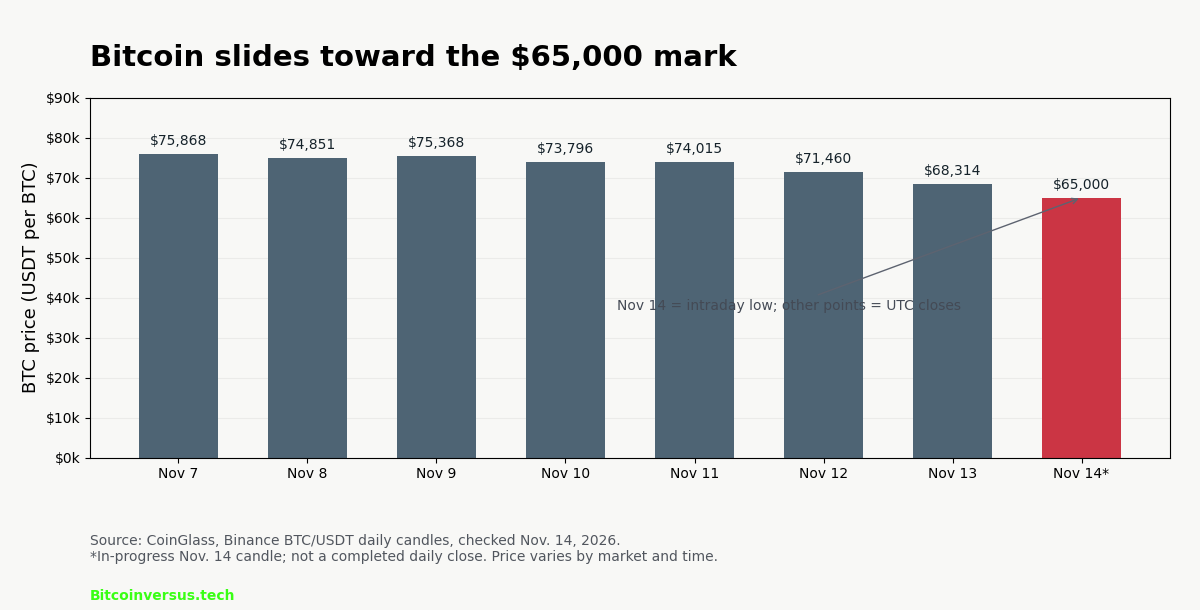
On Binance’s cited spot series, Bitcoin closed November 7 near $75,868 and touched $65,000 on November 14. The difference is approximately $10,868, or 14.3%. The comparison uses an earlier daily close against a later intraday low, not two completed weekly closes. Bitcoin Magazine separately reported the sharp weekly decline and the weakest prices since August.
What Binance confirmed about the breach
Binance disclosed that attackers compromised internal systems and used unauthorized access to a wallet-signing service on October 29. Its November 3 technical report placed the affected assets at approximately $6.34 billion, with roughly $2.85 billion frozen or intercepted at that stage. The exchange said it would cover users’ losses with company resources. Replenishing account backing is not identical to recovering the stolen funds.
BitcoinVersus.Tech previously documented the suspected North Korea-linked intrusion and subsequent movement of stolen assets into Bitcoin. The compromised service belonged to an exchange’s infrastructure; the available evidence does not indicate a compromise of the Bitcoin blockchain or its consensus rules. Reuters reported November 14 that Binance had resumed withdrawals on 87 networks and aimed to restore remaining services the following week. Those plans are not confirmation that every withdrawal route was fully restored.
Coinbase points to monetary policy, not one hack
Coinbase Institutional’s November 13 analysis argued that inflation, prospective Federal Reserve rate increases and a stronger U.S. dollar were more important drivers of the latest selloff than the Binance theft alone. Its research said the circulating supply of major stablecoins had contracted by $11.5 billion over 30 days, reducing a potential source of cryptocurrency buying power. It also cited $1.44 billion of U.S. spot Bitcoin ETF outflows over five trading sessions through November 11.
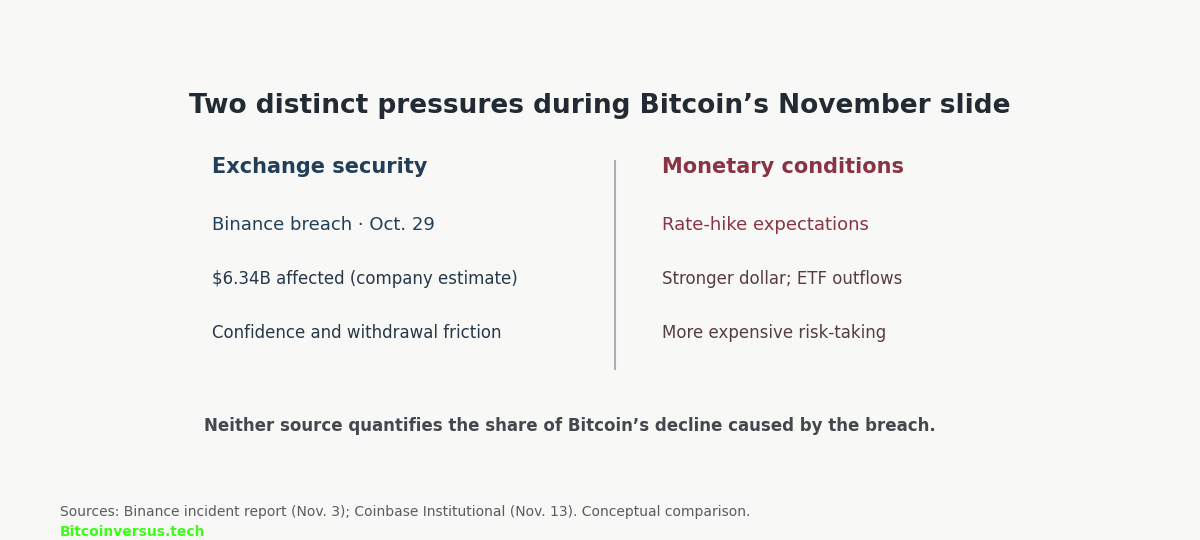
CoinGlass recorded another $185.4 million in net U.S. spot Bitcoin ETF outflows for November 13. ETF withdrawals, leveraged liquidations and weaker risk appetite can reinforce selling, but contemporaneous movement does not prove a single causal chain. Earlier BitcoinVersus.Tech reporting on ETF flows highlights how quickly fund demand can reverse. Cryptocurrency exchange outages and security concerns can also damage confidence independently of macroeconomic pressure.
What the $65,000 break does and does not mean
Crossing a round-number price threshold does not automatically trigger additional losses. Coinbase’s published scenarios identified approximately $62,000 as another potential support area if selling continued, not a guaranteed target. For Bitcoin miners, a lower coin price can reduce revenue per unit of hashrate unless network difficulty, fees or operating costs adjust; related Bitdeer efficiency reporting illustrates the distinction between power consumption and mining profitability.
The key uncertainty remains attribution. Binance’s breach is verified, and Bitcoin’s decline is observable, but no source reviewed quantified how much of the selling directly resulted from the hack. Further exchange recovery reports, ETF flows, Federal Reserve developments and market liquidity will offer stronger evidence than assigning the price move to one headline. Corporate Bitcoin exposure, explored in BitcoinVersus.Tech’s risk analysis, provides another channel through which lower prices can affect public-market sentiment.
Sources and method: CoinGlass BTC price and Binance daily candles (November 14, live and subject to revision); Bloomingbit Binance price snapshot (November 14/15 local dates); Binance security incident account (November 3); Coinbase Institutional weekly analysis (November 13); Reuters Binance withdrawal report (November 14). $75,867.60 minus $65,000 = $10,867.60; divided by $75,867.60 = 14.32%. Company-reported impact and freeze amounts are not independently audited recovery totals.
Editor’s Note: Market quotes are time-sensitive snapshots, not guaranteed current prices. Coinbase’s interpretation is attributed rather than presented as established causation. The featured cover is conceptual artwork, not incident footage. The in-story chart and analytical illustration are original graphics grounded in the sources identified in their captions. No authenticated event-specific YouTube video was verified for use. Actual exchange systems and investor transactions were not tested.

BitcoinVersus.Tech is volunteer-run. To support independent research, scan the original QR code from another screen with a compatible Bitcoin wallet. On a phone displaying the QR, use a wallet image-import feature if available. Verify the recipient address 3C9o19EH5HSiwEPyCTmEKzxhNCbo2X6TTb and the optional 5,000-satoshi amount before sending; Bitcoin payments are generally irreversible.
We volunteer daily to ensure information on BitcoinVersus.Tech is Verifiably True. Reporting is educational and informational, not individualized technical, financial or investment advice.


Leave a Reply