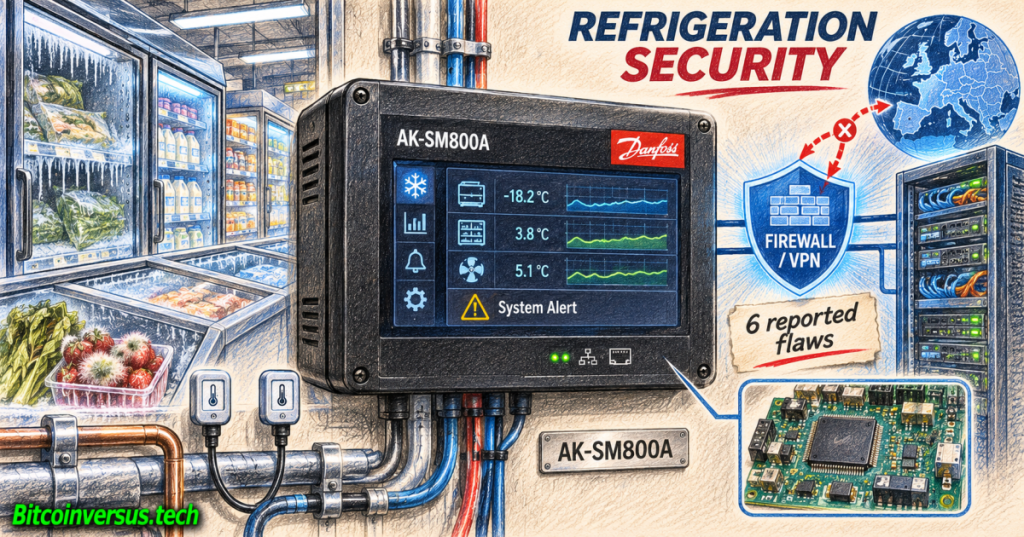
European cyber agencies are urging operators to isolate industrial refrigeration controllers after researchers identified six previously unknown vulnerabilities in Danfoss AK-SM 800A equipment. The findings concern remote code execution before login and affect firmware through version 5.3.2, according to advisories published November 12–13, 2026.
The warning follows two waves of attacks on publicly accessible supermarket refrigeration systems, beginning in France on October 11 and spreading across Europe from November 2. Crucially, investigators have not established that the six newly disclosed flaws were used in those attacks. The newly reported vulnerabilities represent a separate technical risk.
Official Danfoss North America technical walkthrough of AK-SM 800A networking and remote-management connections, September 2021. Archival manufacturer training; no claim that the video shows hacking activity.
Six vulnerabilities identified in controller firmware
Dutch security firm Midnight Blue said researcher Carlo Meijer found six pre-authentication memory-corruption weaknesses while examining the AK-SM 800A software. The team demonstrated remote code execution in a controlled test and reported insufficient compiler protections in relevant ARM Linux applications. The affected system uses Danfoss’s Danux Linux platform, and the researchers said its applications could run with root-level privileges.
A critical distinction concerns Strict Session Control. Danfoss added stronger authentication and HTTPS enforcement in later firmware releases, but Midnight Blue also identified a flaw in the component responsible for enforcing sessions. A protected login page therefore cannot be treated as proof that a publicly accessible controller is safe.
The vulnerability researchers withheld key exploit details during coordinated disclosure. As of their November report, CVE identifiers remained pending. Their assessment that a sophisticated compromise could survive a factory reset or render equipment inoperable describes potential impact, not an established result from the earlier supermarket attacks.
German agency corrects guidance about version 5.4.0
Germany’s Federal Office for Information Security (BSI) initially indicated on November 13 that Danfoss software 5.4.0 was unaffected. A subsequent correction said involvement of the newer firmware version could not yet be ruled out. The qualification matters: Danfoss offers a 5.4.0 download, but availability of a software package does not independently establish resolution of newly disclosed vulnerabilities.
Ireland’s National Cyber Security Centre separately advised against relying on firmware updates, password changes or Strict Mode alone for internet-exposed devices. Its November 13 advisory also identifies legacy Danfoss AK-SM and AK-SC products alongside Copeland/Dixell XWEB controllers as relevant to the broader attack situation. The six new bugs were specifically documented in the AK-SM 800A; those findings should not be automatically assigned to every listed product.
Danfoss North America’s October 2024 training session explains AK-SM 800A upstream and downstream communications, Ethernet and remote-management interfaces. Official archival product education, not a vulnerability demonstration.
Internet exposure declined, but the threat persists
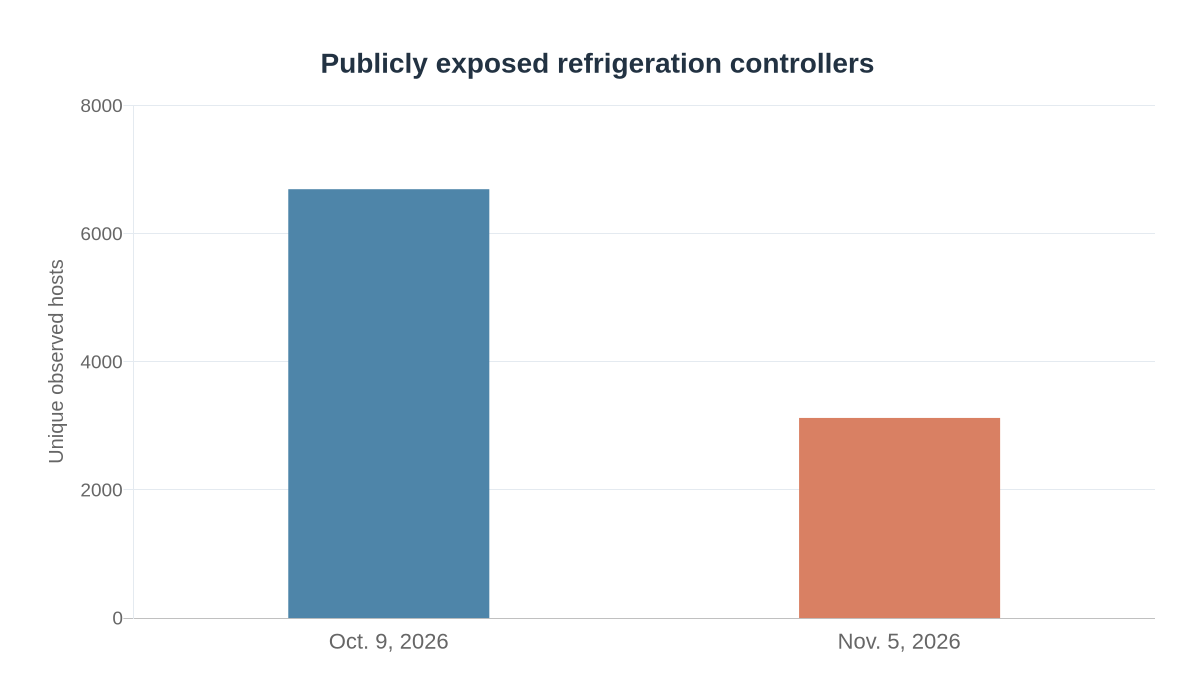
Censys tracked 6,695 distinct publicly exposed hosts across the Danfoss StoreView and Copeland/Dixell XWEB product families on October 9, declining to 3,124 by November 5. The difference of 3,571 hosts represents a 53.3% reduction. Removal from public scanning can reflect network isolation or changed visibility; it does not establish that systems were patched or never compromised.
The latest disclosures extend the technical explanation behind our October investigation into supermarket defrost attacks and the November 7 U.S. cold-chain warning. They also reinforce longstanding industrial-network isolation principles previously discussed in BitcoinVersus.Tech’s industrial robot-controller security coverage. The relevant engineering boundary is the remote management interface—not the refrigeration compressor itself.
Practical response for operators
Operators should inventory controllers accessible through store networks, service-provider gateways and cellular modems; remove direct public-internet management access; and provide essential remote servicing through a properly secured VPN or equivalent protected network. Technicians should review temperature setpoints, defrost schedules, alarm thresholds and account changes, and coordinate updates with manufacturer guidance and safe maintenance windows. Internet protocol filtering alone is an interim control, not a complete replacement for network isolation.
For retailers, equipment manufacturers and industrial security teams, the event illustrates a broader failure mode: routine remote-maintenance convenience can create a pathway to physical product loss. No public evidence reviewed for the new six flaws establishes a live exploit campaign or proves version 5.4.0 safe.
Primary sources and calculation: Ireland NCSC advisory, November 13; Midnight Blue technical disclosure; German BSI notice, November 13 and republished BSI correction; Danfoss firmware support page; Censys November 5 exposure study; French CERT incident alert. Exposure calculation: (6,695 − 3,124) ÷ 6,695 × 100 = 53.34%. Counts represent observed public-facing hosts at two dates, not installed-unit totals.
Editor’s Note: Earlier BitcoinVersus.Tech articles covered the French attacks and U.S. cold-chain alert. The November 2026 follow-up covers six newly disclosed vulnerabilities and the German agency’s corrected statement on firmware 5.4.0. Reported exploit research, actual refrigeration incidents and hypothetical persistent attacks are separate evidence categories. BSI has not confirmed exploitation of the six new vulnerabilities in the wild, nor a definitive exemption for firmware 5.4.0. The original 1200 × 630 colored-pencil featured cover is conceptual, not a photograph of a compromised store. The Censys chart is original and zero-based. Two Danfoss manufacturer videos are archival training. Actual playback and mobile-device rendering were not independently verified before publication.

BitcoinVersus.Tech is volunteer-run and provides independent educational technology reporting. Donations are voluntary; a suggested 5,000-satoshi contribution supports research and publishing. Scan the QR from a second screen with a compatible Bitcoin wallet. On mobile, save the image and use a wallet capable of scanning saved QR images. Verify the recipient address 3C9o19EH5HSiwEPyCTmEKzxhNCbo2X6TTb and exact amount before payment. Bitcoin transactions are generally irreversible.
We volunteer daily to ensure information on the BitcoinVersus.Tech platform is Verifiably True. Coverage is educational and informational and does not constitute financial, investment or individualized cybersecurity advice.


Leave a Reply